
SPRITE
The “lighter” cola alternative — but how does the sugar really stack up?
One 260ml Serving = 46.8% of Your Daily Added Sugar Limit
A standard Sprite serving (200ml, per this label) contains 23.4g of added sugar. A full 600ml bottle packs approximately 70g of added sugar — nearly 3× the WHO recommended daily limit of 25g. All of it is free sugar with zero fibre — absorbed rapidly and causing a sharp blood glucose spike.
Sugar teaspoons in one 600ml Sprite bottle (approx 70g sugar = 17.5 tsp)
■ Green = within WHO daily limit (25g) · ■ Red = above WHO daily limit · Total in full bottle: ~70g (17.5 tsp)
Nutrition Facts — Per 100ml (Label Values)
Serving size is 200ml. One bottle contains 1.3 servings. All values below are per 100ml as shown on the Indian nutrition label. %RDA is based on a 2,000 kcal diet.
| Nutrient | Per 100ml | Per 200ml Serving | % RDA / Serving | What It Means | Verdict |
|---|---|---|---|---|---|
| Energy | 49 kcal | 98 kcal | 4.9% | All calories from sugar — zero fat, protein, or fibre calories | Empty Calories No nutritional value attached to these calories. |
| Carbohydrate | 12.2 g | 24.4 g | — | Nearly all of this (11.7g) is pure sugar — tiny remainder may be from citric acid | ⚠ High 24g carbs per serving, all essentially free sugar. |
| Total Sugars | 11.7 g | 23.4 g | — | Entire sugar content — sucrose (table sugar) in the Indian formulation | ✖ Very High 23.4g per serving — 94% of WHO daily free sugar limit in one drink. |
| Added Sugars | 11.7 g | 23.4 g | 46.8% | 100% of all sugars are added — no natural sugars from fruit juice | ✖ 46.8% RDA Nearly half your daily sugar allowance in one serving. A full bottle = almost 3× the daily limit. |
| Total Fat | 0 g | 0 g | 0% | No fat at all | ✓ Zero Not a fat concern. |
| Protein | 0 g | 0 g | — | No protein | Zero Not a protein source. |
| Sodium | 10.1 mg | 20.2 mg | 1% | Trace sodium from sodium citrate and sodium benzoate | ✓ Low Negligible — not a sodium concern at normal intake. |
Every Ingredient Decoded
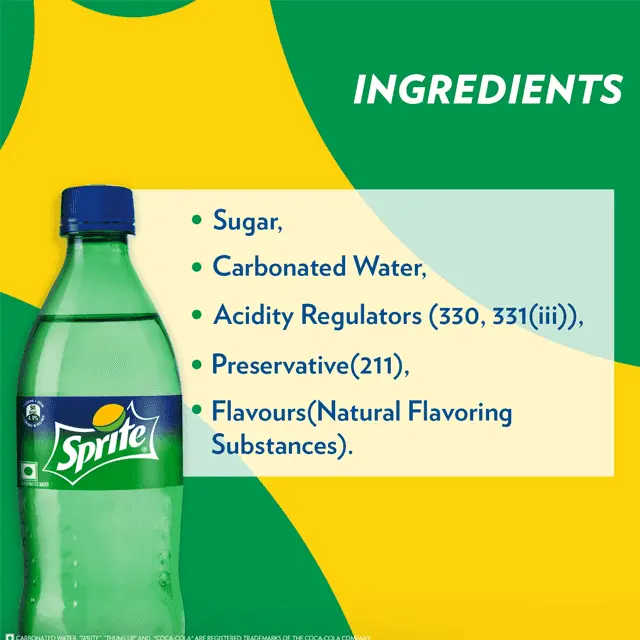
Sprite’s full ingredient list (Indian formulation): Carbonated water, Sugar, Acidity regulator (Citric acid, Sodium citrate), Preservative (Sodium benzoate), Natural lemon and lime flavors.
Unlike Coca-Cola, the Indian Sprite uses cane sugar rather than High-Fructose Corn Syrup — which is one genuine positive in its favour.
| Ingredient | Role | What It Does | Health Note | Verdict |
|---|---|---|---|---|
| Carbonated Water | Base | Purified water infused with CO₂ under pressure — creates the fizz and mild tartness | Carbonic acid from CO₂ is mildly acidic but far less erosive to enamel than citric or phosphoric acid. CO₂ has no metabolic effect | ✓ Safe The cleanest ingredient in the formula. |
| Sugar (Sucrose) | Sweetener | Provides all 11.7g of sugar per 100ml — the primary source of calories and sweetness | Indian Sprite uses regular cane sugar (not HFCS). While cane sugar is metabolised more predictably than HFCS, 11.7g/100ml is still a very high sugar concentration. Rapid absorption without fibre causes blood glucose spikes | ✖ Primary Concern Better than HFCS but still a large dose of free sugar. The dominant nutritional issue with Sprite. |
| Citric Acid | Acidity Regulator | Provides the sharp, sour lemon-lime taste. Controls pH to improve shelf life and enhance flavour | Citric acid is highly erosive to tooth enamel — more erosive per unit than phosphoric acid in Cola drinks at equivalent pH levels. Sprite’s pH is approximately 3.3 — strongly acidic. Regular sipping is particularly damaging to enamel | ✖ Dental Risk The biggest hidden risk in Sprite. More erosive to teeth than Coca-Cola’s phosphoric acid at the same frequency. |
| Sodium Citrate | Acidity Regulator / Buffer | Works alongside citric acid to control pH and improve the stability and mouthfeel of the drink | Sodium salt of citric acid. Safe at normal food levels. Contributes to the mild 10.1mg sodium per 100ml reading on the label | ✓ Safe Food-grade buffer. No health concerns at these amounts. |
| Sodium Benzoate | Preservative | Prevents microbial growth, extending shelf life. Inhibits bacteria, yeast and mould | Sodium benzoate is generally recognised as safe (GRAS) at 0.1% concentration. However, when combined with ascorbic acid (Vitamin C), it can form benzene — a known carcinogen. Sprite does not contain Vitamin C, so this reaction is not a concern here specifically | ⚠ Note Safe in Sprite alone. Avoid taking alongside Vitamin C supplements. At permitted levels, not a significant concern. |
| Natural Lemon & Lime Flavors | Flavoring | Provides the characteristic fresh citrus taste — the core of Sprite’s identity | “Natural flavors” from lemon and lime are generally derived from actual citrus fruit components. This is more transparent than Coca-Cola’s undisclosed “natural flavors.” No significant health concerns | ✦ Relatively Clean More transparent flavoring than most soft drinks. Real citrus-derived flavors. |
Sprite vs Other Soft Drinks — Quick Comparison
| Parameter | Sprite (India) | Coca-Cola | 7UP | Limca |
|---|---|---|---|---|
| Calories/100ml | 49 kcal | ~42 kcal | ~44 kcal | ~46 kcal |
| Sugar/100ml | 11.7g | ~10.6g (HFCS) | ~10.6g | ~11.5g |
| Sweetener type | Cane sugar | HFCS (US) / Sugar (India) | Cane sugar | Cane sugar |
| Caffeine | ✓ Zero | ~34mg/355ml | ✓ Zero | ✓ Zero |
| Acid type | Citric acid | Phosphoric acid | Citric acid | Citric acid |
| Preservative | Sodium benzoate | None | Sodium benzoate | Sodium benzoate |
| Artificial color | ✓ None | Caramel IV | ✓ None | ✓ None |
| Dental risk | High (citric acid) | High (phosphoric acid) | High (citric acid) | High (citric acid) |
The Honest Verdict
Sprite is slightly better than Coca-Cola in two specific ways: it uses cane sugar instead of HFCS, and it contains no caffeine and no artificial colours. That’s where the advantages end. The sugar content is marginally higher than Coke, and the citric acid creates a real dental erosion risk that’s comparable to — and possibly worse than — Coca-Cola’s phosphoric acid.
Like all carbonated sugary drinks, Sprite belongs in the “occasional treat” category, not as a daily hydration choice. If you’re choosing between soft drinks at a party or meal, Sprite is a reasonable pick. If you’re drinking it daily instead of water, that’s the problem — and it doesn’t matter that it’s “clear.”
👍 What Works
- Zero fat, zero protein concerns
- Caffeine-free — safe for children and caffeine-sensitive people
- No artificial colours — genuinely cleaner than colas
- Cane sugar (not HFCS) in Indian formulation
- More transparent flavoring than Coca-Cola
- Low sodium (10.1mg/100ml) — no BP concern
👎 The Real Concerns
- 11.7g added sugar per 100ml — full bottle = 3× WHO limit
- Citric acid — significant dental enamel erosion risk
- Zero nutritional value — no vitamins, minerals, or fibre
- Sodium benzoate — mild concern; avoid with Vitamin C supplements
- Causes rapid blood glucose spike with no fibre buffer
- Not meaningfully healthier than Coca-Cola despite the “clean” image
⚠️ This review is based on publicly available nutrition label data and food science literature. It is not medical or dental advice. Individuals with diabetes, dental concerns, or digestive conditions should consult a healthcare professional regarding soft drink consumption.