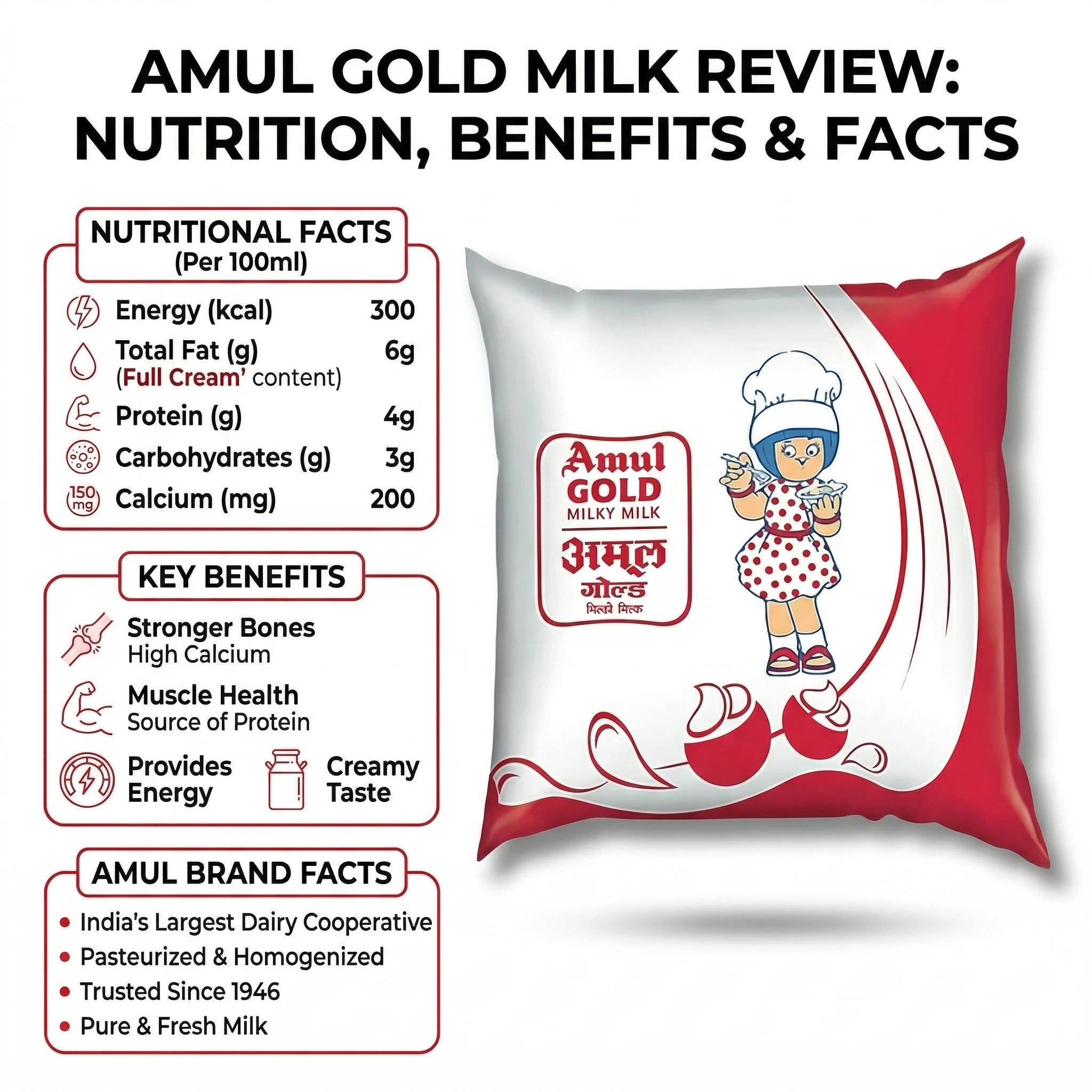


Amul Gold Full Cream Milk Is India’s most loved milk also its most nutritious?
Zero Added Sugar — The Label Rarely Seen on Indian Food Products
Amul Gold Full Cream Milk has 0.0g added sugar — one of the few food products that earns a clean zero on this count. The 5g carbohydrate per 100ml is entirely from lactose — naturally occurring milk sugar. Lactose is metabolised more slowly than sucrose and doesn’t cause the same insulin spike. For people watching their sugar intake, full cream milk is a genuinely clean source of calories.
Full Nutrition Facts — Per 100ml
Approximate values as per FSSAI norms. All values are per 100ml — a standard glass of milk is approximately 200–250ml.
| Nutrient | Per 100ml | Per 250ml Glass | What It Means | Verdict |
|---|---|---|---|---|
| Energy | 86.4 kcal | 216 kcal | Moderate calorie density for a whole food — every calorie comes with protein, calcium, and fat-soluble vitamins | ✓ Nutritious calories Unlike soft drinks or snacks, these calories carry real nutritional value alongside them. |
| Total Fat | 6.0 g | 15.0 g | Full cream milk retains all natural milk fat — the vehicle for fat-soluble vitamins A, D, E and K | ✓ Natural fat Milk fat is a complex mixture of fatty acids including short-chain fats beneficial for gut health. Not a processed fat. |
| Saturated Fat | 3.9 g | 9.75 g | Predominantly from short and medium-chain saturated fatty acids naturally present in dairy | ⚠ Moderate Higher than toned milk but from a whole food source. The saturated fat in dairy behaves differently from saturated fat in ultra-processed foods. |
| Trans Fat | 0 g | 0 g | No industrial trans fat. Trace natural ruminant trans fats (CLA, vaccenic acid) may be present but are beneficial | ✓ Clean Zero industrial trans fat. Any natural dairy trans fats are health-positive. |
| Total Carbohydrate | 5.0 g | 12.5 g | Entirely from lactose — the naturally occurring milk sugar. No added sugar of any kind | ✓ Natural lactose only Lactose is digested slowly compared to sucrose — more metabolically gentle. Zero added sugars. |
| Added Sugar | 0.0 g | 0.0 g | Absolutely zero added sugar — the 5g carbs are entirely natural lactose | ✦ Gold Standard One of the very few packaged food products in India with a genuine 0g added sugar claim. |
| Protein | 3.1 g | 7.75 g | Complete protein — all 9 essential amino acids present. Includes casein (~80%) and whey (~20%) | ✦ Complete protein Dairy protein is among the highest-quality protein sources available. Excellent bioavailability. |
| Calcium | 108.0 mg | 270 mg | Highly bioavailable calcium — fat helps absorption. A glass provides ~27% of the 1000mg adult daily requirement | ✦ Excellent source 108mg/100ml is a meaningful calcium dose. Fat-soluble Vitamin D in the fat helps absorption — a full-fat advantage. |
What’s Actually in Full Cream Milk?
Amul Gold Full Cream Milk has a single ingredient: Standardised Full Cream Cow Milk. FSSAI standards require full cream milk to have a minimum of 6% fat and 9% solids-not-fat (SNF). Unlike many packaged food products reviewed here, there are no additives, no preservatives, no emulsifiers, no flavourings.
| Component | What It Is | Amount (approx.) | Why It Matters |
|---|---|---|---|
| Casein Protein | Slow-digesting milk protein — the white precipitate in milk | ~2.5g / 100ml (80% of protein) | ✦ Sustained amino acid release Casein digests slowly, providing a steady supply of amino acids. Excellent for overnight muscle repair — why warm milk before bed is genuinely beneficial. |
| Whey Protein | Fast-digesting milk protein — soluble fraction | ~0.6g / 100ml (20% of protein) | ✓ Fast-acting Contains beta-lactoglobulin and alpha-lactalbumin. Highest biological value of any protein. Absorbs rapidly after exercise. |
| Lactose | Naturally occurring milk sugar — disaccharide of glucose + galactose | ~5g / 100ml | ✓ Natural sugar Metabolised more slowly than sucrose. Feeds beneficial gut bacteria. Up to 60–70% of Indians have varying degrees of lactose intolerance — worth noting. |
| Milk Fat | A complex mixture of saturated, monounsaturated, and polyunsaturated fatty acids plus fat-soluble vitamins | 6g / 100ml | ✓ Vitamin carrier Full-fat milk retains Vitamins A, D, E and K — all fat-soluble. Skimmed milk loses these unless they’re added back artificially. |
| Calcium | Highly bioavailable mineral — dairy calcium is better absorbed than plant-based calcium | 108mg / 100ml | ✦ Best food source Dairy calcium has ~32% absorption rate vs ~5–20% from plant sources like spinach or kale. Full-fat milk’s Vitamin D content further boosts absorption. |
| Phosphorus | Works with calcium for bone and teeth formation | ~95mg / 100ml (estimated) | ✓ Bone support The calcium:phosphorus ratio in milk is near-ideal for bone mineralisation. |
| Vitamin B12 | Critical B vitamin — primarily found in animal foods | ~0.4mcg / 100ml (estimated) | ✦ Key for India B12 deficiency is endemic in India, especially among vegetarians. Full cream milk is one of the best vegetarian B12 sources available. |
| Conjugated Linoleic Acid (CLA) | Naturally occurring trans fat in ruminant milk — classified as beneficial | Trace | ✓ Beneficial CLA in dairy is associated with anti-inflammatory effects and fat metabolism support. Present in full-fat but largely absent in skimmed variants. |
Amul Gold vs Other Milk Types — How Does It Compare?
The Indian dairy market offers several tiers of milk. Here’s how Amul Gold sits relative to the alternatives:
| Parameter | Amul Gold (Full Cream) | Toned Milk | Double Toned | Skimmed |
|---|---|---|---|---|
| Fat % | 6.0g | 3.0g | 1.5g | ~0.5g |
| Protein | 3.1g | ~3.2g | ~3.2g | ~3.4g |
| Calcium | 108mg | ~115mg | ~115mg | ~120mg |
| Calories/100ml | 86.4 kcal | ~58 kcal | ~46 kcal | ~35 kcal |
| Fat-soluble vitamins (A,D,E,K) | ✦ Naturally present | Reduced | Minimal | Mostly absent |
| Vitamin B12 | Present | Present | Present | Present |
| CLA | ✓ Present | Trace | Minimal | Absent |
| Best for | Children, growing adults, athletes, chai & cooking | Weight management, everyday use | Calorie-restricted diets | Extreme calorie restriction only |
Who Should Drink Amul Gold Full Cream Milk?
Full cream milk is the ideal choice for most people in the following categories:
| Who | Why Amul Gold is recommended |
|---|---|
| Children (1–12 years) | Fat is essential for brain development and nerve myelination. Children need full-fat dairy for growth. Paediatric guidelines globally recommend full-fat milk for children under 5. |
| Teenagers (active, growing) | High calcium (108mg/100ml) and complete protein support bone density formation — the critical window for peak bone mass is 10–20 years. |
| Athletes and active adults | Casein protein supports overnight recovery. Fat provides dense, sustained energy. Full spectrum of amino acids aids muscle repair. |
| Vegetarians (especially Indian) | Primary source of complete protein, B12, calcium, and Vitamin D in a meat-free diet. Particularly important for north Indian vegetarians. |
| Elderly (60+) | Calcium and protein are critical to prevent sarcopenia (muscle loss) and osteoporosis. Full-fat milk is more palatable and calorie-dense for elderly people with reduced appetite. |
| Pregnant and nursing mothers | High-quality protein, calcium, and fat-soluble vitamins are all essential during pregnancy and lactation. Full cream milk provides the most complete nutritional package. |
| People using milk in cooking | Full cream milk gives superior results in chai, dahi, paneer, kheer, and all Indian cooking. The fat content is what creates the texture and flavour these dishes depend on. |
The Honest Verdict
Amul Gold Full Cream Milk is one of the most nutritionally complete foods available — and one of the cleanest packaged products you can buy in India. Single ingredient, zero additives, zero added sugar, zero trans fat, meaningful protein, excellent calcium, and the full spectrum of fat-soluble vitamins intact. The 6g of fat is a feature, not a bug — it’s what makes the calcium and vitamins bioavailable and keeps you satiated longer.
The only caution is for people with a clinical lactose intolerance diagnosis, cardiovascular disease where a doctor has specifically restricted saturated fat, or those in a strict caloric deficit where every calorie matters. For everyone else — this is real food, minimally processed, and genuinely nourishing.
👍 Why It’s Excellent
- Single ingredient — just full cream cow milk
- Zero added sugar — one of very few packaged foods to earn this
- Zero trans fat — naturally clean fat profile
- 108mg calcium per 100ml — highly bioavailable dairy calcium
- Complete protein — all 9 essential amino acids (casein + whey)
- Fat-soluble vitamins A, D, E, K naturally retained
- Vitamin B12 — critical for India’s largely vegetarian population
- CLA naturally present — anti-inflammatory fat
- No preservatives, no emulsifiers, no additives
👎 Who Should Be Cautious
- Lactose intolerance — 5g lactose per 100ml may cause discomfort
- Dairy/milk allergy — contains milk (declared allergen)
- Strict calorie deficit — at 86.4 kcal/100ml, a 500ml glass is ~430 kcal
- CVD patients — check with cardiologist about saturated fat (3.9g/100ml)
- Vegan diet — dairy by definition
⚠️ This review is based on published nutritional label data and food science literature. It is not medical or dietary advice. Individuals with lactose intolerance, milk allergy, or cardiovascular conditions should consult a healthcare professional for personalised guidance.