 D2C Brand Deep Dive · Indian Beauty
Plum Goodness: How India’s First Vegan Beauty Brand Built a ₹419 Crore Empire on Ethics
From a bold idea in 2013 to a profitable, PETA-certified powerhouse — the full story of Plum Goodness, India’s clean beauty revolution.
The Origin Story: A Bold Bet Against the Grain
In 2014, when most Indian beauty brands were still chasing “fair skin” with whitening creams, Plum Goodness said no — publicly, loudly, and without apology.
The man behind this refusal was Shankar Prasad — an IIT and ISB alumnus, a Unilever veteran who had spent years inside one of the world’s largest consumer goods companies. He understood the industry’s formulation choices, its marketing shortcuts, and the chemicals quietly buried in ingredient lists. In 2013, he walked away from that comfort and chose to build something different.
Plum Goodness launched in 2014 with just 15 products, all of them 100% vegan, cruelty-free, and free of parabens, phthalates, SLS and SLES. The brand carried a certification from PETA India and a simple, honest promise: goodness that delivers. No gimmicks, no harmful shortcuts.
“I have managed to stay true to why I built the brand — to bring goodness to the world.”
— Shankar Prasad, Founder & CEO, Plum GoodnessThat same year, Plum became the first Indian beauty brand to publicly reject fairness products. At a time when “whitening” and “brightening” were standard marketing language across FMCG giants, this was a radical act of values-led branding. It earned Plum immediate credibility with urban millennials and Gen Z consumers who were already beginning to question the industry’s obsession with skin tone. Plum was also the first Indian brand to donate 1% of its revenue to earth-friendly causes from day one.
The Timeline: From 15 Products to ₹419 Crore
Brand DNA: When Ethics Become the Business Model
Most brands talk about values. Plum builds operations around them. This distinction matters more than it sounds.
Every Plum product is PETA India certified — meaning no animal-derived ingredients, no animal testing at any point in the supply chain, and third-party verification to back those claims. Formulations actively exclude over 1,500 potentially harmful chemicals. Actives like niacinamide, vitamin C, tea tree oil, AHAs, and hyaluronic acid are chosen because they deliver clinically observable results.
Plum Goodness — Goodness That Delivers
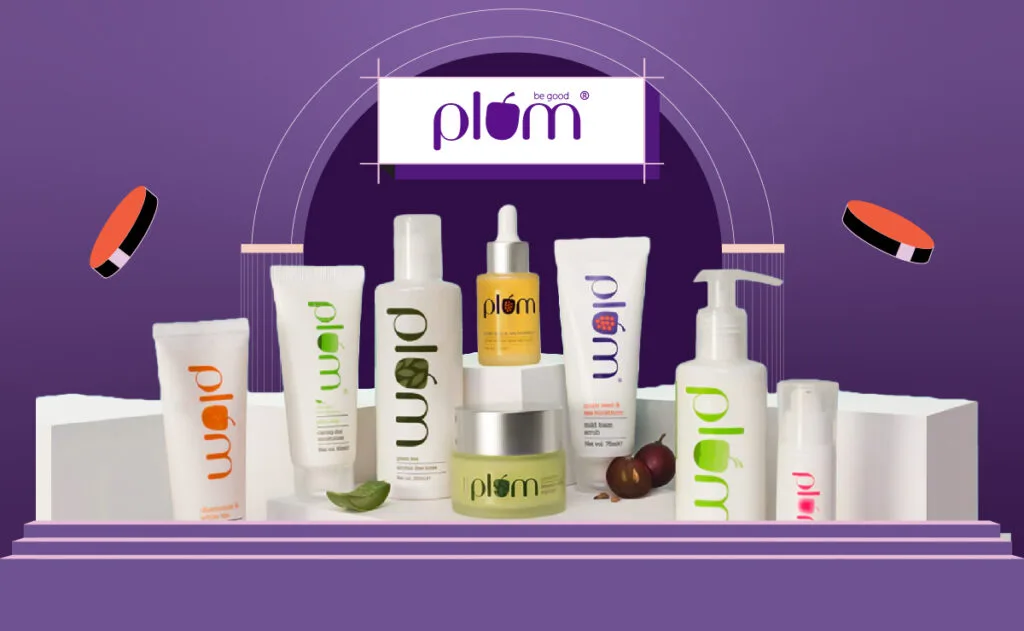
India’s first 100% vegan, cruelty-free beauty brand. Skincare · Haircare · Body care · Makeup · Men’s grooming. All PETA certified. All toxin-free.
Empties4Good: Turning Customers Into Environmental Partners
Plum’s most distinctive initiative is Empties4Good — a recycling programme where customers return five empty Plum containers in exchange for shopping credit. The brand then ensures responsible recycling through verified partners. By 2024, over 3 lakh (300,000) containers had been collected and recycled. This is not just environmental responsibility; it is also a retention mechanic that keeps customers coming back to Plum’s direct channels.
Project Blackboard: Beauty That Educates
Plum commits a percentage of its annual revenue to Project Blackboard, which funds education for underprivileged children across India. When a consumer buys a Plum serum, they are, in a small but real way, paying for a child’s schooling. This is CSR embedded into the product’s revenue model — not an afterthought in a sustainability report.
Plum’s “3P” Framework
People — PETA-certified, cruelty-free, inclusive formulations for all skin types and tones.
Planet — Empties4Good recycling, 1% revenue to earth-friendly causes, conscious consumption campaigns.
Profit-sharing — Value created for investors, employees, retail partners, and the communities Plum’s supply chain touches.
Growth & Financials: From Loss-Making to ₹25 Crore Profit
The financial story of Plum Goodness is one of the most instructive in Indian D2C — not because of flashy valuation headlines, but because of what the FY2025 numbers actually mean: disciplined growth finally bearing fruit after years of investment.
The Funding Journey
| Round | Year | Amount | Key Investors |
|---|---|---|---|
| Seed / Early | 2018 | Undisclosed | Unilever Ventures, Faering Capital |
| Series B | 2020–21 | ~$13M | Faering Capital, Unilever Ventures |
| Series C | 2022 | $35M (₹270 Cr) | A91 Partners + existing investors |
| Total | — | $51.8M+ | A91 Partners, Unilever Ventures, Faering Capital |
The shift from an ₹84 crore loss in FY24 to ₹25 crore profit in FY25 is not accidental. Plum has reduced its dependence on deep discounting, improved marketing efficiency, and focused its investment on high-margin product segments. India’s beauty and personal care market is projected to reach $40 billion by 2030, making it one of the most attractive growth sectors in the country. Plum is now profitable and well-funded enough to ride that wave without burning cash.
Who Is the Plum Customer — and What Do They Actually Think?
A consumer research study surveying 100 Plum users paints a remarkably clear picture of the brand’s audience — revealing both its strengths and the pressure points that could slow its growth.
The Core Demographic Profile
| Factor | Finding | What This Means |
|---|---|---|
| Gender split | 78% female respondents | Brand resonates strongly with women consumers |
| Age group | 62% aged 20–30 | Millennial and Gen Z buyers dominate the base |
| Satisfaction (women) | 85% rated above “neutral” | Core audience is loyal and retained |
| Purchase frequency | 36% buy beauty products “very frequently” | High repeat-purchase potential in the base |
| Brand preference | 40% prefer Plum over competitors | Strong loyalty despite premium price perception |
| Brand awareness | 65% are aware of Plum | 35% untapped — headroom still exists |
Product Performance — What Customers Say
More than 70% of respondents rated Plum products as “effective” or “very effective” in addressing their skincare and haircare concerns. Ingredients like niacinamide, tea tree oil, and vitamin C received the highest praise for delivering visible results. This is the brand’s most critical asset — a formulation track record that genuinely works.
Digital Presence & E-Commerce: The Nykaa Problem
Plum is a digitally native brand — discovered on Instagram, reviewed on Reddit, bought on Nykaa. But this digital success has created an uncomfortable dependency the brand is now working hard to fix.
Where Customers Buy Plum
| Platform | Purchase Share | Why Customers Choose It |
|---|---|---|
| Nykaa | 44% | Fast delivery, loyalty points, bundled deals, trusted discovery |
| Amazon | 30% | Prime delivery, easy returns, strong review ecosystem |
| Plum Official Website | 18% | Exclusive SKUs, new launches — but UX friction limits use |
| Offline / EBO Stores | ~8% | Touch-and-feel experience, in-store discovery |
The 44% Nykaa concentration is a structural problem disguised as a success metric. Nykaa typically charges 25–35% commission from beauty brands. Every sale Plum makes through Nykaa is a sale where Plum forfeits margin and, critically, first-party customer data. The fact that only 18% of buyers use Plum’s own website represents an enormous unrealised opportunity.
How Customers Discover Plum
The discovery funnel is entirely digital and social. 68% of consumers first found Plum through Instagram or Facebook. Micro-influencers in the skincare niche — those with 10,000–100,000 followers — were cited by 40% of users as the reason for their first purchase. Community reviews on Reddit’s r/IndianSkinCareAddicts and MakeupAlley drove trust, with 55% saying peer reviews increased their confidence in the brand’s claims.
Three Website Issues Costing Plum Direct Sales
🔍 Confusing Product Filters
33% of users found the filtering system difficult — especially when shopping by skin type or skin concern.
📱 Mobile Load Issues
28% reported slow load times or display problems on mobile, causing abandonment mid-checkout.
💳 Checkout Errors
22% faced unclear payment options or errors during checkout — a direct conversion killer.
🏪 Underutilised Own Channel
Only 18% of buyers regularly use plumgoodness.com vs 44% on Nykaa — significant margin leak.
Competitive Landscape: Where Plum Wins and Where It Struggles
| Brand | Positioning | Price | Vegan / CF | Key Strength |
|---|---|---|---|---|
| Plum Goodness | Vegan, ethical, science-backed | ₹₹₹ | 100% PETA | Ethics + performance + D2C community |
| Mamaearth | Toxin-free, natural, family-safe | ₹₹ | Partial | Mass reach, aggressive pricing, TV spend |
| Minimalist | Ingredient-transparent, actives-led | ₹₹ | CF claimed | HUL-backed, ultra-affordable actives |
| Dot & Key | Skin solutions + aesthetic packaging | ₹₹₹ | CF claimed | Nykaa distribution, gifting, bright branding |
| The Body Shop | Global ethical beauty, fair trade | ₹₹₹₹ | Certified | Global brand equity, premium retail footprint |
Plum occupies a unique and defensible position — it has the ethical certification of The Body Shop, the digital agility of Mamaearth, and the ingredient credibility of Minimalist. What it lacks is the mass affordability that Mamaearth and Minimalist use to dominate price-sensitive segments.
The acquisition of Minimalist by HUL is worth noting carefully. It confirms that FMCG giants now recognise clean, ingredient-transparent beauty as a high-growth category — which validates exactly the space Plum has been building in for over a decade. But it also means Minimalist now competes with Plum backed by HUL’s distribution network, marketing budget, and retail muscle. The competitive pressure will only intensify.
Challenges Plum Must Solve to Sustain Its Momentum
1. Price Sensitivity is the Biggest Barrier
Fifty-five percent of surveyed consumers felt Plum’s price point is “too high” relative to budget alternatives. Open-ended responses suggested either a 10–15% reduction or the introduction of value packs. Plum’s vegan, certified, active-ingredient formulations carry a genuine cost premium — but that premium has to be communicated and bridged, not assumed away. A brand that earns 70%+ effectiveness ratings but loses 55% of potential buyers to sticker shock has a very fixable problem.
2. Rising Customer Acquisition Costs
Marketing expenses already account for 30–40% of Plum’s total revenue. In India’s skincare category, customer acquisition costs have risen sharply to ₹450–₹600 per customer, up from ₹300–₹500 in earlier years. For a brand that has only just turned profitable, any sustained CAC inflation could compress margins quickly and push Plum back into loss-making territory.
3. Gen Z’s Experimental Buying Behaviour
Plum’s core demographic — 20–30-year-old urban women — is simultaneously the most valuable and the least brand-loyal segment in Indian consumer history. Gen Z drives skincare demand but shows a pronounced tendency to trial new entrants constantly, often switching brands with every recommendation from a new influencer or Reddit thread. Retaining this consumer requires continuous product innovation, authentic community engagement, and a user experience that makes staying with Plum easier than leaving.
4. Tier II & III Expansion Complexity
Plum’s current buyer base skews metro and Tier I — consumers with strong internet access, higher disposable incomes, and pre-existing familiarity with clean beauty concepts. Expanding into Tier II and III cities via EBOs will mean encountering a fundamentally different consumer: more price-sensitive, less familiar with vegan beauty credentials, and more influenced by in-store experience than Instagram discovery. The brand messaging and in-store education strategy will need meaningful recalibration for this audience.
Strategic Roadmap: What Plum Is Doing — and What It Should Do Next
Pricing Optimisation
The most impactful near-term lever is lowering the entry price barrier without discounting core SKUs. Introducing mini product formats (15–30 ml) priced at ₹199–₹249 removes the financial risk for first-time buyers. Value bundles — a “Basic Skincare Trio” or “Summer Essentials Kit” at 10–15% off individual pricing — increase basket size while improving perceived value.
Winning Back Direct Traffic
With only 18% of buyers currently shopping at plumgoodness.com, there is a clear structural opportunity to reduce Nykaa dependency. A loyalty programme exclusive to the official site, combined with site-only promotions, a streamlined mobile UX, guest checkout, and clearly visible payment options (UPI, cards, wallets), could meaningfully shift this split within 12–18 months — and recover substantial margin in the process.
EBO Push in Tier II & III Markets
Plum’s Exclusive Brand Outlet strategy is gaining momentum — and for good reason. Physical stores serve a dual purpose: they enable the tactile product trial that converts hesitant consumers who won’t risk buying a ₹600 serum without testing it first, and they build brand credibility beyond the digital bubble where Plum has operated since 2014.
Expanding the Category Portfolio
Plum has already extended into haircare, body care (Plum BodyLovin’), makeup, and men’s grooming (brand: Phy). Each extension uses the same ethical formulation philosophy — giving the brand a coherent, trusted story across all personal care categories. The goal of becoming a complete personal care brand rather than a specialist skincare label is the right strategic direction, and it’s already well underway.
Sampling and Referral Programmes
Offering sample sachets at ₹49–₹99 for top-selling products — free with orders above ₹499 — can convert hesitant first-timers into full-price buyers. A referral programme offering ₹100 store credit for every referred friend who completes a purchase could make Plum’s loyal users its most cost-effective acquisition channel.
Final Verdict: What Plum Goodness Really Represents
Plum Goodness is not just a skincare brand. It is proof of concept — that Indian consumers will choose ethics alongside efficacy, if you make the case convincingly and consistently enough.
The journey from 15 products in 2014 to ₹419 crore in FY2025 revenue, backed by first-ever profitability, is a textbook case in patient brand building. Shankar Prasad resisted the temptation to chase GMV at all costs, held his ingredient philosophy through years of operating losses, and has now emerged with a profitable, trusted, and genuinely differentiated brand in one of the world’s most competitive beauty markets.
The challenges — price sensitivity, rising CAC, website UX gaps, Gen Z’s experimental loyalty — are real. But they are all solvable problems for a brand that now has ₹25 crore in profit, $51.8 million in investor backing, and a decade of hard-earned consumer trust. The harder thing — building a genuinely ethical brand from scratch in a market that had never seen one — is already done.
The Bottom Line
Plum is one of India’s most important D2C success stories — not because of its valuation, but because of what it changed. It shifted the clean beauty conversation from niche urban aspiration to mainstream consideration. As India’s ₹3+ lakh crore beauty market accelerates toward $40 billion by 2030, Plum Goodness is positioned to lead the ethical, vegan segment — provided it can solve its price-access problem and own its direct channel more aggressively. The brand’s best chapter is still ahead of it.
Frequently Asked Questions About Plum Goodness

Pankaj Dubey is an entrepreneur, business analyst, digital marketer, financial researcher, and brand strategist. He specializes in developing marketing strategies, building and positioning brands, and conducting in-depth business and financial research. He is also known for creating detailed case studies on reputed brands, analyzing market trends, and sharing insights through his writing and blogging. His work combines business intelligence, strategic thinking, and digital innovation to help businesses grow and strengthen their market presence.