
Google Just Reinvented
the Laptop.
Meet Googlebook.
Fifteen years after Chromebook changed how schools bought computers, Google killed the cursor as we know it. Introducing Googlebook — a new category of AI-native laptops with Gemini baked into the operating system itself, launching Fall 2026.
The Scene That Started Everything
On May 12, 2026, in a virtual event called The Android Show: I/O Edition — held strategically one week before Google I/O 2026 kicks off on May 19 in Mountain View, California — Google did something it has attempted before and rarely pulled off cleanly: it announced an entirely new category of personal computing hardware.
The room was not shocked. The internet, however, was buzzing. A day earlier, a 16-minute video had already leaked on 9to5Google showing the underlying Android desktop OS experience: windowed apps, virtual desktops, a terminal application — the bones of something that looked like Android had finally grown up and decided it wanted to be a laptop operating system.
And then at The Android Show, Google made it official. Googlebook. Not a Pixelbook. Not a Chromebook. Something new — built on a fusion of Android and ChromeOS, with Gemini no longer living in a sidebar or a chat window but embedded directly into the operating system itself. Into the cursor. Into the desktop. Into every file, every email, every image on your screen.
Google called it “the first laptop designed from the ground up for Gemini Intelligence.” That is a remarkable claim. Here is what it actually means.
What Exactly Is Googlebook?
Googlebook is not a Chromebook with AI features bolted on. Google has been careful and explicit about this distinction. It is a new category of premium laptops built from the ground up around Gemini Intelligence — Google’s flagship family of AI models developed with Google DeepMind. The devices will launch in the fall of 2026 in partnership with major PC manufacturers, in a variety of form factors and sizes.
The defining thesis is simple and radical at the same time: instead of AI being an application you open, or a chatbot you invoke, or a button you press — AI is the operating environment itself. Gemini is the infrastructure, not a feature. The laptop exists to make Gemini useful in the context of your actual work, not the other way around.
Google’s Senior Director of Android Tablets and Laptops, Alexander Kuscher, described the vision in the announcement: the goal is to make Googlebook feel “like having an incredibly smart collaborator sitting next to you at all times — one who knows your context, reads your screen, and helps before you even have to ask.”
The OS: Android + ChromeOS — What That Actually Means
This is the part that requires the most careful unpacking. Googlebook does not run Android. It does not run ChromeOS. It runs a new platform built on the Android tech stack combined with ChromeOS.
What does that mean practically? It means Google Play app support is native — not the bolted-on, sometimes-janky Android app support that Chromebooks have offered for years. Apps that exist on your Android phone can now run on Googlebook as first-class citizens, designed for a laptop screen. Meanwhile, ChromeOS’s stability, browser-native experience, and enterprise management layer provide the professional foundation.
More importantly, building on the Android tech stack means Google can ship updates and innovations faster. Android’s development cadence is faster than ChromeOS’s. By inheriting Android’s update infrastructure, Googlebook can receive new Gemini capabilities, new OS features, and new integrations more rapidly than any previous Google laptop platform.
TechRadar called it, potentially, “the world’s first AI OS” — though Google itself prefers the term “intelligence system” over “operating system,” deliberately positioning it as something more than software and less than the traditional OS concept.
The Leak That Came First — 9to5Google
The day before Google’s official announcement, technology publication 9to5Google published a 16-minute video revealing Android’s upcoming desktop OS experience built for Googlebook. The leak was detailed, functional, and gave the internet its first real look at what was coming.
What the leaked video showed:
- Virtual desktops — multiple workspaces, similar to macOS Spaces or Windows virtual desktops
- A terminal application — suggesting developer and power-user focus beyond the traditional Chromebook audience
- Windowed Android apps — apps from Google Play running in resizable windows with a traditional taskbar
- A taskbar — familiar desktop interface elements adapted from Android’s tablet interface
- Basic desktop features — file management, app launcher, system tray
The leak confirmed what Google had quietly been building: Android’s desktop mode was not a side project or an experiment. It was the foundation of an entirely new laptop platform — one that Google was about to stake its hardware ambitions on for the next decade.
The fact that a 16-minute functional demo leaked the day before the official announcement suggests Google’s supply chain and partner communications were already well advanced — OEM partners like Acer, Dell, and HP would have needed detailed OS access to begin hardware design. The leak was not a surprise to Google. The product was already real and in partner hands.
Magic Pointer: The Cursor Gets a Brain
Of all the features Google announced for Googlebook, Magic Pointer is the one that best illustrates the entire philosophy of the product.
The cursor has been fundamentally unchanged since the mouse was invented. Point. Click. Right-click for a context menu. That was the evolution of 50 years of personal computing. Google is proposing the next step.
On Googlebook, wiggling the cursor activates a contextually aware Gemini overlay that reads what is on screen — the actual content under the pointer — and immediately surfaces AI actions relevant to it. Not a general chatbot. Not a search bar. The specific, contextual intelligence of Gemini applied to whatever you are looking at, right now, in real time.
Magic Pointer was built in collaboration with the Google DeepMind team — a signal that this is not a lightweight UI trick but a genuinely deep integration of frontier AI capabilities at the hardware-software interface level. It is, in Google’s framing, “prompts in the form of gestures” — making AI assistance available at every point of interaction rather than requiring users to switch contexts to use it.
Create Your Widget: AI-Built Personalised Dashboards
The second headline feature is Create Your Widget — a Googlebook-specific expansion of an Android feature that lets you build custom desktop widgets entirely through natural language prompts to Gemini.
The concept: instead of choosing from a library of pre-built widgets (weather, calendar, clock — the usual suspects), you describe what you want and Gemini assembles it for you. Gemini can search the open internet, pull from your Gmail, read your Google Calendar, and combine them into a single, functional widget that lives on your desktop — tailored specifically to your current life.
Google’s own example is evocative: planning a family reunion in Berlin. You prompt Gemini. It pulls your flight and hotel confirmations from Gmail, surfaces the restaurant reservations, adds an event countdown, and builds a single widget that holds all of it on your desktop — updated in real time, no manual data entry required.
This is the difference between a smart device and a personalised device. Personalisation has been a hollow marketing word for 20 years. On Googlebook, it means your desktop is genuinely different from everyone else’s, assembled dynamically by an AI that reads your actual data.
Quick Access: Your Phone Files, Right There
The third key feature addresses one of the most persistent friction points in modern computing: the fact that your most important files are always on a different device than the one you are currently using.
Quick Access lets you browse, search, and use files stored on your Android phone directly from the Googlebook’s file browser — with no transfer, no cloud sync step, no AirDrop equivalent required. The file appears in the file system as if it were already on the laptop. You can view it, insert it into a document, attach it to an email — all without physically moving it.
This is a direct answer to one of Apple’s most compelling ecosystem arguments: that the iPhone and Mac work together seamlessly through Handoff, Continuity, and AirDrop. Google’s answer is not wireless proximity-based sharing — it is making the phone’s storage transparently accessible as part of the laptop’s file system. Architecturally more ambitious. Practically, potentially more powerful.
The Glowbar: A Physical Signal for an AI Device
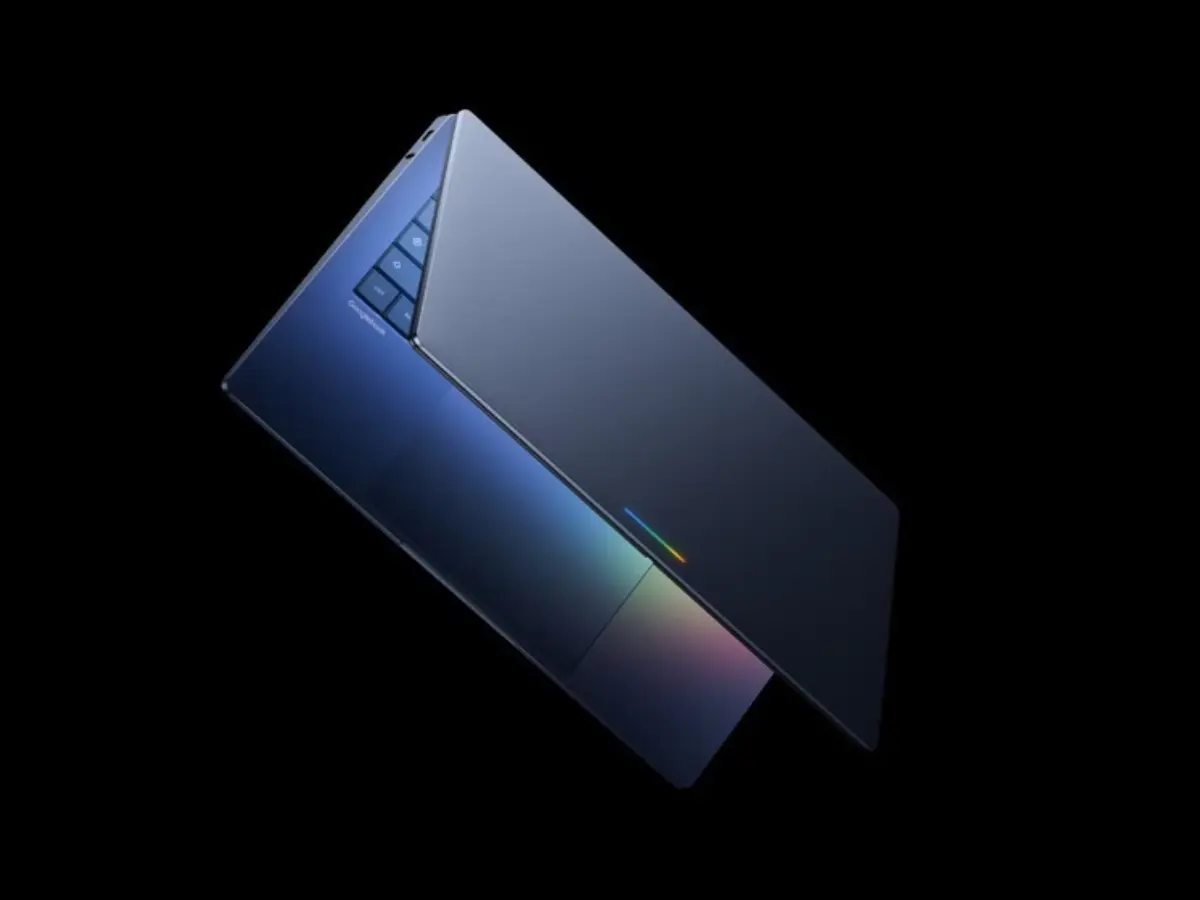
Hardware matters. Google’s announcement included one intriguing physical design detail that sets Googlebook apart visually from any laptop currently on the market: the glowbar.
Details remain limited, but the glowbar is a distinctive design element — a physical illuminated strip on the device — that is explicitly described as “functional,” not merely decorative. Based on reporting from TechRadar and others, the most likely function is that the glowbar lights up and pulses when Gemini is listening or responding — a physical, ambient indicator of AI activity, visible even when the device is closed.
This is a meaningful design decision. It makes the AI’s presence legible in physical space, not just on a screen. In a world where AI activity is increasingly invisible — running silently in the background — a device that physically signals when it is listening creates a different relationship between user and machine. It is honest design, and it is also deeply useful for those who want to know when Gemini is actively engaged.
OEM Partners: Who Is Actually Building Googlebook
Google announced its hardware partnerships directly in the Googlebook reveal. Five manufacturers — the same companies that have built the Chromebook ecosystem for over a decade — will produce the first Googlebook devices.
This is a significant list. Dell and HP in particular represent enterprise market access — these are not school-sale manufacturers. Lenovo is the world’s largest PC maker by volume. The presence of all five suggests Google has secured genuine commitment from the industry, not just exploratory interest. These companies do not tool up manufacturing lines for speculative projects.
Google confirmed the devices will feature premium materials, multiple form factors (laptop, 2-in-1, and potentially others), and the distinctive glowbar design element. Pricing has not been announced, but analysts widely expect Googlebook to be positioned above entry-level Chromebooks, competing directly with premium Windows AI PCs from Microsoft’s Copilot+ program and Apple’s M-series MacBook lineup.
Is Googlebook Killing the Chromebook?
This is the most politically charged question around the Googlebook announcement — and Google has been deliberately evasive about the answer. When TechCrunch asked a Google spokesperson directly whether Googlebook replaces Chromebook, the answer was careful: Google plans to continue supporting current Chromebook users, with devices receiving updates through their existing support commitments.
That is a support commitment, not a future roadmap. It does not say new Chromebooks will be made. It does not say ChromeOS continues as an innovation platform. It says existing users will not be abandoned — a legally and ethically necessary statement, and not much more.
Reading between the lines, the evidence is clear: Googlebook is what comes after Chromebook. The Chromebook launched in 2011 as a browser-based, low-cost, cloud-first computing device for a world where the web was the primary software delivery mechanism. Fifteen years later, that world has changed dramatically. AI is the delivery mechanism now. Gemini is the new web. And Googlebook is the hardware built for that new reality.
Chromebook was Google’s answer to the question: what is computing for people who mostly just need a browser? Googlebook is Google’s answer to the question: what is computing for people who want AI to handle the parts of computing they currently have to do themselves?
Google has form here. When Android was launched, the company said it was not competing with the iPhone. When Chrome was launched, Google said it was not competing with Windows. In both cases, the competitive intent was obvious to anyone paying attention. Googlebook is not killing Chromebook. But Chromebook, as a meaningful innovation platform, is likely over.
How It Stacks Up: Googlebook vs the Competition
| Feature | Googlebook | Chromebook | Windows Copilot+ | MacBook (M4) |
|---|---|---|---|---|
| AI in OS | Gemini — native OS layer | Add-on / web app | Copilot — integrated | Apple Intelligence — integrated |
| Cursor AI | Magic Pointer (DeepMind) | None | Limited Copilot overlay | None |
| OS Foundation | Android + ChromeOS fusion | ChromeOS | Windows 11 | macOS |
| App Ecosystem | Google Play + web apps | Web apps + limited Android | Win32 + Windows Store | macOS + iPhone apps |
| Phone Integration | Quick Access (deep Android) | Phone Hub (basic) | Phone Link (Android/iPhone) | Continuity + AirDrop |
| Custom Widgets | Gemini-built AI widgets | None | Widgets (static) | Widgets (static) |
| Price Tier | Premium (TBD) | Budget–Mid | Mid–Premium | Premium |
| Launch | Fall 2026 | Available now | Available now | Available now |
The honest competitive assessment: Googlebook’s AI integration is architecturally deeper than anything currently shipping from Microsoft or Apple. Magic Pointer has no direct equivalent. Create Your Widget has no direct equivalent. The Android + ChromeOS fusion enabling native Google Play apps at laptop scale has no direct equivalent.
The question is execution — and Google has a complicated hardware history to overcome.
What We Still Don’t Know
The Googlebook announcement was, deliberately, a preview. Google showed a vision and named partners. It did not reveal the details that buyers actually need to make decisions. The following remain unanswered as of the announcement date.
- Pricing — No pricing announced. Analysts expect premium tier, above Chromebook, competing with Copilot+ PCs and MacBook Air.
- Processor — No chipset partner confirmed. Expected to include on-device AI processing (NPU) for Gemini. No confirmation of Intel, AMD, Qualcomm, or MediaTek.
- RAM & Storage — No specifications disclosed. Premium AI processing likely requires 16GB+ RAM minimum.
- Display — No screen sizes, resolutions, or touchscreen confirmation.
- Battery Life — No figures. On-device AI inference is power-intensive.
- Weight & Dimensions — No physical specifications.
- Specific Models — No individual product SKUs from any OEM partner.
- India & Global Pricing — No regional pricing or availability information.
- Full OS Privacy Policy — If Gemini reads your screen context in real time, data handling policies will be critical.
Google directed interested buyers to googlebook.com for updates ahead of the Fall 2026 launch. More details are expected at Google I/O 2026, beginning May 19.
Google’s Hardware History: Cause for Both Hope and Caution
No honest analysis of Googlebook can skip this context. Google has announced premium laptop hardware categories before — and not all of them survived.
The Success Story
Launched as a browser-native, low-cost education device. Became genuinely transformational in schools worldwide. Still alive and widely sold in 2026. Google’s most successful hardware platform by volume.
The Premium Failure
Google’s attempt at a premium ChromeOS laptop. Beautiful hardware, ChromeOS limitations, high price point. Discontinued in 2022. A cautionary tale about premium Google hardware that couldn’t justify its price against both MacBook and cheaper Chromebooks simultaneously.
The Platform Abandonment
Cloud gaming platform. Technically impressive. Shut down in 2023. Reminded users that Google’s hardware and platform commitments have a limited shelf life if growth targets are not met.
The New Bet
All five of the world’s largest PC manufacturers committed. Built on Android’s faster development cadence. Gemini deep in the OS rather than bolted on. The conditions are different. Whether the outcome is different remains to be seen.
The difference with Googlebook, if there is one, is the OEM partner list. Pixelbook was a Google-made device. Googlebook is being made by Acer, Asus, Dell, HP, and Lenovo — companies that have existing sales relationships, distribution networks, and enterprise contracts. Google does not have to sell the hardware. The partners will. That is a structurally different go-to-market than any previous Google laptop attempt.
People Also Ask — Googlebook FAQ
The Verdict: Real Revolution or Google Hype?
Here is the honest answer: it is too early to know, and the track record demands caution.
What is unambiguously real: the OEM commitment. Acer, Asus, Dell, HP, and Lenovo do not build manufacturing lines for vaporware. The product exists. The software exists — the 9to5Google leak was 16 minutes of working OS, not a rendering. The partnerships are signed. The launch window is defined.
What is genuinely innovative: Magic Pointer has no direct competitor anywhere. The idea of contextual AI embedded in the cursor itself — rather than in a sidebar, a chatbot, or a keyboard shortcut — is a new paradigm for human-computer interaction. Create Your Widget, as described, is meaningfully more powerful than static widgets. Quick Access is a direct, practical answer to the friction of multi-device computing.
What requires watching: Google’s hardware history. Pixelbook was also genuinely good hardware that died because the software ecosystem couldn’t justify the premium price. Googlebook is betting that Gemini is so useful, so embedded, so contextually helpful that users will pay a premium for hardware built around it. That bet will be proved or disproved by actual usage — not by demo videos.
The broader story is this: the Chromebook was born in 2011 when Google believed the browser would become the universal computing environment. It was right. Fifteen years later, Google is betting that AI — specifically Gemini — will become the next universal computing environment. If it is right again, Googlebook is not just a laptop. It is the beginning of an entirely different relationship between people and machines.
This article is written for informational and editorial purposes only. All facts, features, quotes, and product details are sourced from publicly available announcements made by Google at The Android Show on May 12, 2026, and corroborated by reports from multiple technology publications. Googlebook specifications, pricing, and availability are subject to change. This publication has no affiliation with Google LLC or any of the mentioned OEM partners. Google, Gemini, Googlebook, Magic Pointer, ChromeOS, and Android are trademarks of Google LLC. All other brand names are the property of their respective owners.