India’s $214 Billion E-Commerce Race:
Flipkart, Amazon & Meesho
Battle for a Tripling Market
India’s online retail market is set to nearly triple from $70 billion in FY25 to $214 billion by FY30. Flipkart dominates GMV and users, Amazon holds metro ground, and Meesho is rewriting the value-commerce playbook. Here’s everything the ICICI Securities report reveals.
01. The Big Picture — A Market Tripling
Numbers in Indian business rarely move as dramatically as this one. According to a comprehensive new report by ICICI Securities, India’s e-commerce market — valued at approximately $70 billion in FY25 — is on track to reach somewhere between $174 billion and $214 billion by FY30. Even the conservative end of that range represents a 2.5x expansion in five years. The upper bound is a genuine tripling.
To put that in perspective, India’s entire retail market stood at around $978 billion in FY25. E-commerce currently claims about 7% of it. By FY30, the country’s retail pie itself grows to $1.4–1.6 trillion, and online commerce’s share climbs to 13%. That’s not incremental growth — it’s a structural reshaping of how Indians shop.
02. E-Commerce Penetration & the Retail Shift
The bigger story beneath the headline numbers is what happens to the structure of Indian retail as e-commerce grows. The report identifies a slow but significant squeeze on unorganised retail — the kirana stores, street vendors, and local mandis that form the backbone of how most Indians have historically bought things.
In FY25, unorganised retail accounted for 79% of India’s total retail market. By FY30, that share is projected to fall to 66%. That 13-percentage-point drop doesn’t sound dramatic, but applied to a $1.5 trillion market, it represents hundreds of billions of dollars in spending shifting from informal to formal and digital channels.
| Retail Segment | FY25 Share | FY30 Projected Share | Trend |
|---|---|---|---|
| Unorganised Retail | 79% | 66% | ↓ Declining |
| Organised Offline Retail | ~14% | ~21% | ↑ Growing |
| E-Commerce (Online) | ~7% | ~13% | ↑ Fastest growth |
| Total Retail Market | $978 Billion | $1.4–1.6 Trillion | ↑ Expanding |
03. What’s Driving the Growth
The ICICI Securities report traces India’s e-commerce acceleration back to a specific inflection point: 2016. That year, the Jio revolution brought cheap mobile data to hundreds of millions of Indians simultaneously. What followed was the rapid rise of smartphone ownership, the UPI payments infrastructure that made digital transactions frictionless, and the build-out of logistics networks capable of reaching districts that courier services had never previously served reliably.
Smartphone & Internet Access
India has nearly 970 million internet subscribers today. Affordable data and sub-$100 smartphones have made online commerce accessible to a population that was largely unaddressed five years ago.
UPI Payment Infrastructure
UPI-led payments have removed the friction of digital transactions. With over 10 billion monthly UPI transactions, the payment problem that once blocked e-commerce adoption has been decisively solved.
Logistics Network Expansion
Stronger last-mile delivery networks — including players like Ekart, Delhivery, and Xpressbees — have extended reliable delivery reach deep into tier III and IV cities and rural areas.
Quick Commerce Rising
The sector has shifted beyond traditional online retail into hyperlocal and quick commerce models, with 10–30 minute delivery becoming a competitive battleground in metro and tier I markets.
Post-Pandemic Habit Lock-In
Covid-19 converted millions of reluctant offline shoppers into digital regulars. The grocery and essentials categories especially saw permanent structural shifts in consumer behaviour.
Digital Public Infrastructure
India Stack — Aadhaar, UPI, ONDC, and Open Credit Enablement Network — creates a government-built digital foundation that lowers the cost and friction of building e-commerce businesses.
04. Rural India & the Tier II–IV Surge
Perhaps the most striking projection in the ICICI Securities report is this: by 2026, rural regions and tier II–IV cities are expected to contribute more than 60% of India’s total e-commerce demand. This is a complete inversion of how the market looked five years ago, when it was essentially a metro phenomenon.
This shift explains much of the competitive positioning of the three major players. Meesho’s entire existence is built on this insight — that the next several hundred million Indian online shoppers look nothing like the metro consumer, and that serving them requires fundamentally different logistics economics, pricing models, and product catalogues.
05. The Three Giants: Flipkart, Amazon & Meesho
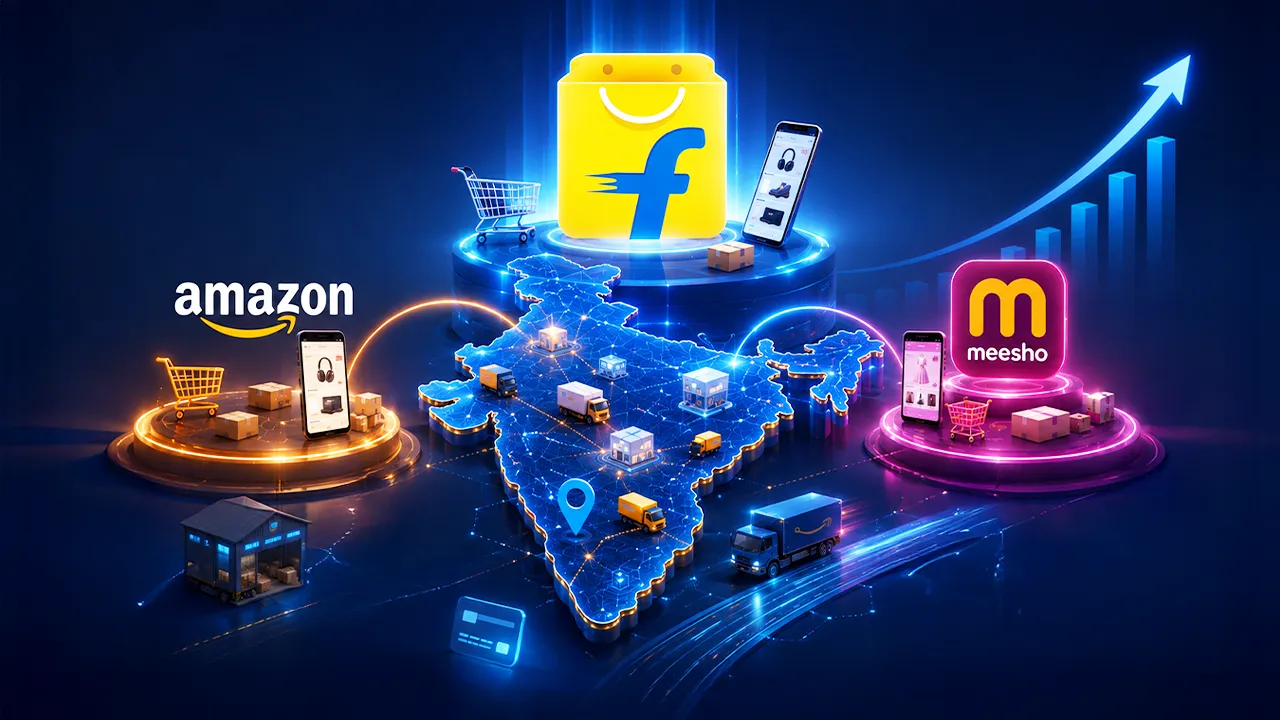
India’s e-commerce market is effectively a three-player race, with Flipkart commanding a dominant position at the top, Amazon holding firm as a strong second, and Meesho establishing itself as the undisputed platform of India’s value-conscious, non-metro consumer. Here’s how the three compare at a glance:
| Metric | Flipkart | Amazon India | Meesho |
|---|---|---|---|
| GMV Market Share | 50–60% | 25–30% | ~10% |
| Monthly Active Users | 220–240 million | ~150 million | ~200 million |
| Parent / Backer | Walmart | Amazon (US) | SoftBank, Meta, others |
| Core Strength | Smartphones, Electronics | Metro, FMCG, Beauty | Value commerce, Tier II–IV |
| Key Category GMV | 63–64% from electronics | 180M+ products, 100+ categories | Low-ticket, fashion, general |
| Logistics Arm | Ekart (in-house) | 100+ fulfilment centres | Third-party network |
| Profitability Status | Improving | Investing in growth | Challenges remain |
06. Flipkart — The Market Leader
Walmart’s Indian bet continues to pay off. Flipkart holds an estimated 50–60% of India’s e-commerce GMV — a share that is not just large but structurally entrenched. The ICICI Securities report attributes this dominance to three interlocking advantages: category concentration, logistics control, and financial ecosystem depth.
The electronics and smartphones category — contributing 63–64% of Flipkart’s GMV — is a strategic moat. These are high-value, high-frequency-research purchases where trust, delivery speed, and after-sales assurance matter enormously. Flipkart has built that trust over a decade. Its Big Billion Days sale events remain the most-anticipated e-commerce events in the Indian calendar.
The in-house logistics arm Ekart gives Flipkart something Amazon and Meesho have to buy from the market: end-to-end delivery control. Combined with PhonePe’s payments infrastructure — separately valued but deeply integrated — Flipkart operates as much as a financial and logistics platform as a retailer.
Its seller network of approximately 450,000 merchants ensures catalogue depth that is difficult for new entrants to replicate, particularly in electronics, where authorised seller relationships and warranty support are non-trivial.
07. Amazon India — The Metro Fortress
Amazon India occupies a distinct and profitable niche. While Flipkart chases GMV scale, Amazon has built density in markets where spending power and willingness to pay for premium service are highest — India’s metro cities and their upper-middle-class consumers.
Amazon India’s 180 million product catalogue across more than 100 categories gives it a breadth that few platforms globally can match. Its strength in beauty, personal care, and FMCG categories speaks to its metro consumer base, where brand awareness and product variety drive buying decisions more than price alone.
The launch of Amazon Now — the company’s entry into quick commerce — signals that Amazon is not content to cede the on-demand grocery and essentials space to competitors like Blinkit and Zepto. This is a high-burn category, but one where customer frequency and basket stickiness make long-term economics attractive.
08. Meesho — The Value-Commerce Disruptor
Meesho is the most interesting story in Indian e-commerce right now. Not because of its current size — roughly 10% GMV share — but because of what it reveals about the next chapter of the market.
While Flipkart and Amazon built for India’s digitally literate, English-comfortable, credit-card-holding urban consumer, Meesho built for everyone else. Its platform caters primarily to price-sensitive buyers in tier II cities and smaller towns, where ₹299 is a real price point and free delivery is a non-negotiable expectation, not a perk.
Meesho’s GMV contribution to India’s e-retail market grew from roughly 5% in 2021 to more than 10% in 2025 — a doubling in four years achieved by relentlessly targeting the consumers other platforms underserved. Its user base of approximately 200 million monthly active users is remarkable for a platform that is only the third-largest by GMV. The high user count relative to GMV reflects the platform’s low average order values — a structural feature, not a bug, of serving the value-commerce segment.
The profitability challenge the report identifies is real and well-understood. When average order values are low and delivery costs are a fixed reality of geography, unit economics are difficult. Meesho will need to either raise average order values, reduce delivery costs through density, or monetise users through advertising and financial services to reach sustainable profitability.
09. Category-Wise GMV Breakdown
Not all of India’s e-commerce growth is uniform. The ICICI Securities report breaks down how different product categories contribute to the overall GMV picture — and the dominance of high-value electronics is striking.
Smartphones and electronics together account for roughly 50–70% of India’s e-commerce GMV — a concentration that underlines why Flipkart, with its 63–64% share of revenues coming from these categories, is so dominant. These purchases are also high-considered: consumers research extensively, compare prices across platforms, and then transact. Platform trust and price competitiveness are both critical.
The long-term opportunity, the report suggests, lies in categories with low current household penetration. Home appliances in rural India. Online grocery in tier III cities. Travel in first-time-digital-payment users. These are the categories where the next wave of GMV growth will be captured — and where Meesho, Amazon Now, and ONDC-based players are positioning themselves most aggressively.
10. FAQ — Quick Answers
According to ICICI Securities, India’s e-commerce market is projected to reach $174–214 billion by FY30, up from approximately $70 billion in FY25. That’s nearly a tripling of market size in five years, driven by rising internet penetration, rural adoption, and expanding digital payment infrastructure.
Flipkart, owned by Walmart, is the clear market leader with an estimated 50–60% GMV market share and 220–240 million monthly active users — more than any other platform. Its dominance is built on electronics, smartphones, an in-house logistics network (Ekart), and PhonePe’s payments ecosystem.
Amazon India holds an estimated 25–30% GMV market share with approximately 150 million monthly active users. It is strongest in metro markets and categories like beauty, personal care, FMCG, and general merchandise. It has also entered quick commerce through Amazon Now.
Meesho’s contribution to India’s e-retail GMV grew from roughly 5% in 2021 to over 10% in 2025 — doubling in four years. It now has approximately 200 million monthly active users, making it the platform with the second-highest user base despite being third in GMV share. It serves primarily price-sensitive, non-metro consumers.
Smartphones are the single largest category, accounting for 30–40% of total GMV. Appliances and electronics add another 20–30%, meaning these two high-value segments together represent roughly half to two-thirds of India’s total online retail spending.
A very large one. Tier II–IV cities and rural regions are expected to contribute more than 60% of India’s total e-commerce demand by 2026 — a reversal from the metro-dominated early years of Indian e-commerce. This shift is already reshaping competitive strategy, with Meesho and ONDC positioning themselves most directly for this consumer.
In FY25, e-commerce accounts for approximately 7% of India’s $978 billion retail market. By FY30, as the retail market grows to $1.4–1.6 trillion, e-commerce’s share is projected to rise to 13%. The share of unorganised retail falls from 79% to 66% in the same period.
⚡ The Story in Seven Points