
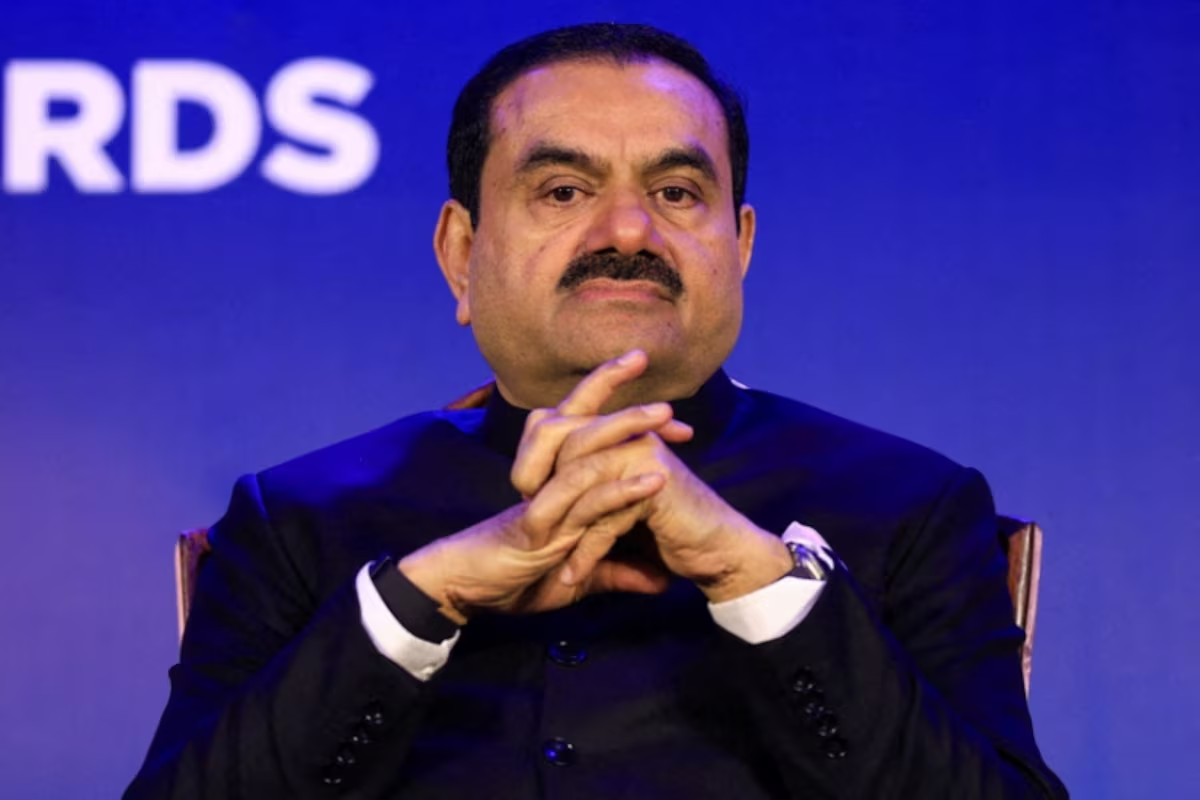
Adani vs. America:
The $265 Million Bribery Case
That Just Changed Its Ending
The US Justice Department is set to drop criminal fraud charges against Indian billionaire Gautam Adani. Simultaneously, he and his nephew have agreed to pay $18 million to settle a related SEC civil lawsuit — without admitting any wrongdoing. Here is the full story.
01. How It All Began
Gautam Adani built one of the most remarkable business empires of the 21st century — a sprawling conglomerate spanning ports, airports, power, roads, and renewable energy across India and beyond. With a net worth of $82 billion, he sits comfortably among the world’s wealthiest people. His group’s 11 publicly listed companies are woven into the infrastructure backbone of the world’s most populous nation.
Then, in November 2024, something unprecedented happened. A federal court in Brooklyn, New York, handed down a criminal indictment against him. The charges came from the US Department of Justice during the final months of the Biden administration — and they were serious. Not a regulatory slap on the wrist. A full five-count criminal fraud case alleging a sprawling, deliberate bribery operation worth more than a quarter of a billion dollars.
The question that followed was simple, if uneasy: how does the world’s most ambitious infrastructure builder end up in a New York courtroom?
02. What the US Actually Alleged
The indictment told a specific story. According to federal prosecutors, Gautam Adani and seven co-defendants — including his nephew Sagar Adani — orchestrated a scheme to bribe Indian state government officials. The goal was to win lucrative contracts for Adani Green Energy to supply solar power to India’s state electricity distribution companies, known as DISCOMs.
The civil complaint filed by the SEC ran parallel to the criminal case. It added a further dimension: while allegedly running this bribery scheme, the Adanis also raised billions of dollars from US investors — and, the SEC claimed, misled those investors about the company’s compliance with anti-bribery laws. Adani Green Energy reportedly raised more than $175 million from US investors during this period. Azure Power Global, another entity named in the civil case, had its shares trading on the New York Stock Exchange.
That US market connection — fundraising in America, stock trading in America — is what gave Brooklyn’s Eastern District Court jurisdiction over conduct that physically happened in India. The Adanis would later challenge this logic vigorously.
The Alleged Bribe
Over $250 million promised or paid to Indian state government officials to secure solar power supply contracts for Adani Green Energy.
The Investor Angle
The SEC alleged the Adanis misled US investors about anti-bribery compliance while raising $175M+ from American capital markets.
The Jurisdiction Hook
All alleged conduct was in India, but charges were filed in Brooklyn because the fundraising tied to the scheme happened in the US.
Five Counts
The criminal indictment carried five counts including conspiracy to commit wire fraud, securities fraud, and obstruction of justice.
The Adani Group denied every allegation from day one. “The claims made in the US DOJ indictment and US SEC civil complaint are baseless,” the company stated publicly, and it never wavered from that position.
03. A Full Case Timeline
’24
’24
’26
’26
’26
04. The Key Players
Gautam Adani
63-year-old billionaire. Worth $82B (Forbes). Primary defendant. Agreed to pay $6M to SEC. Criminal charges set to be dropped.
Sagar Adani
Gautam’s nephew and executive at Adani Green Energy. Named in both criminal and civil cases. Agreed to pay $12M to the SEC.
Robert Giuffra Jr.
Top Wall Street lawyer hired in January 2026. Also a personal attorney to President Donald Trump. Led the presentation to DOJ officials seeking dismissal.
US SEC
Filed civil fraud complaint in November 2024. Settlement now agreed at $18M total, subject to federal court approval in New York.
US DOJ
Filed five-count criminal indictment in Brooklyn. Now moving to withdraw charges — a decision reportedly influenced by Adani’s $10B US investment pledge.
Azure Power Global
Another energy company cited in the SEC civil case. Its shares were traded on the NYSE, establishing part of the US jurisdictional basis for the case.
05. The $18 Million SEC Settlement
On May 14–15, 2026, Adani Green Energy confirmed to both the BSE and NSE that a settlement had been filed with the US Eastern District Court of New York. The financial breakdown is straightforward, if notable for what it does not include — any admission of guilt.
No admission of wrongdoing
No admission of wrongdoing
Subject to court approval
To put $18 million in perspective: Adani Green Energy alone raised more than $175 million from US investors during the period covered by the alleged scheme. The settlement amounts to roughly 10% of that figure. Some legal analysts note this is a relatively modest penalty given the scale of the alleged conduct — a reflection, perhaps, of how significantly the defense team eroded the government’s confidence in its own case.
06. Why the DOJ Is Backing Down
The decision to drop criminal charges is the more dramatic development — and the one with the most unanswered questions. Criminal indictments are not abandoned lightly. What happened?
According to sources cited by Reuters, Adani’s legal team — led by Robert Giuffra Jr. — made a comprehensive presentation to Justice Department officials in April 2026. The argument had two distinct prongs: procedural and factual.
| Defense Argument | The Claim | Government’s Reported Position |
|---|---|---|
| Jurisdiction | All alleged conduct was in India; US law doesn’t apply | Under review — not resolved |
| Evidence | No credible evidence of bribery scheme existed | Case reportedly seen as weak |
| Court Appearance | Neither defendant ever appeared; case stalled 18+ months | Prosecution effectively frozen |
| Investor Harm | No evidence of harm to US investors | Disputed but not disproven |
| $10B Investment | Investment blocked by ongoing prosecution | Some prosecutors called it irrelevant |
Interestingly, the picture inside the Justice Department itself was not unanimous. Reuters’ sources noted that some prosecutors argued the promised $10 billion US investment should carry no weight in determining the case’s merits. It was not clear whether others viewed it differently. That internal tension makes the DOJ’s decision all the more significant — it appears the institutional calculus ultimately favored withdrawal despite at least some pushback from career prosecutors.
07. The $10 Billion Factor
You cannot fully understand the resolution of this case without understanding the geopolitical and economic backdrop against which it played out.
After Donald Trump won the US presidential election in November 2024, Gautam Adani made a high-profile public pledge. He announced that the Adani Group would invest $10 billion in US energy security and infrastructure projects, with a target of creating 15,000 American jobs. The statement positioned Adani as a partner in Trump’s economic vision at the very moment his legal troubles in the US were intensifying.
Adani’s lawyers subsequently told DOJ officials that this investment — which New York Times reporting described as “frozen” by the criminal charges — could not proceed while the prosecution was active. Whether that argument swayed anyone inside the DOJ is disputed. But the timing of events makes it impossible to ignore as a factor shaping the broader environment in which the case was reconsidered.
Giuffra’s dual role — as both Adani’s lead attorney and a personal lawyer to President Trump — adds another layer to this story that analysts have noted, though no direct political interference in the DOJ process has been alleged or documented.
08. What Happened to Adani Stocks
The market’s reaction to the settlement news was swift and broadly positive — though the stocks had already been recovering well before May 15.
| Company | Movement on May 15, 2026 | 2026 YTD Performance | Key Note |
|---|---|---|---|
| Adani Green Energy | +3.53% | +41% | Above 52-week high |
| Adani Enterprises | Pared early losses | +24% | Above 52-week high |
| Group-wide (Jan 2026) | −$13 billion | — | Post-SEC summons shock |
Analysts at Deven Choksey Research noted that easing US legal uncertainty structurally reopens international capital markets for the Adani Group. The group carries roughly 2.78 trillion rupees (approximately $29 billion) in net debt as of late 2025, with global banks and capital markets accounting for 41% of total borrowing. A resolved US legal overhang directly improves the group’s ability to access that pool of capital again.
09. What This Means Going Forward
The near-simultaneous resolution of both the SEC civil case and the likely withdrawal of criminal charges marks the most significant legal development for the Adani Group since the original November 2024 indictment. But what does it actually change?
International Capital Access
The legal cloud had effectively frozen Adani’s access to global bond markets and many international banking relationships. That barrier now lifts significantly.
Renewable Expansion Resumes
Adani Green Energy’s massive pipeline of solar and wind projects — some of the world’s largest — can now accelerate without the reputational drag of active US fraud charges.
US Investment Pledge Unlocks
The $10 billion US investment commitment, described as frozen by the charges, can now theoretically proceed — creating an alignment of interests between Adani Group and the Trump administration’s economic agenda.
Other Investigations Remain
Analysts note that Adani may still face financial penalties from other US agencies, including a possible action from the US Treasury, related to separate ongoing investigations. The legal story may not be fully closed.
Hindenburg Shadow Persists
The Adani Group faced separate scrutiny after a 2023 report by short-seller Hindenburg Research alleging accounting fraud and stock manipulation. That broader reputational challenge is unaffected by the SEC settlement.
Debt Management Challenge
With $29 billion in net debt and 41% held internationally, the group’s growth depends on continued access to global capital. The settlement helps — but strong earnings execution remains non-negotiable.
10. Quick-Answer FAQ
Federal prosecutors charged him with five counts including conspiracy to commit wire fraud, securities fraud, and obstruction of justice. The core allegation was that he and seven others paid more than $250 million in bribes to Indian government officials to win solar energy contracts for Adani Green Energy.
No. The SEC settlement is explicitly structured without any admission or denial of wrongdoing by either Gautam Adani or Sagar Adani. The Adani Group has maintained throughout that all allegations are baseless.
According to Reuters sources, Adani’s lawyers successfully argued that the US lacked proper jurisdiction and that the evidence supporting the charges was insufficient. The case had also been effectively stalled for over 18 months because neither defendant had appeared in court. Adani’s promise of a $10 billion US investment — which his lawyers said was blocked by the charges — may also have factored into the broader context.
Robert Giuffra Jr. is one of Wall Street’s most prominent defense attorneys and is also a personal lawyer to President Donald Trump. Adani hired him in January 2026. His dual role has drawn attention, though no direct political interference in the DOJ’s decision has been alleged or documented.
Not yet. Adani Green Energy confirmed that a request for entry of final judgment was filed with the US Eastern District Court of New York on May 15, 2026. The court’s formal approval is still awaited.
With the legal cases resolving, the investment — pledged after Trump’s 2024 election win and described as covering US energy security and infrastructure — can now theoretically proceed. It had reportedly been frozen while criminal charges were active. Adani committed to creating up to 15,000 American jobs through the investment.
Not entirely. Reports suggest separate investigations by other US agencies, including possibly the Treasury Department, may still be active. The Hindenburg Research allegations of 2023 remain a separate unresolved reputational matter. The SEC and DOJ resolutions are significant but may not be the final chapter.
⚡ The Story in Six Points
Read this also: Full Biography of Gautam Adani