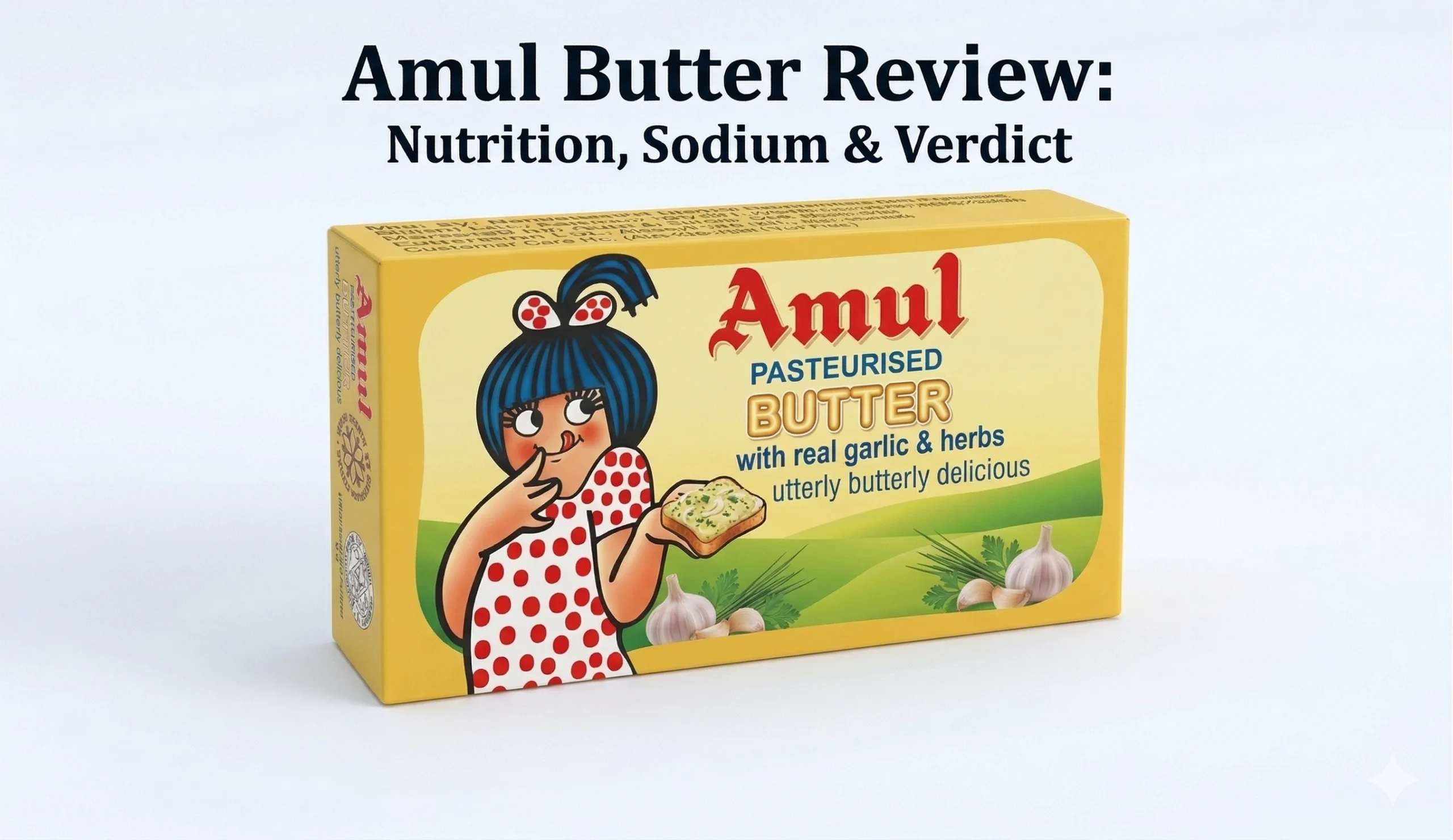


Amul Pasteurised Butter
722 calories, 836mg sodium, and 650mcg Vitamin A — the label behind the iconic yellow box
836mg Sodium Per 100g — The Number That Gets Overlooked
The WHO recommends keeping sodium under 2,000mg per day. Amul Butter contains 836mg per 100g — 42% of the daily limit from butter alone, before your meals. A generous 10g spread on toast = 83.6mg sodium; a restaurant-style paratha with 20–25g butter = 167–209mg. The sodium comes from salt added during processing — butter is naturally almost sodium-free. If you’re watching blood pressure or sodium intake, the serving size matters significantly here.
650mcg Vitamin A Per 100g — The Nutritional Star of Butter
Amul Butter contains 650mcg of Vitamin A per 100g — the ICMR recommended daily intake for adult men is 600mcg. This means 100g of butter provides your entire day’s Vitamin A. Even a modest 10g serving delivers 65mcg — a meaningful contribution. Vitamin A in butter is in retinol form (pre-formed Vitamin A) — the most bioavailable form, directly usable by the body without conversion. This is the key nutritional advantage butter has over plant-based spreads and margarine.
Full Nutrition Facts — Per 100g
All values are per 100g. A standard serving of butter is typically 5–14g (1 tsp to 1 tbsp). Values below include what a typical 10g serving delivers.
| Nutrient | Per 100g | Per 10g (1 tbsp) | What It Means | Verdict |
|---|---|---|---|---|
| Energy | 722 kcal | 72.2 kcal | Nearly all calories are from fat — 10g butter adds ~72 kcal to a meal, comparable to a teaspoon of oil | ⚠ Calorie dense Lower than ghee (897 kcal/100g) because butter retains ~16–18% water. Portion control matters. |
| Total Fat | 80 g | 8.0 g | A mixture of saturated (~50%), monounsaturated (~25%), and polyunsaturated (~4%) fats — plus water and milk solids | ⚠ High 80g/100g — but at a 10g serving, 8g fat is manageable within a balanced diet. |
| Saturated Fat | ~50 g (est.) | ~5.0 g | Milk fat saturated fatty acids — dominated by palmitic acid, myristic acid, and stearic acid from cow dairy | ⚠ Monitor Not listed separately on this label. Estimated at ~50g/100g for standard Indian butter. Relevant for people managing LDL cholesterol. |
| Trans Fat | Not listed | — | Trace natural ruminant trans fats (CLA, vaccenic acid) may be present — these are beneficial, not industrial trans fats | ✓ Natural only No industrial trans fat. Any ruminant trans fats are health-positive. |
| Sodium | 836 mg | 83.6 mg | From added salt during manufacturing — Amul Butter is salted butter (not unsalted). This is the primary nutritional concern | ✖ High — the key flag 836mg/100g = 42% of WHO daily sodium limit. Heavy users need to count this carefully. |
| Total Carbohydrate | 0 g | 0 g | Zero carbohydrates — all lactose is removed in processing (churning separates fat from whey) | ✓ Zero Keto-friendly, diabetic-safe from a carb perspective. Lactose-intolerant people can usually tolerate butter. |
| Added Sugar | 0 g | 0 g | Absolutely zero added sugar | ✦ Clean Zero added sugar. The 0g carbohydrate means no lactose either at this fat concentration. |
| Protein | 0.5 g | 0.05 g | Trace milk proteins remaining after churning — not a protein source | Trace Negligible. Not a protein food. |
| Vitamin A | 650 mcg | 65 mcg | Retinol — pre-formed, most bioavailable form of Vitamin A. Supports vision, immunity, skin, and cell growth | ✦ Excellent 650mcg = 108% of ICMR adult daily Vitamin A RDA. The standout nutritional value of butter over all plant-based spreads. |
What’s Actually in Amul Pasteurised Butter?
The full ingredient list for Amul Pasteurised Butter is short and clean: Pasteurised Cream (from Cow/Buffalo Milk), Salt. That’s it. No emulsifiers, no preservatives, no colouring agents, no flavourings — just churned cream and salt.
| Ingredient | What It Is | Role | Health Note | Verdict |
|---|---|---|---|---|
| Pasteurised Cream | The fat-rich layer of cow or buffalo milk, heat-treated and then mechanically churned until fat globules clump into butter | The entire nutritional and flavour base of butter — provides all fat, Vitamin A, and the characteristic dairy flavour | Pasteurisation kills harmful pathogens while preserving nutritional value. Churning concentrates the fat to ~80% while separating out most of the water, lactose, and protein. The resulting product is approximately 80% fat, 16–18% water, 1.5–2% salt, and trace milk solids | ✦ Real dairy Single-origin dairy fat — no processing beyond churning and pasteurisation. A genuinely clean ingredient. |
| Salt (NaCl) | Sodium chloride — the same table salt used in cooking, added at approximately 1.5–2% of butter weight | Two functions: (1) Flavour enhancement — the salt-fat combination is what makes butter taste distinctively rich and moreish; (2) Natural preservation — salt lowers water activity, extending shelf life without chemical preservatives | This is the source of all 836mg sodium per 100g. A necessary ingredient for shelf stability and flavour, but the primary nutritional concern for people managing blood pressure or sodium intake. Unsalted butter (also available from Amul) contains dramatically less sodium (~10–15mg/100g) | ⚠ Primary sodium source The reason the sodium figure is high. Consider Amul Unsalted Butter if sodium is a concern — same nutrition, ~95% less sodium. |
Butter vs Ghee — Head to Head
| Parameter | Amul Butter | Amul Cow Ghee | Amul Pure Ghee |
|---|---|---|---|
| Calories/100g | 722 kcal | 897 kcal | 897 kcal |
| Fat/100g | 80g | 99.7g | 99.7g |
| Water content | ~16–18% | ~0% | ~0% |
| Sodium/100g | 836mg ⚠ | ~0mg | ~0mg |
| Vitamin A | 650mcg ✦ | 600mcg | ~50mcg (15% DV) |
| Lactose | Negligible | None | None |
| Smoke point | ~150°C ⚠ | ~250°C ✓ | ~250°C ✓ |
| Added salt | Yes (~1.5%) | No | No |
| Butyric acid | Present (less) | Higher (~3–4g) | Higher (~3–4g) |
| Best use | Toast, baking, finishing | Tadka, cooking, finishing | Tadka, cooking, finishing |
| Shelf life (unopened) | Refrigerated — shorter | Room temperature — longer | Room temperature — longer |
The Honest Verdict
Amul Pasteurised Butter is an excellent natural food product with a genuinely short, clean ingredient list — just cream and salt. The 650mcg Vitamin A per 100g is exceptional, zero carbs and zero added sugar are real positives, and it’s naturally free of any industrial additives or preservatives. It is simply churned dairy fat — as natural a cooking fat as exists.
The flag worth watching is the 836mg sodium — a figure that surprises most people who assume butter is just fat and nothing else. At typical daily usage (10–20g), the sodium contribution is manageable (84–168mg). But heavy butter users or those already managing blood pressure need to account for this. The simple solution: use Amul Unsalted Butter where possible, or measure your portions.
👍 What Works
- 650mcg Vitamin A — 108% of adult daily RDA per 100g
- Only 2 ingredients — cream and salt. No additives whatsoever
- Zero carbohydrates, zero lactose — safe for lactose intolerant people
- Zero added sugar — genuinely clean on this count
- No industrial trans fat — pure natural dairy fat
- Real CLA and butyric acid — naturally present, gut and metabolism benefits
- Lower calorie than ghee (722 vs 897 kcal/100g) due to water content
- Vegetarian certified — no animal rennet
👎 Watch Out For
- 836mg sodium per 100g — 42% of WHO daily limit. The main concern
- 80g fat per 100g — calorie-dense, easy to overconsume
- Saturated fat ~50g/100g — relevant for cardiovascular monitoring
- Low smoke point (~150°C) — not suitable for high-heat Indian cooking
- Requires refrigeration — less convenient than ghee for Indian kitchens
- Contains milk — declared allergen
⚠️ This review is based on published nutritional label data and food science literature. It is not medical advice. Individuals with milk allergy, cardiovascular conditions, or hypertension should consult a healthcare professional for personalised dietary guidance.