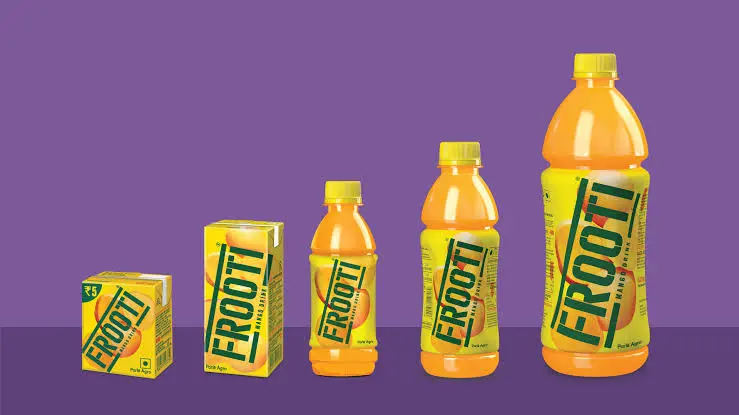


FROOTI
The tetra pack has 19.5% mango. The big bottle has 11.2%. And the export pack prints a children’s warning. Here’s everything.
Official Warning on Frooti Export Pack: “Colour May Have an Adverse Effect on Activity & Attention in Children”
The Frooti export label (Image 3) carries this exact statutory warning regarding Sunset Yellow FCF (INS 110). This warning is mandated by the EU and several other regulatory bodies for any product containing this synthetic azo dye. The UK FSA’s 2007 Southampton study linked INS 110 to increased hyperactivity in children. India’s FSSAI does not require this warning on domestic packs — which is why the tetra pack and large bottle labels in India don’t display it. The same colour, the same drink, the same children — but a different warning depending on which country the bottle is sold in. This is the most important finding in this review.
Two Frooti Formulas — Side by Side
This is the most important discovery in this review. Frooti is not one product — it’s at least two different formulations depending on pack type:
📦 Frooti Tetra Pack (Small)
| Mango Pulp | 19.5% |
| Preservative | No added preservative |
| Stabilisers | None listed |
| Antifoaming agent | None |
| Flavours | Nature-identical only |
| Vitamin A | 120mcg / 100ml |
| Calcium | 8mg / 100ml |
| Energy | 65 kcal / 100ml |
| Added sugar | 13.3g / 100ml |
🚚 Frooti Large Bottle (Thermally Processed)
| Mango Pulp | 11.2% only |
| Preservative | No added preservative |
| Stabilisers | INS 466, INS 415 |
| Antifoaming agent | INS 900a |
| Flavours | Nature-identical only |
| Energy | 62.9 kcal / 100ml |
| Added sugar | 14.2g / 100ml |
| Sodium | 25.4mg / 100ml |
| Vitamin A / Calcium | Not listed |
13.3g Added Sugar Per 100ml — The Number That Matters Most
Frooti’s tetra pack label specifically discloses 13.3g added sugar per 100ml — a rare level of transparency in the Indian fruit drink market. Natural fruit sugars contribute an additional 2.5g. Total: ~15.8g sugar per 100ml. A 200ml tetra pack delivers 31.6g sugar — 126% of WHO’s daily free sugar limit in one small carton. The large bottle version shows 14.2g added sugar per 100ml — slightly higher, with less mango pulp contributing less natural sugar. The sugar-to-fruit ratio is unfavourable in both formulas.
Sugar in a 200ml Frooti tetra pack (31.6g total ≈ 8 teaspoons, each cube = 4g)
■ Green = within WHO daily limit (25g) · ■ Red = above WHO daily limit · Total: 31.6g in one 200ml tetra pack
Full Nutrition Facts — Tetra Pack Per 100ml
| Nutrient | Per 100ml | Per 200ml Pack | What It Means | Verdict |
|---|---|---|---|---|
| Energy | 65 kcal | 130 kcal | All calories from sugar — one small tetra pack = ~6.5% of daily calorie budget | ⚠ Empty calories Slightly more calories than Maaza (54) at same volume. No nutritional proteins or fats. |
| Carbohydrate | 16.2 g | 32.4 g | Almost entirely sugar — 15.8g sugar out of 16.2g carbs (97%) | ✖ Almost all sugar Minimal starch or fibre — rapid glycaemic spike. |
| Added Sugar | 13.3 g | 26.6 g | Specifically declared added cane sugar — this level of transparency is better than many competitors | ✖ High 13.3g added + 2.5g natural = 15.8g total. One 200ml pack = 106% of WHO daily added sugar limit. |
| Natural Fruit Sugars | 2.5 g | 5.0 g | Sugars naturally present in the 19.5% mango pulp | ✓ Natural Naturally occurring fruit sugars — lower glycaemic index than added sucrose. |
| Protein | 0 g | 0 g | No protein | Zero |
| Fat | 0 g | 0 g | No fat | ✓ Zero |
| Vitamin A | 120 mcg | 240 mcg | From beta carotene in mango pulp — 200mcg per 200ml tetra pack | ✦ Positive Meaningful Vitamin A contribution from real mango. 240mcg = 40% of adult ICMR daily RDA. |
| Calcium | 8 mg | 16 mg | Trace calcium from mango pulp — not a significant source | Trace Negligible — less than 2% of daily calcium needs. |
Every Ingredient Decoded — Both Formulas
Water, Mango Pulp (19.5%), Sugar, Acidity Regulator (INS 330), Antioxidant (INS 300), Food Colour (INS 110), Nature-Identical Flavouring Substances (Mango). NO ADDED PRESERVATIVE.
| Ingredient | Role | Health Note | Verdict |
|---|---|---|---|
| Water | Base carrier | Purified water — no concerns | ✓ Clean |
| Mango Pulp (19.5%) | Primary fruit content — provides natural sugars, beta carotene, Vitamin A, and authentic mango flavour | Real mango at 19.5% is the best ingredient here. Contributes 120mcg Vitamin A and natural antioxidants per 100ml. High enough to qualify Frooti as a genuine “fruit drink” rather than a flavoured sugar water | ✦ Best ingredient 19.5% is the same as Maaza tetra pack. Genuine fruit content. |
| Sugar | Primary sweetener — adds 13.3g of free sugar per 100ml on top of natural mango sugars | The dominant health concern. At 13.3g added sugar per 100ml, the drink is essentially sweetened mango-flavoured water from a glycaemic standpoint. Label credit: Frooti explicitly discloses “added sugar” separately — better than many competitors | ✖ Primary concern High quantity of free sugar — the main nutritional flag. |
| INS 330 (Citric Acid) | Acidity regulator — pH control, tartness, shelf stability | One of the safest, most studied food additives. Contributes to the sour-sweet mango balance | ✓ Safe |
| INS 300 (Ascorbic Acid) | Antioxidant — prevents oxidation and browning of mango pulp | Vitamin C — genuinely beneficial. Preserves colour and freshness while adding nutritional value. No benzene concern (no INS 211 used in Frooti) | ✦ Positive Vitamin C antioxidant adds real value. |
| INS 110 (Sunset Yellow FCF) | Synthetic colour — amplifies and standardises the yellow-orange hue of the drink | Southampton Six dye. Linked to hyperactivity in children in UK FSA 2007 study. Banned or restricted in Norway, Finland, some other markets. EU requires explicit children’s warning. Export Frooti label carries this warning. Indian domestic packs do not | ✖ Children’s warning The key flag. Unnecessary given real mango pulp’s natural colour. Parents of young children should note. |
| Nature-Identical Mango Flavouring | Synthetic molecules chemically identical to natural mango flavour compounds — provides consistent mango intensity beyond what 19.5% pulp delivers | Safe and widely used. Not from real mango but chemically equivalent to natural compounds | ⚠ Synthetic Enhances flavour beyond what the real fruit provides alone. |
Also contains: Sugar (listed before mango pulp in this format), Stabilizers (INS 466, INS 415), Antifoaming Agent (INS 900a). Mango pulp only 11.2%.
| Ingredient | What It Is | Why It’s in the Large Bottle Only | Verdict |
|---|---|---|---|
| INS 466 (Carboxymethyl Cellulose — CMC) | A cellulose-derived thickener and stabiliser — semi-synthetic, derived from plant cellulose reacted with sodium hydroxide | Thermal processing can break down the natural pectin and polysaccharides in mango pulp, causing the drink to separate or become watery. CMC restores body and smooth texture after heat treatment | ⚠ Processing additive Safe at food levels but indicates more industrial processing than the tetra pack. Not present in the better formulation. |
| INS 415 (Xanthan Gum) | Natural microbial polysaccharide — produced by fermentation of Xanthomonas campestris bacteria on sugar | Works alongside CMC to maintain consistent viscosity and prevent settling of mango pulp particles after high-heat processing | ✓ Natural gum Widely used, well-studied, safe. Has prebiotic properties. Better additive than CMC. |
| INS 900a (Polydimethylsiloxane — PDMS) | A silicone-based antifoaming agent — prevents excessive foam formation during high-speed filling and heat processing of the drink | High-heat pasteurisation and fast industrial bottling creates significant foam. PDMS eliminates this efficiently. Used in food industry globally at very low doses (max 10mg/kg in beverages) | ⚠ Industrial additive Safe at permitted levels but is a silicone compound — not something most consumers expect in a fruit drink. Its presence marks the large bottle as a more industrially processed product. |
The Export Warning vs Indian Label — A Direct Comparison
| Aspect | Frooti India Label | Frooti Export Label (Image 3) |
|---|---|---|
| INS 110 disclosure | Listed as “Permitted Synthetic Food Colour (INS110)” | Listed as “Sunset Yellow FCF (Color)” |
| Children’s warning | Not required / not printed | ⚠ “Color may have an adverse effect on activity & attention in children” |
| Regulatory basis | FSSAI — does not mandate warning | EU/FSA — mandatory warning for Southampton Six dyes |
| Same drink? | Yes — same Frooti, same INS 110 dye, different regulatory requirements for the same ingredient | |
Frooti vs Maaza vs Slice — How Do They Compare?
| Parameter | Frooti Tetra | Frooti Large Bottle | Maaza | Slice |
|---|---|---|---|---|
| Mango pulp % | 19.5% | 11.2% ⚠ | 19.5% | ~13% |
| Added sugar/100ml | 13.3g | 14.2g | ~9g est. | ~11g est. |
| Preservatives | None ✓ | None ✓ | INS 202 | INS 211+202 ⚠ |
| Synthetic colour | INS 110 ⚠ | INS 110 ⚠ | INS 110 ⚠ | INS 110 ⚠ |
| Children’s warning on export | Yes | Yes | Yes | Yes |
| Stabilisers | None ✓ | INS 466, INS 415 ⚠ | None | Some |
| Added sugar disclosure | ✦ Explicitly stated | ✦ Explicitly stated | Not separate | Not separate |
| Vitamin A | 120mcg ✓ | Not listed | ~Beta carotene | ~Beta carotene |
The Honest Verdict
Frooti’s tetra pack is the better formulation — 19.5% real mango pulp, no preservatives, no stabilisers, no antifoaming agents, and a declared Vitamin A content (120mcg/100ml). For a mass-market fruit drink, the tetra pack formulation is relatively clean. The explicit “Added Sugar: 13.3g” disclosure on the label is also more transparent than Maaza or Slice.
The large thermally processed bottle is significantly more industrial — less mango (11.2%), more additives (stabilisers, antifoaming agent), and sugar listed before pulp in the ingredients. If you’re choosing between pack formats, the tetra pack is the more honest product.
The INS 110 colour issue applies to both — real mango pulp already provides orange-yellow colour. The synthetic dye is purely for visual consistency. The fact that the export label carries an explicit children’s warning while the Indian domestic label does not is worth knowing — regardless of which country’s rules you follow.
👍 What Works
- Tetra pack: 19.5% real mango pulp — same as Maaza
- No added preservatives in either formulation
- Added sugar explicitly disclosed (13.3g) — better transparency than competitors
- Vitamin A 120mcg/100ml from real mango (tetra pack)
- INS 300 (Vitamin C) antioxidant — adds real nutritional value
- No INS 211 sodium benzoate — no benzene-forming risk
- Xanthan gum (INS 415) in large bottle is a natural, prebiotic gum
👎 The Concerns
- INS 110 carries an official children’s warning on export packs
- Large bottle: only 11.2% mango — less than half of tetra pack
- 13.3–14.2g added sugar per 100ml — high free sugar load
- Large bottle: CMC (INS 466) and antifoaming silicone (INS 900a)
- Nature-identical synthetic flavouring augments the mango taste significantly
- Zero protein, zero fibre — no nutritional buffering for the sugar
- Not a health drink — occasional treat only
⚠️ This review is based on ingredient label data and published food science. It is not medical advice. Parents of young children should note the INS 110 hyperactivity concern. Individuals managing blood sugar should note the high added sugar content in both formulations.