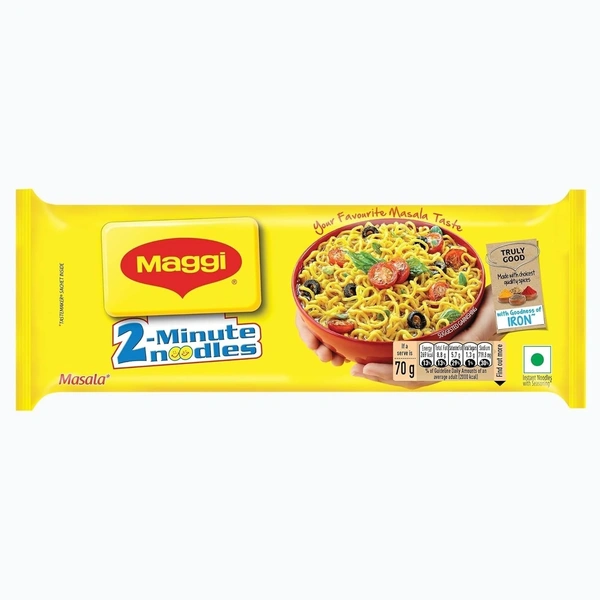

Maggi Masala Noodles
Maida, palm oil, 735mg sodium, and two very different ingredient lists depending on which pack you buy
735mg Sodium Per Serving — 29% of Daily Limit in One Packet
One 62g serving of Maggi Veggie Masala contains 735mg sodium — 29% of the WHO’s 2,000mg daily sodium limit. But most people don’t stop at 62g: a full 70g standard packet delivers ~830mg sodium. Add the cooking water (if salted), side dishes, or a second pack, and you can easily exceed 50–60% of daily sodium from one meal. The noodles contribute some sodium, but the majority comes from the tastemaker sachet — salt, iodised salt, and multiple sodium-containing additives all stack up.
The Two Formulas — Classic Masala vs Veggie Masala
This is the key finding: Maggi produces at least two meaningfully different formulations for the Masala variant. The Veggie Masala (Image 2) is substantially cleaner than the original Classic Masala (Image 3).
🌿 Veggie Masala (Newer Formula)
- Wheat flour (atta) 85.3% — uses atta, not just maida
- 22.5% real mixed spices — coriander, turmeric, cumin, ginger, clove, cardamom, nutmeg
- Real vegetables — onion, carrot, green peas, kasoori methi
- Ferric pyrophosphate (iron fortification)
- No HVP (hydrolysed vegetable protein)
- No flavour enhancer INS 635
- No INS 150d caramel colour
- More transparent, whole-food ingredient list
🔴 Classic Masala (Original Formula)
- Refined wheat flour (Maida) — no atta component
- Hydrolysed groundnut protein (HVP) — umami amplifier
- INS 635 (Disodium 5′-ribonucleotides) — flavour enhancer
- INS 150d (Sulphite Ammonia Caramel) — brown colour
- Flavour enhancer 635 — MSG-adjacent, produces umami
- Maida as both noodle base and tastemaker carrier
- Contains wheat and nut allergens
- May contain milk, mustard, oats, soy
Full Nutrition Facts — Veggie Masala Per 62g Serve
From the official Nestle India nutritional panel (Image 1). One pack = 70g; one serving = 62g (with approximately 1 tablespoon of cooking liquid discarded).
| Nutrient | Per 100g | Per 62g Serve | % GDAP / Serve | What It Means | Verdict |
|---|---|---|---|---|---|
| Energy | 384 kcal | 238 kcal | 12% | A full meal-sized calorie count — 238 kcal from refined carbs and palm oil, with limited satiety value | ⚠ Moderate-high 238 kcal per serve is reasonable but the macros are poor — refined carbs + fat with little protein or fibre. |
| Protein | 8 g | 5 g | 10% | Mostly from wheat gluten — not a complete protein. Falls short of what a real meal should provide | ⚠ Low for a meal 5g protein in a “meal” is very low. Add an egg or paneer to improve protein quality. |
| Carbohydrate | 57.7 g | 35.8 g | 14% | Predominantly refined starch from Maida — high glycaemic index, rapid blood glucose spike, minimal fibre | ✖ High GI refined carbs Maida has GI ~70–85. No fibre to buffer the glucose rise. |
| Total Sugars | 1.3 g | 0.7 g | — | Low natural sugars — not a sugar concern | ✓ Low Sugar is not the issue with Maggi. |
| Added Sugars | 1.1 g | 0.7 g | 1% | Small amount of added sugar in the tastemaker | ✓ Negligible |
| Total Fat | 13.5 g | 6.4 g | 11% | From palm oil used in noodle frying and tastemaker. Both noodles and the masala contain palm oil | ⚠ Palm oil dominates Palm oil is high in saturated fat. Appears twice — in noodles AND tastemaker. |
| Saturated Fat | 7.6 g | 4.9 g | 24% | 24% of daily saturated fat from one snack-sized meal — driven by the palm oil in fried noodles | ✖ High — 24% DV Nearly a quarter of your daily saturated fat limit in one small pack. |
| Trans Fat | 0.12 g | 0.07 g | — | Very small — no significant concern | ✓ Negligible |
| Sodium | 1137 mg | 735 mg | 29% | The dominant nutritional concern — 29% of daily sodium limit in one small meal. Most from tastemaker salt | ✖ Very high — 29% DV The biggest flag in Maggi. Manage by using less tastemaker or choosing low-sodium cooking. |
| Iron (Ferric pyrophosphate) | — | 4.77mg | ~27% RDA (est.) | Iron fortification added to Veggie Masala formula — a genuine public health positive for India | ✦ Fortification positive Iron deficiency anaemia is common in India. Maggi’s iron fortification is meaningful. |
Every Ingredient Decoded — Noodle Block
Wheat flour (atta) 85.3%, Palm oil, Iodised salt, Thickeners (508, 412), Humectants (451i, 452i), Acidity regulators (501i, 500i).
| Ingredient | Amount | What It Is | Role | Verdict |
|---|---|---|---|---|
| Wheat Flour (Atta) | 85.3% | Whole wheat flour — including the bran and germ fractions. Better nutritional profile than pure maida | Primary structure of the noodle. In Veggie Masala, the use of atta (not just maida) provides more fibre, B vitamins, and minerals than the classic formula | ✦ Better than classic Atta-based noodles have lower GI and more fibre than pure maida. A genuine upgrade in Veggie Masala. |
| Maida (in Classic formula) | Primary ingredient | Refined wheat flour with bran and germ removed — very high GI, minimal fibre, depleted micronutrients | Provides the characteristic smooth, stretchy Maggi noodle texture. Cheaper and more shelf-stable than atta | ✖ Classic formula only Pure maida is nutritionally inferior — high GI, low fibre. The Veggie Masala’s atta substitution is a meaningful improvement. |
| Palm Oil | Significant % | Tropical saturated vegetable fat — used for frying the extruded noodles to achieve the characteristic shelf-stable texture | Frying in palm oil gives the noodles their fast-cook ability — the oil structure pre-cooks and structures the noodle so it reconstitutes quickly in boiling water. Also contributes shelf stability | ⚠ Saturated fat source Palm oil is high in palmitic acid (raises LDL). Appears twice — in noodles AND in the masala tastemaker. Combined contribution drives the 7.6g saturated fat per 100g. |
| INS 508 (Potassium Chloride) | Small % | Potassium salt used as a salt substitute/thickener | Modifies texture and reduces need for sodium chloride. Also a thickening agent | ✓ Safe Reduces sodium while maintaining taste. Positive ingredient. |
| INS 412 (Guar Gum) | Small % | Natural gum from guar beans — food-grade thickener and stabiliser | Improves noodle texture and cohesion during extrusion and drying | ✓ Natural Natural prebiotic fibre. No concerns. |
| INS 451i (Sodium Tripolyphosphate) | Trace | Polyphosphate humectant — retains moisture in the noodle structure | Prevents the dried noodle from becoming too brittle and helps rehydration speed | Acceptable Food-grade phosphate at trace levels. Minor concern about cumulative phosphate intake from highly processed diets — not significant from one pack. |
| INS 452i (Sodium Polyphosphate) | Trace | Similar to 451i — additional moisture retention and texture modifier | Works alongside 451i for optimal noodle texture | Acceptable |
| INS 501i (Potassium Carbonate) | Trace | Alkalinity regulator — makes the dough slightly alkaline | The alkaline environment creates the characteristic chewy, yellow noodle texture — similar to lye water in ramen | ✓ Safe Traditional in Asian noodle making. No concerns at food levels. |
| INS 500i (Sodium Bicarbonate) | Trace | Baking soda — leavening and alkalinity | Works with 501i to adjust dough pH for optimal noodle texture | ✓ Safe |
The Tastemaker — Decoded
The iconic Maggi tastemaker (masala sachet) is where the largest ingredient complexity lies. The Veggie Masala version (Image 2) lists an impressive array of real spices. The classic Masala (Image 3) contains additional controversial additives.
| Ingredient / Category | Amount | What It Is | Verdict |
|---|---|---|---|
| Mixed Spices blend | 22.5% | Roasted spice powder (6.4%) including coriander, turmeric, cumin, aniseed, black pepper, fenugreek, ginger, clove, cardamom, nutmeg | ✦ Genuinely impressive Real whole spices at meaningful concentrations. The spice blend in Veggie Masala is a significant nutritional positive — these spices carry curcumin (turmeric), piperine (pepper), gingerols, and other bioactive compounds. |
| Dehydrated Onion & Garlic | 4.2% + 1% | Dehydrated real onion and garlic powder | ✓ Natural Real vegetables — no synthetic flavour substitutes here. |
| Toasted Onion Flakes | 12.4% | Oven-roasted dehydrated onion slices | ✓ Natural Genuine onion — good contribution. |
| Dehydrated Carrot (8.5%) | 8.5% | Real dried carrot — adds beta carotene and natural sweetness | ✓ Natural |
| Dehydrated Green Peas (8.2%) | 8.2% | Real dried green peas — adds plant protein and fibre | ✓ Natural Adds real vegetable nutrition to the meal. |
| Dehydrated Kasoori Methi (1.4%) | 1.4% | Dried fenugreek leaves — a traditional Indian herb | ✓ Traditional |
| Asafoetida (Hing) | Trace | Ferula resin — traditional digestive spice used across Indian cooking | ✓ Traditional Anti-flatulence and digestive properties. Authentic Maggi flavour contributor. |
| Ferric Pyrophosphate | Small % | Iron fortification — added to meet FSSAI iron-fortified noodle standards | ✦ Fortification — genuine positive Addresses widespread iron deficiency anaemia. A meaningful public health contribution. |
| Palm Oil (in tastemaker) | Small % | Carrier fat for the dry spice mixture — helps the tastemaker disperse evenly in cooking water | ⚠ Second palm oil occurrence Palm oil appears twice — in noodles AND tastemaker. Combined contribution is significant. |
| Ingredient | What It Is | Why It’s Controversial | Verdict |
|---|---|---|---|
| Hydrolysed Groundnut Protein (HVP) | Peanuts processed with acid or enzymes to break down proteins into free amino acids, including glutamic acid — a natural MSG equivalent | HVP is used as an umami amplifier — it makes the tastemaker taste more intensely “meaty” and complex without declaring MSG (monosodium glutamate) on the label. People who avoid MSG for sensory or philosophical reasons may not realise HVP achieves the same effect. Also: groundnut is a declared allergen — relevant for nut allergy sufferers | ⚠ MSG-equivalent Functionally equivalent to MSG but listed differently. Safe for most people. Allergen concern for nut-sensitive individuals. |
| INS 635 (Disodium 5′-Ribonucleotides) | A blend of disodium inosinate (IMP) and disodium guanylate (GMP) — synthetic flavour enhancers produced through fermentation | INS 635 is used alongside HVP for a synergistic umami effect — the combination of glutamates (from HVP) and nucleotides (INS 635) produces an umami intensity far greater than either alone. This is the “addictive” quality that makes Maggi hard to put down. INS 635 is derived from meat or sardines in many countries — in India it may be plant-derived but this is not always disclosed. People following strict vegetarianism should be aware | ⚠ Umami enhancer — vegetarianism concern Safe at food levels. But its presence alongside HVP creates an engineered addictive umami profile. May not be purely vegetarian in all production runs. |
| INS 150d (Sulphite Ammonia Caramel) | Class IV caramel colour made using both sulphite and ammonia compounds in the caramelisation process | Class IV caramel colour (same class as in Coca-Cola) produces 4-methylimidazole (4-MEI) as a byproduct — classified as possibly carcinogenic to humans (Group 2B, IARC). The EU requires label disclosure. FSSAI permits INS 150d in India without specific warnings. The amount in Maggi per serving is far below concerning exposure levels, but daily long-term heavy consumption is less well studied | ⚠ Class IV caramel Same colour class as Coca-Cola. Safe at normal consumption. Not present in the cleaner Veggie Masala formula. |
Maggi vs Other Instant Noodles
| Parameter | Maggi Veggie Masala | Maggi Classic Masala | Yippee Noodles | Top Ramen |
|---|---|---|---|---|
| Noodle base | Atta (85.3%) | Maida | Maida | Maida |
| Sodium/serve (approx.) | 735mg ⚠ | ~800mg ⚠ | ~720mg | ~880mg |
| HVP | None ✓ | Present | Some variants | Some variants |
| INS 635 | None ✓ | Present | Some variants | Present |
| Real spice % | 22.5% | ~13% | ~10% | ~10% |
| Iron fortification | Yes ✦ | Some variants | Some variants | Some variants |
| Real vegetables | Carrot, peas, onion, methi ✦ | Limited | Limited | Minimal |
| Palm oil | ⚠ Twice (noodle + tastemaker) | ⚠ Twice | ⚠ Twice | ⚠ Twice |
The Honest Verdict
The Veggie Masala formula represents a genuinely improved Maggi — atta noodles, 22.5% real spices, real dehydrated vegetables, iron fortification, no HVP, no INS 635, no INS 150d. If you’re going to eat Maggi, the Veggie Masala pack is the meaningfully better choice.
The classic Masala formula is a more industrially engineered product — the HVP + INS 635 combination creates an addictive umami profile but involves undeclared MSG-equivalents and a colour with carcinogenic byproduct concerns at high doses. Neither formula is a healthy everyday meal — the sodium alone (735–830mg per pack) makes it unsuitable as a daily staple for anyone managing blood pressure.
Used occasionally — a quick lunch, a monsoon evening comfort food, a hostel dinner — Maggi Veggie Masala is a completely reasonable choice. Used as a daily meal replacement for children or adults, the sodium, refined carbs, and saturated palm oil become genuine dietary concerns.
👍 What Works (Veggie Masala)
- Atta (85.3%) not just maida — lower GI, more fibre
- 22.5% real mixed spices — turmeric, cumin, coriander, ginger, cloves
- Real dehydrated vegetables — carrot, peas, onion, kasoori methi
- Iron fortification — addresses India’s anaemia prevalence
- No HVP, no INS 635, no INS 150d (vs classic formula)
- Reasonable calorie count (238 kcal/62g serve)
- Affordable, quick, and genuinely tasty
👎 The Concerns (Both Formulas)
- 735mg sodium per 62g serving — 29% of daily limit
- Palm oil appears twice — drives 7.6g saturated fat per 100g
- Very low protein for a meal (5g per serve)
- High GI refined carbs — rapid blood glucose spike, low satiety
- Classic Masala: HVP + INS 635 (engineered addictive umami)
- Classic Masala: INS 150d (Class IV caramel, 4-MEI concerns)
- Multiple phosphate additives (three types) in noodle block
- Not suitable as daily meal for children or hypertensive adults
⚠️ This review is based on ingredient label data and published food science. It is not medical advice. People managing hypertension, cardiovascular disease, or diabetes should limit instant noodle consumption due to high sodium and refined carbohydrate content. Classic Masala contains groundnut — relevant for nut allergy sufferers.