
Jyothy Labs From ₹5,000 Borrowed in Kerala to India’s Trusted FMCG Giant

Introduction
One man, ₹5,000, a kitchen experiment — and a brand that changed Indian laundry forever
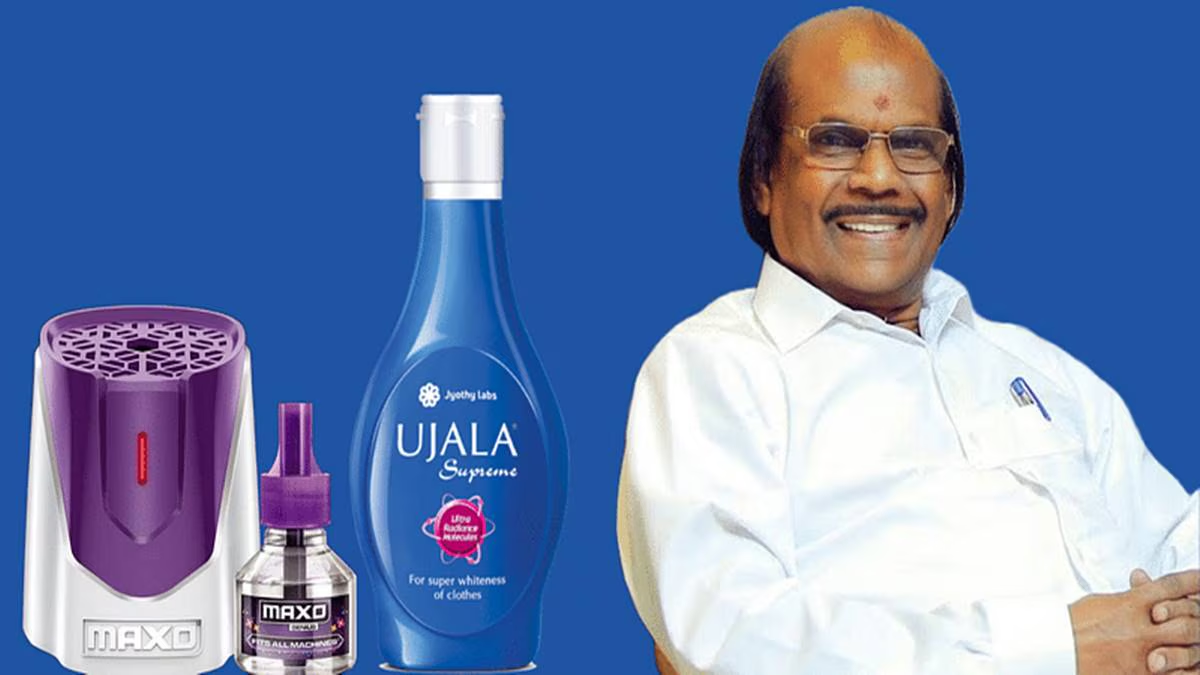
In 1983, a Thrissur accountant with no engineering background and no formal business training borrowed ₹5,000 from his brother, set up a tiny factory on a small portion of family land in Kerala, and began experimenting with purple dyes. His goal: to create a better fabric whitener than anything available in the Indian market at the time. He named the venture Jyothy Laboratories — after his daughter.
That daughter’s name — Jyothy — is today synonymous with India’s most dominant fabric whitener, a brand that holds 84% market share in its category. From that ₹5,000 beginning, Moothedath Panjan Ramachandran built a company that today generates ₹2,893 crore in annual revenue, operates 23 manufacturing plants, distributes through 2.8 million+ retail outlets, and reaches virtually every Indian household through brands like Ujala, Exo, Pril, Maxo, Margo, and Henko.
Ramachandran did not study at IIT or IIM. He was an accountant from Thrissur who read a chemical magazine, tried an experiment in his kitchen, and built one of India’s great consumer brands from the conviction that people deserved better products at honest prices.
— FMCG Sector Analysis, 2026This case study covers the complete Jyothy Labs story — the founder’s unlikely origin, how Ujala went from door-to-door sales by six women to a national icon, the bold Henkel acquisition that put Jyothy in the top-five Indian FMCG league, and the second-generation leadership of MR Jyothy that is charting the company’s next chapter.
The Founder — MP Ramachandran
A B.Com graduate, a curious mind, and a lifelong conviction that innovation beats qualification
Moothedath Panjan Ramachandran was born in Thrissur, Kerala — a commercial and cultural hub in God’s Own Country. He completed his B.Com degree from St. Thomas College, Thrissur and then pursued post-graduation. After completing his studies, he worked as an accountant — a stable, respectable career. But his mind was always elsewhere.
Ramachandran was deeply curious about making things — specifically, about making better things than what the market offered. He was never satisfied with existing fabric whiteners. The indigo-based powders available in early 1980s India left stains on light-coloured fabrics, were difficult to use in the right quantities, and produced inconsistent results. Housewives across India struggled with the same problem every week: how to get white clothes genuinely white again after washing.
He started experimenting at home — in his own kitchen — trying different formulations. The results were consistently unsatisfactory. Then one day, while reading a chemical industry magazine, he found a critical piece of information: purple dyes, used by textile manufacturers to achieve the whitest and brightest colours, could potentially be adapted as a laundry whitener for domestic use.
He spent an entire year experimenting with purple dye formulations. Eventually, he got it right. The product that emerged — a liquid fabric whitener based on optical brightening agents — was cleaner, easier to use, and more effective than anything on the Indian market. In 1983, he borrowed ₹5,000 from his brother, set up a small factory on family land, and gave his creation a name: Ujala — meaning “brightness” in Hindi — and named the company after his daughter.
Birth of Ujala — The Purple Dye Discovery
How six women selling door-to-door built India’s #1 fabric whitener
Ujala Supreme Liquid Fabric Whitener was, from the very beginning, a product built on genuine insight rather than marketing. The existing market was dominated by indigo-based powder whiteners. Ramachandran’s liquid formulation offered three clear advantages: no staining on fabric, very small quantities needed per wash (a few drops per bucket), and consistently brighter results. In a country where laundry is a daily ritual for most families, these advantages were immediately perceptible to any housewife who tried it.
Ramachandran had no advertising budget, no retail relationships, and no distributor network. His initial sales force consisted of six women who went door-to-door across Thrissur, demonstrating Ujala directly to homemakers. The product sold itself. Word spread through neighbourhoods organically. This grassroots approach built genuine brand loyalty that expensive advertising could never have created.
Ujala was initially sold in south India. Its success in Kerala gave Ramachandran the confidence to expand. In 1992, Jyothy Labs set up its first manufacturing plant in Chennai to scale production. By 1997, Ujala Supreme had expanded across all of India and become a household name in the fabric care category. The brand’s dominance grew consistently — today, Ujala Supreme holds 84% market share in the fabric whitener segment in India.
The Ujala case is one of the most studied examples of category creation in Indian FMCG: a product that did not simply take market share from competitors, but instead defined and dominated an entirely new sub-category of fabric care.
Ujala didn’t just beat competitors. It created a category — and then owned 84% of it for decades. That is the definition of category leadership.
— FMCG Category Analysis, 2024Growth Strategy — Test, Then Scale
The Jyothy Labs formula that has worked for four decades
Jyothy Labs has one distinctive and consistently applied go-to-market strategy: launch in one state or region, study consumer behaviour carefully, refine the product, and only then expand nationally. This approach — disciplined, patient, data-driven — stands in sharp contrast to the launch-big, spend-heavy approach of FMCG multinationals.
- Phase 1 — Regional Launch: Introduce the product in one state (typically South India where Jyothy’s roots are strong). Price affordably, distribute directly, listen to consumers.
- Phase 2 — Consumer Study: Observe actual usage patterns, complaint patterns, repeat purchase behaviour. Don’t rush. Refine the product formulation and packaging if needed.
- Phase 3 — National Rollout: Only once the product has proven itself regionally does Jyothy invest in national distribution and advertising. This preserves capital and ensures brand credibility.
- Phase 4 — Brand Building: Use category leadership, not just product features, as the positioning. Ujala means fabric brightness. Margo means neem-based care. These are category-defining associations.
This same playbook was applied to Maxo (initially a strong South India insecticide brand), Exo (dishwash bar launched regionally in the south before going national), and Margo (neem soap). The strategy consistently produces brands with genuine consumer loyalty rather than purchased market share.
Another pillar of the strategy: value pricing. Jyothy’s products are consistently priced for the Indian mass market — not premium, not cheap, but genuinely affordable for the growing middle class and rural India. This accessibility has built scale that premium brands cannot easily replicate.
Brand Portfolio — 6 Power Brands
From a single product company to a ₹2,893 crore multi-brand FMCG house
The Henkel Acquisition — Jyothy Enters the Big League
A ₹60.73 crore bet that multiplied Jyothy’s addressable market 5x overnight
By 2010, Jyothy Labs was a strong but narrowly positioned FMCG company — primarily known for Ujala (fabric whitener), Maxo (insecticides), and Exo (dishwash bar). A three-brand company with deep South Indian roots but limited premium product presence. Then came the defining strategic move of the company’s history.
In March 2011, Jyothy Laboratories acquired a 50.9% controlling stake in Henkel India — the Indian subsidiary of German FMCG multinational Henkel AG & Co KGaA — in a cash deal of ₹60.73 crore. At one stroke, Jyothy gained access to:
- Henko — premium international detergent brand (Matic, Stain Champion variants)
- Pril — Germany’s leading dishwash liquid brand, with strong Indian recognition
- Margo — India’s original neem soap, a heritage personal care brand
- Fa — international deodorant and personal care brand
- Mr. White and Chek — value detergent powders
- Neem — oral care and personal care range
Before acquisition: Jyothy operated in a USD ~1 billion market opportunity. After acquisition: total addressable market expanded to USD ~5 billion — a 5x increase in market opportunity. In one transaction, Jyothy leapt from a regional FMCG player to a top-five Indian FMCG contender, competing directly with HUL, P&G, Godrej Consumer, and ITC. MP Ramachandran described it as “a historic and much-anticipated move.”
The acquisition was not without challenges. Henkel India had been loss-making and required significant turnaround effort — rationalising product lines, rebuilding distribution, and investing in brand relaunch. Jyothy also took on debt to fund the acquisition, which pressured financials in the short term. But by FY2014–15, the turnaround was largely complete. Power brands like Exo, Pril, Henko, and Margo began contributing meaningfully to revenue, and the integrated company had a far stronger competitive position than either entity had independently.
Timeline — Key Milestones
Four decades of building India’s most trusted everyday brands
MR Jyothy — The Second Generation
Harvard, Welingkar, and 15 years in marketing before the founder’s daughter took the helm
The company is named after her. She grew up watching her father build it from nothing. But MR Jyothy (Moothedath Ramachandran Jyothy) did not simply inherit the CEO title — she earned it over 15 years of hands-on business experience within the company she was born to lead.
MR Jyothy holds a postgraduate degree in management from Welingkar Institute of Management, Mumbai and a diploma in Family Managed Business Administration. She subsequently completed the prestigious Owner/President Management Programme at Harvard Business School. She joined Jyothy Labs in 2005–06 as a marketing trainee — not in a leadership role, but in a working role.
The Exo Turnaround — Her Defining Moment
In 2007, she was given responsibility for the Exo dishwashing bar marketing. The brand had potential but was underperforming against better-resourced competitors. The message from her father was clear: prove yourself on Exo first. She did — turning around the brand’s positioning, distribution, and visibility in South India in a way that would serve as the template for Exo’s eventual national expansion. This success opened the door to broader responsibilities.
Over the next 13 years, she drove growth across multiple brands, was the “principal architect behind all product innovations from Jyothy Labs since 2009,” and built the marketing and distribution capabilities that powered the company’s post-Henkel growth. She was appointed Managing Director on 1 April 2020 — unanimously, by the board.
MR Jyothy has won the ‘Woman Entrepreneur of the Year’ from Zee Business, been voted among the 50 Most Influential Women in Indian Media, received the Impacts 50 Most Influential Women award, the Emerging Kerala Business Conclave Women Entrepreneurship Excellence Award, and the World Federation of Marketing Award — the third such award Jyothy Labs has received from that body.
Under her leadership, Jyothy Labs has focused on expanding the personal care segment (targeting 15–20% of revenue vs 10% today), investing in digital marketing and e-commerce, and pursuing the next revenue milestone of ₹5,000 crore. She has stated publicly this target will not take another five years.
SWOT Analysis
Where Jyothy Labs stands in 2026
- Ujala Supreme: 84% market share — near-monopoly in fabric whitener
- Zero debt company — fully funded from operations, no interest burden
- 23 manufacturing plants, 2.8M+ retail outlets across India
- Strong promoter holding (62.9%) — aligned, committed leadership
- Revenue CAGR 10.8% over 5 years; PAT CAGR 18.1% over 5 years
- EBITDA margin 17.4% — stable and improving since FY22
- Test-then-scale strategy produces genuine brand loyalty, not paid share
- Revenue CAGR of 10.7% over 5 years — below category leaders like HUL
- Over-dependence on Ujala (42% revenue) — single brand concentration risk
- Premium segment thin — Henko faces stiff competition from Ariel, Surf Excel
- Personal care still only ~10% of revenue despite years of effort
- Debtor days increasing (27.4 → 35.2 days) — receivables management
- Limited global presence — only 2.6% exports, Bangladesh JV modest
- Personal care expansion: target 15–20% of revenue (currently 10%)
- ₹5,000 crore revenue target — next milestone, strong growth runway
- Premiumisation: growing Indian middle class upgrading to branded FMCG
- E-commerce and quick commerce: significant digital distribution untapped
- Rural India expansion — under-penetrated markets for Maxo, Exo, Margo
- Ujala fabric conditioner (Young & Fresh) — new sub-category creation
- Inorganic growth: cash on books ready for strategic brand acquisitions
- HUL, P&G dominant in premium and mass — intense competition across categories
- Raw material price volatility (petrochemicals, surfactants) impacts margins
- New-age D2C brands threatening personal care and dish wash categories
- Ujala category itself faces slow growth — fabric whitener market maturing
- Mkt cap down ~40% in 1 year — investor confidence needs rebuilding
- Soft consumer demand environment in FY25 pressuring volume growth
Financial Performance
From ₹1,927 crore (FY21) to ₹2,893 crore (FY25) — steady, debt-free growth
| Year | Revenue (Cr) | Net Profit (Cr) | EBITDA % | Growth | Bar |
|---|---|---|---|---|---|
| FY21 | ₹1,927 | ₹159 | ~13% | Base year | |
| FY22 | ₹2,171 | ₹240 | ~14% | +12.7% | |
| FY23 | ₹2,400 | ₹370 | ~15% | +10.5% | |
| FY24 | ₹2,810 | ₹369 | 17.4% | +17.1% | |
| FY25 | ₹2,893 | ₹343 | 17.4% | +3.3% |
Revenue Mix by Segment — FY25
| Segment | Key Brands | % of Revenue | Revenue (est.) | Market Position |
|---|---|---|---|---|
| Fabric Care | Ujala, Henko, Mr. White | ~42% | ~₹1,215 Cr | #1 (Ujala: 84% MS) |
| Dishwashing | Exo, Pril | ~35% | ~₹1,013 Cr | #2 India |
| Personal Care | Margo, Neem, Fa, Jovia | ~10% | ~₹289 Cr | Growing |
| Household Insect. | Maxo Coil, Liquid, Cream | ~8.5% | ~₹246 Cr | #2 by volume |
| Laundry Services | Fabric Spa (JFSL) | ~2% | ~₹58 Cr | Premium niche |
| Others / Exports | Various | ~2.5% | ~₹72 Cr | Bangladesh JV (75%) |
Jyothy Labs is a zero-debt company — a rare distinction in Indian FMCG. Cash and equivalents stood at ₹84+ crore; reserves at ₹1,770+ crore as of FY24. Current ratio 2.37. Dividend payout ratio ~35–46%. ROE 20.42%. The company is actively looking for strategic acquisitions to deploy its cash balance, particularly in personal care and dishwashing categories.
Distribution & Market Reach
The invisible backbone that makes Jyothy’s brands available in every kitchen and bathroom
An FMCG brand’s true competitive advantage is not its product formulation — it is the ability to get that product onto the shelf nearest to the consumer, consistently, at the right price. Jyothy Labs has built one of India’s most extensive FMCG distribution networks over four decades:
The 23 manufacturing plants are strategically located across India to minimise logistics costs and ensure supply chain resilience. The direct reach of 1.2 million outlets means Jyothy has sales staff visiting these stores regularly — ensuring product placement, feedback, and freshness. The remaining 1.6 million outlets are covered through the 9,900+ channel partner network.
Importantly, Jyothy reaches rural India effectively — a capability that many premium FMCG brands struggle with. The company’s affordable pricing and regional distribution depth means its brands are available not just in urban supermarkets but in village kirana stores across the country. This rural penetration is a critical competitive moat.
The company is also building its e-commerce and quick commerce presence — a channel where it has historically been underweighted relative to its offline dominance, but which is becoming increasingly important as urban Indian consumers shift their grocery shopping online.
Key Takeaways
What Jyothy Labs teaches about building enduring Indian consumer brands
Frequently Asked Questions
Everything people ask about Jyothy Labs, Ujala, and the founder’s story
Moothedath Panjan Ramachandran was a B.Com graduate from Thrissur, Kerala, working as an accountant. He became frustrated with existing fabric whiteners — indigo-based powders that stained clothes and produced inconsistent results. He read in a chemical industry magazine that purple dyes could be used to achieve the whitest, brightest textile colours. He spent a year experimenting with purple dye formulations in his own kitchen before getting the right result. In 1983, he borrowed ₹5,000 from his brother, set up a temporary factory on family land in Thrissur, and started manufacturing Ujala Supreme Liquid Fabric Whitener. He named the company Jyothy Laboratories after his daughter Jyothy.
Ujala Supreme created and then dominated the liquid fabric whitener category for three key reasons. First, it solved a genuine consumer problem that existing products (indigo powder whiteners) failed to solve — consistent brightening without staining. Second, Jyothy built genuine distribution depth, starting door-to-door in Kerala and methodically expanding to every corner of India over 40 years. Third, the brand became the category name itself — like Xerox for photocopying or Vaseline for petroleum jelly. In fabric whitening, consumers ask for “Ujala” not “liquid whitener.” At 84% market share, Ujala is one of the highest single-brand market shares in any fast-moving consumer goods category in India.
In March 2011, Jyothy Laboratories acquired a 50.9% controlling stake in Henkel India — the Indian subsidiary of German multinational Henkel AG — for ₹60.73 crore. Henkel India owned internationally recognised brands including Henko (detergent), Pril (dishwash liquid), Margo (neem soap), Fa (deodorant), and Mr. White (value detergent). The acquisition was transformative: Jyothy’s addressable market grew from roughly USD 1 billion to USD 5 billion — a 5x increase. It moved Jyothy from a three-brand regional FMCG company to a top-five Indian FMCG player competing directly with HUL, P&G, ITC, and Godrej Consumer. The acquired brands were initially loss-making but were turned around by FY2014–15 and now form a significant part of Jyothy’s revenue.
MR Jyothy is the daughter of founder MP Ramachandran and became Managing Director of Jyothy Labs on 1 April 2020. She holds an MBA from Welingkar Institute and completed the Owner/President Management Programme at Harvard Business School. She joined the company in 2005–06 as a marketing trainee and built her credentials over 15 years — most notably by turning around the Exo dishwash bar brand in South India, which became a template for the brand’s national expansion. She has been described as the “principal architect behind all product innovations from Jyothy Labs since 2009.” Under her MD tenure, revenue has grown from ~₹1,700 crore to ₹2,893 crore, and she has set a target of ₹5,000 crore. She has won multiple industry awards including Woman Entrepreneur of the Year and World Federation of Marketing recognition.
In FY25 (year ending March 2026), Jyothy Labs reported revenue of ₹2,893 crore (up 3.3% YoY), net profit of ₹343 crore (largely stable), and an EBITDA margin of 17.4%. The company carries zero net debt — a rare distinction in the FMCG sector — with reserves of ₹1,770+ crore. Revenue CAGR over 5 years is 10.8%; net profit CAGR over 5 years is 18.1%. The company pays regular dividends with a payout ratio of approximately 35–46%. The market capitalisation as of early 2026 is approximately ₹8,000–9,000 crore, though the stock fell ~40% in the past year amid soft FMCG demand conditions and sector-wide re-rating.
Jyothy Labs operates six power brands: (1) Ujala — 84% market share in fabric whitener, India’s #1; (2) Exo and Pril — India’s #2 dishwash bar and dishwash liquid, together ~35% of revenue; (3) Margo — India’s original neem-based soap, with strong consumer recall; (4) Maxo — India’s #2 mosquito repellent by volume with 23.8% market share in coils; (5) Henko — premium international detergent (Matic, front-load) targeting urban premium consumers; (6) Mr. White and More Light — value detergent powders with 22.9% market share in Kerala. The company’s products are sold through 2.8 million+ retail outlets across India.
Business Case Study — 2026 Edition
Sources: Jyothy Labs Official Website · Business Standard FY25 Results · Screener.in · Equitymaster FY25 Analysis ·
YourStory · DNA India · Indiaone Finance · CompoundingVoyage · ValuePickr · Official Annual Reports
jyothylabs.com
· Educational and research purposes only.