
Ola Electric India’s Biggest EV Dream — And Its Painful Reality Check

Introduction
From India’s most exciting EV launch to its most instructive failure
Imagine a scooter with 180+ km range, a 7-inch touchscreen dashboard, reverse mode, keyless entry, OTA software updates, cruise control, and multiple riding modes — all at a price point that made competitors look expensive. Now imagine 1 lakh people booking it within 14 hours of pre-booking opening.
This was Ola Electric’s Ola S1 in August 2021. The company’s founder was being called India’s Elon Musk. The 500-acre Giga Factory in Tamil Nadu was hailed as Asia’s largest EV manufacturing facility. Bhavish Aggarwal spoke of changing India’s transportation future. Investors poured in. The valuation hit $3 billion by 2022. The IPO in August 2024 raised ₹5,275 crore at ₹76 per share.
Then the scooters reached people’s driveways. The fires began. The displays froze. The reverse mode triggered at full speed, injuring a senior citizen in Delhi. Service centres couldn’t cope. Scooters queued for months. A comedian’s tweet went viral. 10,000 complaints landed with the Central Consumer Protection Authority. The CEO got an arrest warrant from a consumer court in Goa. By early 2026, the stock had fallen 80% from its all-time high and Emkay Global raised survival doubts.
Ola’s fall is not the story of a bad product. It is the story of a great idea rushed to market — and of what happens when a company prioritises hype over honesty and sales over service.
— EV Industry Analysis, 2026This case study covers every chapter of this story — using real data, court records, financial filings, and documented incidents. Nothing is exaggerated. Nothing is left out.
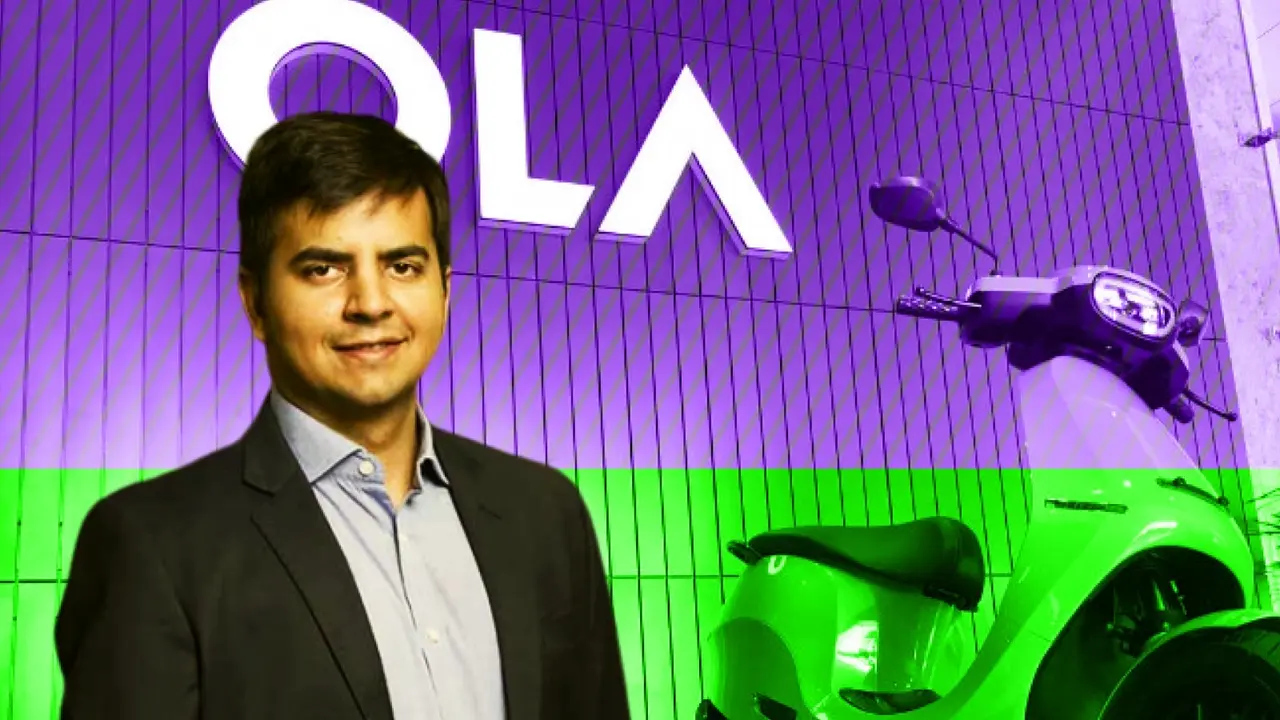
Bhavish Aggarwal — The Founder
The Punjab boy who wanted to build India’s most ambitious tech company
Bhavish Aggarwal was born in Ludhiana, Punjab. He studied Computer Science at IIT Bombay, graduating with top marks. After college, he joined Microsoft Research as an analyst — but left within two years. He was not built for institutional life.
In 2011, a frustrating cab experience became the founding moment of a company: a driver refused to go to his destination, charging extra and behaving unprofessionally. Bhavish thought: why not build a scalable, reliable, app-based cab service for India? Along with co-founder Ankit Bhati, he launched OlaCabs in December 2010 when he was just 25 years old.
His core quality — an ability to build large-scale narratives that attracted capital, talent, and customers — was both his greatest strength and ultimately a major contributing factor to Ola Electric’s problems. When narrative runs ahead of operational reality, eventually reality wins.
Ola Cabs — The Origin & The Cash Burn
Growth at all costs — and the investors who paid for it
Ola Cabs launched in December 2010 in Bengaluru on a growth-first, profit-later philosophy. The strategy: make the service so cheap and available that it became indispensable, then monetise. Reliance Jio had done this with data. For Ola, it proved far more complicated.
To acquire customers: rides at ₹4 per kilometre, heavy discounts, free rides, vouchers. To acquire drivers: guaranteed salaries, high incentives. To grow the fleet: generous terms to car owners. The result: explosive growth to become India’s largest ride-hailing service — but at devastating financial cost.
In FY 2016–17, Ola’s revenue grew from ₹501 crore to ₹10,178 crore. But operating losses also grew from ₹2,820 crore to ₹3,731 crore. For every ₹1 earned, Ola spent ₹3.40. Cash burn in FY17: ₹411 crore. The money was investor capital — not Ola’s own.
When Uber entered India in 2013 with the identical model, a brutal price war began. Both companies burned investor money competing on cheap rides and driver incentives. SoftBank Group, which had invested in Ola from 2014, grew alarmed. It invested in Uber too (2016) and attempted to broker a merger between Ola and Uber India. Both companies refused. The war continued.
Bhavish’s response to sustained losses was diversification: Ola Pay (payments), Ola Dash (grocery delivery), acquisition of Foodpanda India (food delivery). Each entered a crowded market. Each failed to compete with Google Pay, Zepto, Swiggy, and Zomato. Each burned more investor capital. None survived independently.
The key pattern: Bhavish’s businesses ran on investor-funded growth, not organic profitability. By the time Ola Electric was conceived, there was enormous pressure to find a business that could justify the capital already deployed — and attract fresh capital to repay earlier investors.
The EV Pivot — Ola Electric Is Born
From electrifying a cab fleet to building Asia’s largest EV factory
In 2017, Bhavish incorporated Ola Electric as a subsidiary of Ola Cabs, initially to convert Ola’s cab fleet to electric. In 2018 he announced: by 2022, he would add 10 lakh EVs to Ola’s fleet. In 2019, he restructured Ola Electric as a separate company — buying out most shares from Ola Cabs — so it could raise its own funding independently and carry losses off Ola Cabs’ balance sheet.
The Hype Machine — S1 Launch & 1 Lakh Bookings
How Bhavish sold India’s biggest EV dream in 14 hours
Bhavish Aggarwal understood one thing better than most Indian founders: narrative is a product. The Ola S1 launch was timed to Independence Day (15 August 2021), wrapped in the language of Indian technological self-reliance, and positioned as India’s answer to Tesla. The product itself was based on Dutch startup Etergo’s App Scooter — which had already proven these features in European markets.
The pre-booking was designed for maximum FOMO: ₹499 token amount, fully online, limited slots. Within 14 hours, over 1 lakh people had booked — the biggest ever pre-booking day in Indian two-wheeler history. The energy was genuine. The product looked extraordinary.
What Bhavish did not tell the public: Etergo was acquired in 2020, and Ola had given itself just 18 months to adapt a European scooter for Indian roads, Indian weather, Indian traffic conditions, and Indian charging infrastructure before launch. Industry veterans said the minimum required time was 3–4 years.
Bhavish showed India not a finished product — but a promise. And 1 lakh people paid ₹499 each to believe in it. That is how compelling the narrative was.
— Consumer Technology Analysis, 2026Features Promised vs Reality Delivered
India’s scooter iPhone — on paper
The honest assessment: Ola promised features that existed in Europe in good conditions without adequately testing them for sub-zero to 55°C temperatures, monsoon rain, unpaved roads, and the specific riding patterns of Indian commuters. The gap between promise and delivery created thousands of disappointed, then angry, then legally active customers.
When the Dream Broke Down
The 18-month fatal shortcut — and its consequences on Indian roads
The core error was taking an Etergo App Scooter designed for European conditions and launching it in India within 18 months of acquisition — without sufficient re-engineering and localisation. Europe: smooth roads, mild temperatures, lower daily distances, established charging grids. India: potholes, dust, monsoons, 45°C+ summers, power fluctuations.
The Complete Failure Log
- Software crashes and display freezes: The 7-inch touchscreen — the product’s hero feature — froze, rebooted spontaneously, and in many cases stopped working entirely mid-ride. Ola’s own software was not adequately tested for Indian heat and usage patterns.
- Range shortfall: Real-world range fell well below the 180+ km claim in hot weather, carrying two passengers, or on Indian traffic conditions with frequent starts and stops.
- Reverse mode malfunction: Multiple units engaged reverse at full throttle speed rather than the intended crawling pace. A senior citizen in Delhi suffered serious injuries. This went national.
- Bluetooth and navigation failures: Core connected features — Ola’s premium selling points — proved unreliable. Navigation dropped. Music connectivity failed.
- Battery thermal incidents — fires: Multiple scooters caught fire spontaneously. A CCTV video of one such fire went viral in March 2022. Battery thermal management had not been adequately tested for Indian heat conditions.
- No charging infrastructure: TVS and Mahindra had already tied up with petrol pumps to install fast chargers. Ola had not. Its proprietary home charger kit was cumbersome and not widely compatible.
- Service centre desert: By April 2024, only 430 active service centres nationwide for 3.5 lakh+ registered scooters — roughly one service centre per 815 scooters. Wait times stretched to months.
In 2022, Ola Electric recalled 1,441 scooter units — the first major recall in India’s modern EV history. This was reported nationally and permanently attached the word “defective” to the brand. The recall came after multiple fire incidents, the reverse-gear injury, and complaints that could no longer be dismissed.
Fires, Complaints, Courts & the CEO Arrest Warrant
How consumer protection law caught up with India’s most hyped EV brand
The CCPA Notice — 10,000+ Complaints in One Year
In December 2024, the Central Consumer Protection Authority (CCPA) served Ola Electric a formal notice after receiving over 10,000 complaints between September 2023 and August 2024. Breakdown:
- 10,899 cases — Delayed delivery against promised timelines
- 10,459 cases — False feature promises (advertised features not functioning)
- 3,389 cases — Service delays, waiting months for basic repairs
Ola did not meaningfully improve service after the CCPA notice. State governments began to act directly.
Goa Government Bans Ola Sales — 2025
The Goa government temporarily banned Ola Electric’s vehicle registration and sales in the state after more than 2,000 Ola scooters were stuck in long-pending service queues. Customers who had handed over their vehicles for repair were waiting months with no progress, no communication, and no alternative transportation.
The Kunal Kamra Incident — Reputational Turning Point
In 2024, comedian Kunal Kamra posted a photo on X of dozens of Ola scooters gathering dust outside a Maharashtra showroom waiting for service. He tagged Union Minister Nitin Gadkari asking: “Is there anyone listening to consumers?” Rather than addressing the substance, Bhavish personally attacked Kamra online. This triggered a sustained, high-visibility campaign by Kamra amplifying consumer complaints from across India — generating far more negative press than any news article could have.
Pritesh Chandrakant Ghadi of Goa purchased an Ola S1 Pro (2nd Generation) in August 2023 for ₹1,47,499. The scooter developed motor noise, touchscreen failure, and Bluetooth issues within weeks. He submitted it to an authorised Ola service centre. The scooter disappeared from the service centre. After months of non-response, he approached the District Consumer Disputes Redressal Commission, South Goa. On 20 January 2026 the Commission summoned Bhavish Aggarwal personally. He did not appear on the scheduled 4 February date. The Commission issued a bailable arrest warrant — bail fixed at ₹1,47,499 (the scooter’s exact purchase price) — directing Bengaluru Police to produce him on 23 February 2026. The Bombay High Court later stayed the warrant, observing the Commission had exceeded its jurisdiction. The underlying dispute remained unresolved. The reputational damage was permanent.
LG Energy Solution Battery Theft Allegation
In October 2025, when Ola launched Ola Shakti (a home lithium battery backup system), South Korean media reported allegations that Ola had stolen proprietary pouch cell battery technology from LG Energy Solution via a former LG executive. Ola denied all allegations as “misleading and baseless,” saying foreign competitors were nervous about Indian innovation. No Indian court had issued any ruling on this matter as of 2026 — but the allegation damaged Ola’s global credibility. The Ola Shakti product itself used only 1.16% of its factory capacity in its first three operating months.
SWOT Analysis
Where Ola Electric actually stands in 2026
- 10 lakh+ cumulative EV sales since launch — scale achieved
- 500-acre Giga Factory — Asia’s largest 2W EV plant (when utilised)
- Vertically integrated: in-house battery packs, motors, frames
- Strong brand recall — still India’s most recognised EV name
- R&D pipeline: Gen3 S1, Roadster motorcycle series
- ₹2,823 crore unused IPO proceeds (as of March 2025)
- Project Lakshya: EBITDA break-even target at 25,000 units/month
- Net loss ₹2,276 Cr FY25 — 43.7% more than FY24
- Market share: 52% (Apr 2024) → 6% (early 2026)
- Revenue –55% YoY in Q3 FY26 (₹470 Cr vs ₹1,045 Cr)
- Product reliability perception permanently damaged
- 10,000+ CCPA complaints — after-sales service failure at scale
- Entire C-suite resigned in 2024 (CTO, CMO, CPO, CFO, more)
- Promoter stake declining: 34.59% by Dec 2025
- India’s EV 2W market growing 37.5% YoY — massive tailwind
- Roadster motorcycle — new segment, less direct competition
- 6 GWh cell manufacturing — if executed, changes cost structure entirely
- PLI scheme benefits for domestic EV manufacturing
- Gen3 S1 with improved reliability could rebuild trust
- Hyperservice initiative — faster repair turnaround
- TVS iQube, Bajaj Chetak, Ather, Hero Vida all overtaking
- Emkay “survival doubts” downgrade to Sell — ₹20 target
- Net debt ₹670 crore with negative operating cash flows
- Consumer courts, CCPA, LG Energy allegation — ongoing legal risk
- Ola Shakti (home battery) underperforming at 1.16% capacity
- Trust destroyed at scale — years to rebuild, if possible
Financial Deep Dive
From unicorn valuation to Emkay survival doubts — the numbers in full
| Period | Revenue | Net Loss | Market Share | Monthly Units | Bar |
|---|---|---|---|---|---|
| FY22–23 | Growing | ₹1,472 Cr | ~30% | Scaling | |
| FY24 (Peak) | ₹5,010 Cr | ₹1,584 Cr | 52% (Apr peak) | 34,000+ (Feb) | |
| FY25 | ₹4,514 Cr ↓ | ₹2,276 Cr ↑48% | 19–25% | Declining | |
| Q3 FY26 | ₹470 Cr ↓55% | ₹487 Cr (qtr) | ~6% | ~32,000 (qtr) | |
| Feb 2025 | — | — | — | 8,647 units |
Ola Electric listed at ₹76/share in August 2024, raising ₹5,275 crore. By February 2026, shares traded at approximately ₹27–28 — 64% below IPO price. From the all-time high, the fall exceeded 80%. Emkay Global downgraded to ‘Sell’ with target ₹20, noting “turnaround would be difficult and prolonged.” Retail IPO subscribers are sitting on 60–65% unrealised losses. Those who bought at post-IPO highs have lost 70–80%.
The Giga Factory Utilisation Problem
The 500-acre Futurefactory in Hosur was designed to produce 10 lakh scooters per year. With monthly sales down to 8,000–10,000 units by early 2026 — a fraction of the factory’s capacity — the asset generates fixed costs far in excess of its productive output. The Ola Shakti home battery venture, designed to use spare factory capacity, operated at just 1.16% of its available plant capacity in its first three months.
Internal Collapse — The Great Exodus
The year Ola’s entire C-suite walked out
While the external crisis was visible to every customer and investor, internal conditions were equally serious. In 2024 alone — the year Ola hit its peak market share and completed its IPO — the following leaders resigned:
- Head of Design
- Chief Technology Officer (CTO)
- Chief Product Officer (CPO)
- Chief Marketing Officer (CMO)
- Chief People Officer
- VP Head of Sales
- Chief Business Officer (CBO)
- Chief Financial Officer (CFO) — both Ola Group and Ola Electric
- Hemant Bakshi, CEO of Ola Cabs
An entire C-suite departing within 12 months of an IPO is not normal attrition. It is an institutional crisis signal of the highest order. Over 1,000 staff were also laid off during this period.
Former employees described mandatory 14-hour workdays, 7 days a week, an authoritarian top-down management style, and a culture of fear where criticism was unwelcome. Two Ola staff members died by suicide. Bhavish denied the characterisations publicly. The pattern of behaviour — personal social media attacks on critics, dismissal of legitimate complaints, resistance to accountability — remained consistent across multiple documented incidents.
Key Takeaways
What every entrepreneur, investor, and consumer must learn from Ola Electric
Frequently Asked Questions
The questions people ask most about Ola Electric’s story
The root cause was a critically compressed timeline. Ola acquired Dutch EV startup Etergo in 2020 and launched the Indian S1 scooter just 18 months later. Etergo’s App Scooter had been designed for European roads, European weather (mild temperatures, smooth surfaces, less extreme conditions) and European riders. Adapting it for Indian conditions — extreme heat up to 55°C, monsoon rain, rough roads, dust, power fluctuations, heavier loads — required minimum 3–4 years of testing, recalibration, and localisation. Bhavish chose 18 months. The result: software crashes, battery thermal failures (fires), range shortfall, and the dangerous reverse-mode malfunction that injured a Delhi senior citizen.
Pritesh Chandrakant Ghadi from Goa bought an Ola S1 Pro for ₹1,47,499 in August 2023. It developed defects within weeks and when submitted for service at an authorised centre, the scooter disappeared. After months of non-response, he filed with the District Consumer Disputes Redressal Commission, South Goa. On 20 January 2026 the Commission ordered Bhavish Aggarwal to appear personally. When he failed to appear on 4 February 2026, the Commission issued a bailable arrest warrant — bail set at ₹1,47,499 — directing Bengaluru Police to produce him by 23 February. The Bombay High Court stayed the warrant, noting the Commission had exceeded its jurisdiction. The underlying dispute over the missing scooter remained unresolved. The episode made international news.
As of early 2026: Revenue in Q3 FY26 was ₹470 crore — down 55% year-on-year from ₹1,045 crore. Net loss for FY25 was ₹2,276 crore — up 43.7% from ₹1,584 crore in FY24. Market share has fallen from 52% (April 2024) to approximately 6% (early 2026). Monthly volumes were around 32,000 units in Q3 FY26, down from 86,775 in Q3 FY24. The stock trades at ~₹27–28, down 64% from its IPO price of ₹76 and 80% from its all-time high. Emkay Global has issued a ‘Sell’ rating with a target of ₹20, citing “survival doubts.” Net debt stands at ₹670 crore. Auditors have flagged going-concern issues due to negative operating cash flows of ₹2,391 crore in FY25.
In 2024 alone, Ola Electric lost its Head of Design, CTO, CPO, CMO, Chief People Officer, VP Head of Sales, CBO, and CFO (for both Ola Group and Ola Electric), plus the CEO of Ola Cabs. Over 1,000 staff were also laid off. Former employees publicly described a toxic work culture: mandatory 14-hour days 7 days a week, an authoritarian management style that discouraged dissent, and a culture where blame flowed downward and credit flowed upward. Two Ola staff members died by suicide during this period. The loss of an entire C-suite within 12 months of an IPO is an institutional crisis of the highest severity.
Recovery is possible but Emkay Global calls it “difficult and prolonged.” For recovery, Ola needs to: (1) stabilise product quality — Gen3 S1 must deliver what it promises; (2) build real service infrastructure — not just announce 3,200 centres, but operationalise them with trained staff and parts availability; (3) achieve EBITDA break-even, which Project Lakshya targets at 25,000 units per month; (4) rebuild consumer trust through consistent performance over 18–24 months; (5) manage its ₹670 crore net debt and negative cash flows before IPO proceeds exhaust. The Roadster motorcycle and Gen3 S1 are the product bets. The window exists — but it is narrow and narrowing.
In 2024, comedian Kunal Kamra posted a photograph on X showing dozens of Ola scooters queued outside a Maharashtra showroom, waiting months for service. He tagged Union Minister Nitin Gadkari and asked whether consumers had any voice. Instead of acknowledging the valid complaint, Bhavish Aggarwal personally attacked Kamra on social media. This was a strategic error: Kamra responded by systematically compiling and sharing consumer complaints from across India, creating a sustained national conversation about Ola’s service failures. The episode is studied as a case of how not to handle legitimate criticism — Bhavish’s personal combativeness turned a manageable PR moment into an extended reputational crisis.
Business Case Study — 2026 Edition
Sources: Ola Electric Q3 FY26 Results · Autocar Professional FY25 Report · Emkay Global Research Note Feb 2026 ·
Business Standard · Inc42 · InsightEV.com · Goodreturns · Moneylife · Times of India · Consumer Court Records (South Goa)
olaelectric.com
· Educational and research purposes only.