
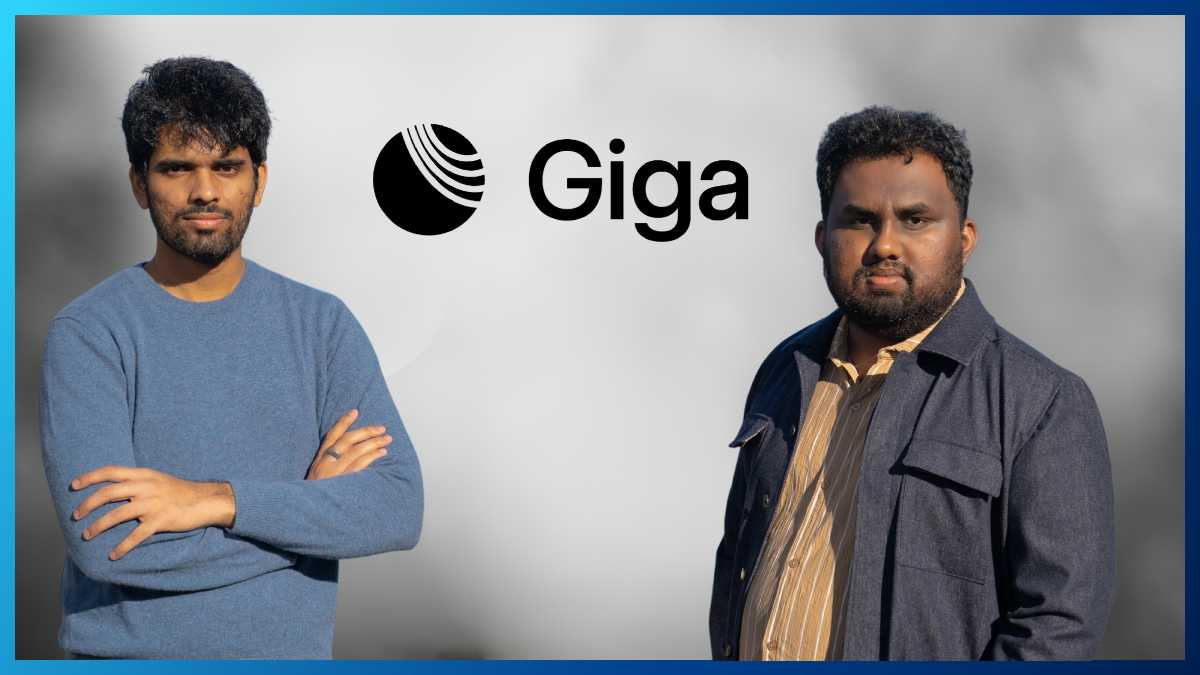
They Said No to ₹5 Crore.
Then Built a $61M AI Startup
in Just 2 Years.
How Varun Vummadi and Esha Manideep — two IIT Kharagpur graduates — rejected over $675,000 in job offers, bootstrapped with Kaggle prize money, cracked Y Combinator, pivoted three times, and built Giga AI into the voice AI company powering DoorDash’s customer support.
The Scene That Started Everything
Picture a hostel room in IIT Kharagpur. Late 2022. Two final-year engineering students — laptops open, textbooks pushed aside. One of them, Varun Vummadi, has just received an offer of $525,000 per year to trade derivatives at a top quant firm in the United States. The same week, Stanford University accepted him for a PhD in LLM optimisation research. His classmate, Esha Manideep Dinne, just received a $150,000 high-frequency trading role offer in India.
Combined, these two students walked away from over $675,000 in annual compensation before either had turned 25. Their families thought it was madness. These were once-in-a-generation financial outcomes for two engineers from non-wealthy backgrounds. And they said no.
Because Varun had been reading Paul Graham essays since he was a teenager. He was convinced — irrationally, as it turned out correctly — that the people who build AI products will own the future far more completely than the people who use AI to price options. Esha’s logic was colder and equally brave: even a failed startup is a better expected lifetime outcome than three safe years.
Two years later, their company Giga AI raised $61 million from Silicon Valley’s most respected investors. DoorDash became their flagship client. Both founders appeared on Forbes 30 Under 30 Asia 2024. And Andhra Pradesh — Varun’s home state — claimed the story as its own.
The Offers They Walked Away From
Before going further, it is worth pausing on exactly what was on the table — because the numbers matter for understanding the magnitude of this decision.
Total value declined: over $675,000 per year. This was a calculated bet on a future that had not yet arrived — made by two engineers who had the technical skill to bet with conviction, not just with hope.
Who Are the Two Founders?
Varun Vummadi — Co-founder & CEO
Varun studied Electrical Engineering at IIT Kharagpur and grew up in Vijayawada, Andhra Pradesh. He arrived at IIT with intellectual restlessness that did not fit comfortably into standard placement funnels. While classmates prepared for consulting and banking roles, Varun was consuming Paul Graham essays, reading about Y Combinator, and thinking about building products. His machine learning depth was real and demonstrable — he competed and won on Kaggle before any investor had written him a cheque. As CEO of Giga, he handles strategy, fundraising, enterprise sales, and the company’s public presence. He was praised publicly by Andhra Pradesh minister Nara Lokesh, who posted his congratulations on X when Giga made headlines.
Esha Manideep Dinne — Co-founder & CTO
Esha studied Computer Science at IIT Kharagpur and ranked 3rd institute-wide with a 9.79 GPA — in one of India’s most academically competitive environments. He interned as a systems engineer at Quadeye Securities, one of India’s leading proprietary trading firms. He led the Math Club at IIT Kharagpur. As CTO, Esha owns the AI architecture, systems design, and engineering that makes Giga’s product function at sub-400ms latency at enterprise scale. His YC profile note: “Off work, I watch anime and read novels.”
The IIT Dorm Room Idea — 2023
The company started in 2023 inside a college hostel room in Kharagpur. The original idea was not what Giga is today. The first iteration was an on-premise large language model stack for enterprises: “What if companies could fine-tune and run Llama2-level models privately, faster and cheaper than OpenAI?”
Technically it was strong — reportedly 3× faster and 70% cheaper for certain fine-tuned use cases. But a structural problem emerged: GPT-4 kept getting cheaper and smarter every month. Foundation model providers continuously improved their APIs and cut prices. The business model had a ceiling it could not grow through.
Varun and Esha faced the question every serious founder eventually faces: not “how do we execute this plan” but “is this the right plan to execute?”
The Kaggle Hustle — ₹80 Lakh From Competitions
Before any investor wrote a cheque — before Y Combinator, before San Francisco — there was a laptop, a Kaggle account, and a specific kind of hustle most people do not think of as a funding strategy.
Kaggle is the global data science competition platform where companies post real-world problems and award prize money to the best solution. Varun competed with enough consistency to earn over $100,000 (approximately ₹80–83 lakh) in prize money. This was the runway that funded Giga’s earliest months — earned in public, in merit-based competition, against the world’s best data scientists.
This is also one of the clearest signals of what kind of founders they are: they competed for resources before they had a product, and they won.
Using Kaggle competitions as a bootstrapping mechanism is genuinely unusual. It means proving technical credibility publicly — in competitions judged entirely by results, not pitch decks — before approaching any investor. Most early-stage founders raise from friends and family, or bootstrap through consulting. Varun competed his way to early capital.
Y Combinator — The ₹4 Crore Bet
In 2023, Varun and Esha applied to Y Combinator — the accelerator founded in 2005 by Paul Graham, the same person whose essays Varun had been reading since his teens. YC alumni include Airbnb, Dropbox, Reddit, Stripe, and Instacart. Thousands of startups apply every year. Fewer than 1–2% are selected.
Giga was accepted into Y Combinator Summer 2023 (S23). The deal: approximately $500,000 (~₹4 crore) in seed funding for approximately 7% equity. Interestingly, Varun has shared that the original YC application was made with an India edtech idea — not enterprise AI. Halfway through the batch, they pivoted. YC’s culture explicitly encourages this.
Three Pivots: EdTech → On-Prem LLM → Voice AI
India EdTech Idea
Original YC application concept. Rejected internally mid-accelerator when the founders realised where the real pull was.
On-Premise LLM Stack (Giga ML)
Private enterprise LLM infrastructure — 3× faster, 70% cheaper for fine-tuned use cases. Technically strong, commercially capped. GPT-4 kept improving and prices kept falling. The business model had no ceiling to grow through.
Voice AI for Enterprise Customer Support
The question they asked: “Where can we ship AI today, at scale, where people will pay — fast?” Customer support. Massive market. Universally broken. No good AI solution. This became Giga.
Product, Clients & Forbes 30 Under 30 Asia 2024
Enterprise deployments begin. Both founders named in Forbes 30 Under 30 Asia 2024 for AI and enterprise technology.
$61M Series A — DoorDash Deployment Live
Led by Redpoint Ventures. YC and Nexus Venture Partners participate. DoorDash flagship client confirmed. Millions of calls handled monthly.
Pre-Series B — ~$137 Million
Fortune 100 expansion. ~90 employees. Total capital raised exceeds $200 million.
Sitting in a Call Center — The Zepto Visit
One detail in Giga’s story that rarely gets enough attention: before writing a single line of their voice AI system, Varun and Esha flew to India and sat inside Zepto’s call centers. They watched live calls. They observed the exact moment customer frustration peaked. They saw agents juggling policy documents, switching languages mid-call, escalating to supervisors, and managing the kind of multi-layered, emotionally charged conversation that no scripted chatbot had ever successfully handled.
This is the kind of primary research that separates founders who build products people actually use from founders who build impressive demos. What they saw was essentially unchanged from 2009: enterprises receiving millions of calls, chats, and tickets every month — most repetitive, many requiring context, all expensive, none resolved well.
Their internal mantra crystallised from this visit: “Genius within a second.”
How Giga AI Actually Works
Giga is not a chatbot with a voice skin. The platform is built around a unified real-time orchestration layer that simultaneously manages every cognitive task an AI agent needs to perform during a live conversation — all within 400 milliseconds.
DoorDash: The Breakthrough Client
Securing DoorDash as a client was not just a commercial win — it was a proof point at a scale that matters. DoorDash operates across 40+ countries, serving nearly 50 million people per month. Co-founder Andy Fang publicly endorsed Giga’s deployment, stating it delivered measurable improvements including fewer escalations, faster resolution paths, and more efficient workflows.
The use case: when a DoorDash delivery driver cannot complete a delivery, Giga’s system can simultaneously maintain a live voice connection with the driver, call the consumer to verify the address, cross-check policy compliance, and resolve the issue — without a human agent, in under 400 milliseconds.
DoorDash processes roughly 2 billion orders per year. Even a fraction of that as AI-resolved support interactions represents tens of millions of conversations. Giga’s deployment is not a pilot — it is production infrastructure running at real-world enterprise scale.
$61 Million Series A — November 2025
On November 5, 2025 — exactly two years after the company was founded — Giga announced its $61 million Series A. The round was led by Redpoint Ventures, an early backer of Netflix, Stripe, Zendesk, and Twilio. Y Combinator doubled down on its earlier bet. Nexus Venture Partners also participated. The announcement was covered by Fortune, Yahoo Finance, and major technology publications within 24 hours.
The Controversy — Allegations & Blackmail
Success attracts scrutiny. Giga’s arrived with timing that felt orchestrated.
December 2025 — The Allegations: Former employee Jarrett Steel posted a viral thread on X claiming revenue misrepresentation, excessive 12-hour work days, misleading employment terms, and an insensitive cultural remark by a founder.
December 15, 2025 — Escalation: Steel claimed former employees and contractors gave him 70GB of data containing alleged evidence of misconduct.
December 25, 2025 — Giga’s Response: Giga issued a formal statement alleging individuals had illegally stolen proprietary information and were demanding $3 million in cryptocurrency to anonymous accounts in exchange for not publishing it. Giga called it blackmail and initiated legal action. Y Combinator publicly backed Giga and dismissed the claims. The company denied every allegation categorically.
Outcome: In March 2026 — three months after the controversy peaked — Giga closed a Pre-B round approaching $137 million. Institutional investors were not deterred.
Full Funding Journey — Data Table
| Date | Round | Amount | Lead Investor | Key Milestone |
|---|---|---|---|---|
| 2022–23 | Kaggle Prize | ~₹80L ($100K) | — | Self-funded. Varun wins global data science competitions to build runway. |
| Aug 2023 | YC Seed | ~$500K | Y Combinator | YC S23. 7% equity. India edtech → on-prem LLM → voice AI pivot begins. |
| Oct 2023 | Seed Extension | $3.6M | Nexus Venture Partners | Three months old. Voice AI direction confirmed. Product dev accelerates. |
| Nov 5, 2025 | Series A | $61M (₹510Cr+) | Redpoint Ventures | DoorDash client confirmed. Forbes 30U30 Asia 2024. Millions of calls/month. |
| Mar 2026 | Pre-Series B | ~$137M | TBA | Fortune 100 expansion. ~90 employees. Total raised: $200M+ |
Total funding raised as of March 2026: over $200 million — in under 3 years from founding. Most Series A companies take 3–5 years to reach this capitalisation level.
The $47.5 Billion Market Opportunity
Voice AI is not a niche. It is a market growing at a rate that reflects how fundamental spoken language is to every business–customer relationship.
Giga competes with ElevenLabs, Vapi, Retell AI, and Decagon on the startup side. The differentiator Giga is building is not just technical performance but enterprise deployability — policy-grounded responses, compliance-safe outputs, and a “live in two weeks” promise that directly attacks every competitor’s deployment friction. Enterprise software that takes six months to implement is the norm. Two weeks is a direct, aggressive attack on that norm.
Pre-B Round: ~$137 Million — March 2026
Three months after the Series A closed — and three months after the controversy peaked — Giga completed a Pre-Series B round approaching $137 million. The company has ~90 employees, offices at 355 Bryant Street in San Francisco, and is actively pursuing Fortune 100 enterprises across e-commerce, financial services, healthcare, and telecommunications.
Varun and Esha are, as of this writing, in their mid-twenties. They have raised more capital in two and a half years than most founders raise in a career — while handling public allegations, online racism, and the competitive pressure of building in the most crowded segment of the most competitive technology cycle since mobile.
People Also Ask — Giga AI FAQ
Verified answers to the most searched questions about Giga AI.
The Verdict — What This Story Actually Teaches
The Giga AI story is already extraordinary by any reasonable measure. But the lesson it carries is not simply “reject big job offers and build a startup.” That would be a dangerous misreading. The lesson is more precise — and more applicable.
Varun and Esha did not bet on a dream. They bet on a specific combination of factors they could see clearly: a massive, universally underserved problem; a timing window they understood because they had studied the technology closely; a skill set they had proved publicly through Kaggle before proving it privately to investors; and a market signal they validated by sitting in an actual call center rather than hypothesising on a whiteboard.
They pivoted three times — not from weakness, but from clear-eyed analysis. They bootstrapped before raising. They chose San Francisco over Bangalore to be closer to enterprise buyers. They handled a public controversy without disrupting their fundraising because they had real product metrics and real clients to show.
The IIT Kharagpur dorm room. The Kaggle all-nighters. The Zepto call center visit. The Y Combinator S23 acceptance. The DoorDash deployment at sub-400ms latency. The Forbes 30 Under 30 Asia 2024 recognition. The $200 million raised before either founder turned 27.
This is what it looks like when two people with the right skills, the right timing, and the right audacity decide that the future is not something that happens to them. It is something they will build.
- Fortune Magazine — Giga AI Series A Coverage (Nov 2025)
- Y Combinator — Giga AI Company Profile
- Globe Newswire — Official Series A Press Release
- Giga AI Official Website — giga.ai
- IIT KGP Alumni Foundation — Founder profiles
- Forbes 30 Under 30 Asia 2024 — AI & Enterprise Technology category