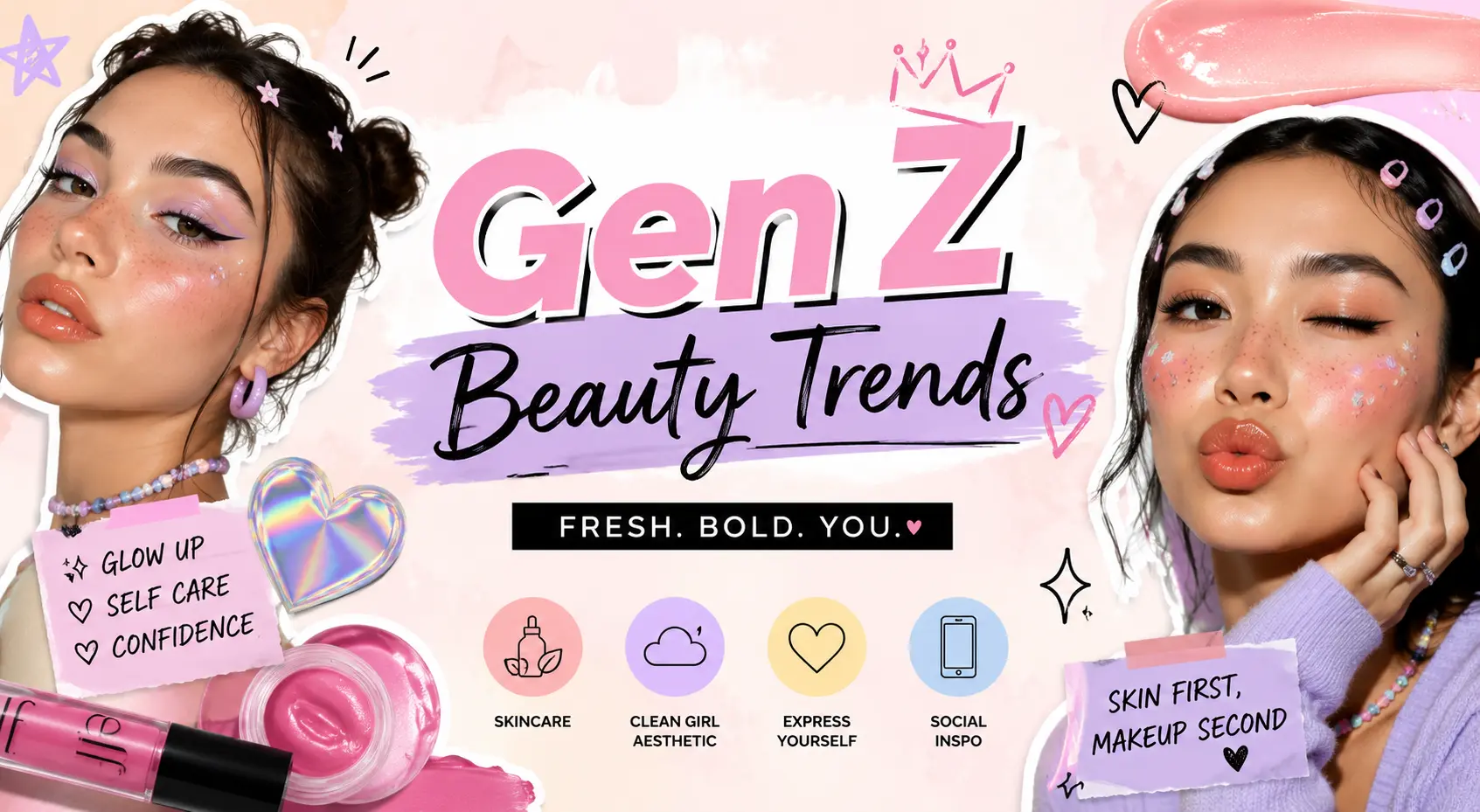

Gen Z Beauty Trends 2026:
The Complete Guide
Glass skin, skinimalism, clean formulas, micro-luxuries, and wellness-first rituals — a deep, honest look at how Gen Z is approaching beauty in 2026 and what’s really driving every single choice.
Gen Z beauty in 2026 is defined by merging skincare and wellness into one intentional daily ritual. The biggest trends are glass skin (luminous, deeply hydrated, dewy finish), skinimalism (minimal daily makeup, maximum skin investment), clean and sustainable beauty (ingredient transparency, cruelty-free, eco-conscious packaging), micro-luxury (selective splurging on a few quality products), and bold expressive makeup for creative occasions.
The overarching shift: beauty is no longer about covering up. It’s about taking care — and letting that care show through.
What’s Really Driving Gen Z Beauty Choices in 2026?
Gen Z didn’t just grow up with smartphones — they grew up with skincare tutorials, ingredient breakdowns, and beauty creator communities that ran parallel to their entire adolescence. By the time they started buying their own products, they already had years of education behind them. They knew what niacinamide was before they could legally vote.
That background creates a fundamentally different beauty consumer — one who reads ingredient lists, cross-references brand claims with dermatologists on TikTok, and cares about the factory where the product was made almost as much as whether it actually works. In 2026, that consumer sits at the centre of gravity for the global beauty industry. And every brand has had to reckon with it.
Several specific forces are shaping not just what Gen Z buys, but how they think about beauty as a whole.
The Great Skin-First Pivot
For a generation that grew up watching heavy contouring tutorials on YouTube, the shift to skincare-first thinking is striking. Gen Z has largely concluded that the best makeup is great skin — and has invested accordingly. Skincare spend has grown steadily while makeup spend has become more selective and intentional. The logic is simple: fix the canvas and you need far less on top of it.
Authenticity Over Aspiration
Traditional beauty advertising sold aspiration — the airbrushed, perfectly lit, professionally retouched version of someone — and asked you to buy your way there. Gen Z doesn’t buy this story. They’re drawn to creators who show real skin texture, real dark circles, real pores, and real trial-and-error with products. Beauty brands still leaning on heavily produced aspiration campaigns are losing ground fast with this audience.
Sustainability Has Become Non-Negotiable
A few years ago, “clean” or “sustainable” was a differentiator. In 2026, for Gen Z, it’s a baseline requirement. Products with excessive plastic packaging, brands with opaque supply chains, formulas full of concerning ingredients — these are increasingly automatic disqualifiers. The sustainability bar keeps rising, and Gen Z is the one raising it.
Beauty as Mental Health
Post-pandemic, Gen Z reframed their beauty routines as acts of self-care rather than social performance. A morning skincare routine isn’t about vanity — it’s a grounding ritual that’s just for them. This wellness lens on beauty has fundamentally changed product categories. Skincare with calming textures, pleasant scents, and sensory application experiences now competes on an emotional dimension alongside its efficacy.
Top 12 Gen Z Beauty Trends of 2026 — Full Breakdown
These aren’t trends plucked from a runway nobody watched. These are styles and rituals genuinely showing up in daily routines, social media feeds, and shopping baskets right now. Each one is explained fully — what it is, why it resonates with Gen Z, and how it plays out in practice.

Glass Skin & the Dewy Finish Obsession
If there is one aesthetic that captures where Gen Z skincare stands in 2026, it is glass skin — that luminous, pore-blurring, almost translucent glow that looks like you have been drinking two litres of water a day and sleeping eight hours every night. Glass skin is the K-beauty import that Gen Z has fully adopted and made unmistakably their own. It is about achieving skin that reflects light rather than absorbs it, with a natural healthy sheen rather than a highlighted-with-product shimmer.
Getting there requires a hydration-forward, multi-step approach: a gentle double cleanse, toner or essence layering, a serum heavy on hyaluronic acid, a lightweight moisturiser, and broad-spectrum SPF. The finish is either left completely bare or enhanced with the thinnest possible skin tint. The goal is always for skin to look like skin — just the very best, most hydrated version of it.
Adjacent aesthetics — cloud skin, boiled-egg skin, milky skin — are all chasing the same underlying goal: natural, healthy, deeply hydrated skin that photographs well in any light without heavy editing. Brands that make this achievable for diverse skin tones and types are consistently winning Gen Z loyalty.
What You Actually Need for Glass Skin
- A gentle, non-stripping double cleanser — oil balm first, mild foam second
- A hydrating toner or essence layered before serums
- A water-based serum with hyaluronic acid and skin-brightening actives
- A light gel or water-cream moisturiser — nothing occlusive or heavy
- Broad-spectrum SPF as the non-negotiable final step before leaving the house
- A face mist for mid-day hydration refresh, especially in air-conditioned environments

Skinimalism: Less Makeup, More Skin
Skinimalism is the word that best describes what Gen Z actually does most mornings: very little. A well-maintained skincare routine, perhaps a light skin tint or BB cream, maybe some mascara and a tinted lip balm — and out the door. The goal is to look like you have great skin, not like you spent 45 minutes covering it up. This is not laziness — it is philosophy. After years of being sold the idea by makeup tutorials that your natural face needed eight products before it was presentable, Gen Z has simply decided that is not true.
Skinimalism has driven real growth in the skin-like makeup category: serum foundations, skin tints, SPF-infused cushion compacts, glossy hydrating lip balms, and tinted moisturisers. Products that enhance rather than mask. Brands still leading with heavy full-coverage formulas marketed as “flawless” are increasingly out of step with where Gen Z daily makeup is heading.

Clean Beauty & Sustainable Formulas
Clean beauty for Gen Z is not just about what is missing from the formula — it is an entire ecosystem of values. A genuinely “clean” product, by 2026 Gen Z standards, carries a transparent ingredient list with no questionable synthetics, cruelty-free testing credentials, ideally vegan formulation, minimal and recyclable or refillable packaging, a traceable supply chain, and brand-level environmental commitments expressed without corporate-speak or greenwashing.
That is a high bar — but the brands genuinely meeting it are building the most loyal Gen Z followings in beauty right now. Ingredient-forward brands, waterless formulas (which dramatically reduce packaging needs), solid format products like shampoo bars and face wash bars, and carbon-transparent operations are all gaining traction. The clean beauty market continues expanding rapidly, and Gen Z is the primary reason why.
What Gen Z specifically avoids: parabens, sulphates in cleansers, synthetic fragrance (both a common irritant and a sustainability concern), phthalates, and microplastic beads in exfoliants. Many also pay attention to palm oil sourcing, mica mining ethics, and the environmental safety of chemical SPF filters — a level of supply-chain scrutiny that would have seemed niche just five years ago.
Micro-Luxury Beauty
Gen Z is not avoiding luxury beauty — they are being extremely selective about it. Rather than an entirely high-end routine, they invest in one or two premium products where quality genuinely makes a noticeable difference (a prestige serum, a luxury lip treatment, a niche fragrance) and keep the rest of their routine accessible. This “micro-luxury” approach — also called selective splurging — reflects financial realism combined with genuine appreciation for craft and quality. Mini formats and limited-edition releases play directly into this by offering low-commitment entry points to premium brands.
Sensory & Texture-Forward Skincare
In 2026, skincare is evaluated by how it feels as much as what it does. Whipped textures, melting cleansing balms, cooling jelly moisturisers, silky serum-oils, and bouncy gel-creams answer a growing demand for genuine sensory pleasure in daily routines. The application itself should feel like a small moment of indulgence, not a clinical chore. Brands responding with mousse cleansers, aqua-texture SPFs, and jelly blushes that feel enjoyable to use are differentiating meaningfully. Texture has become a strategy — not an afterthought.
Bold & Expressive Makeup
Skinimalism governs the daily routine, but Gen Z absolutely still uses makeup as a creative, expressive tool for going out, festivals, events, and content creation. Graphic eyeliner in unexpected shapes and colours, blush worn high on the nose bridge and temples, rhinestone and gem-embellished looks, chrome and metallic lids, and bold lip colours all show up regularly. The contrast with everyday skinimalism is part of the point — when makeup is worn with intention, it makes a real statement. Goth and grunge revival aesthetics, gaming-inspired looks, and experimental textures are gaining strong momentum.
SPF as a Daily Non-Negotiable
Gen Z has become the most SPF-committed generation in beauty history. Years of education from dermatologist creators has made sun protection genuinely habitual, not aspirational. The investment logic also clicks naturally: if you are spending money on vitamin C, retinol, and brightening serums, you need SPF or you are actively working against yourself. The best-performing SPFs for Gen Z are lightweight, non-white-casting, hybrid formulas that also deliver skincare benefits. Heavy, pill-under-makeup, or greasy SPFs are being replaced entirely.
AI-Powered Beauty Personalization
51% of beauty consumers now say they are interested in AI-powered shopping tools, and Gen Z leads this interest. From foundation shade finders that use phone cameras to accurately match undertones, to skincare diagnostic tools that analyse concerns from selfies, to personalised routine builders that account for climate and lifestyle — AI is making beauty feel genuinely tailored in a way that generic product pages never could. Brands investing in this technology are reducing returns, increasing purchase confidence, and building relationships with Gen Z that feel personal.
Barrier Repair & Skin Health First
Years of over-exfoliating, over-retinolling, and aggressive actives-stacking have left many Gen Z skins compromised — and the beauty conversation has shifted in response. Barrier repair is now a foundational concept: ceramides, fatty acids, niacinamide, centella asiatica, and beta-glucan are all ingredients known for strengthening the skin’s protective layer. The priority has shifted from “fix every concern as aggressively as possible” to “make sure the skin is healthy enough to handle treatment first.” Gentler, protective routines are replacing the actives-heavy stacks of a few years ago.
Inclusive Beauty as the Standard
Gen Z came of age during the Fenty Beauty moment — the launch that proved 40+ foundation shades was not a niche need but an industry-wide failure. Since then, they have expected inclusivity as a baseline: shade ranges that genuinely work for deep skin tones, formulas that perform equally on oily and dry skin, and marketing that reflects real diversity without tokenism or box-ticking. Brands that launch with limited shade ranges, or who use inclusion as a campaign beat rather than an operational commitment, face swift and vocal public criticism.
Fragrance as Identity
Fragrance has had a major cultural moment with Gen Z — not as a luxury afterthought but as a core identity-building category. PerfumeTok has built enormous communities around scent reviews, layering combinations, and niche house deep-dives. Gen Z approaches fragrance with the same ingredient-literacy they bring to skincare: they understand fragrance families, know the difference between top, middle, and base notes, and actively seek out indie and niche houses. Gourmand scents, transparent skin scents, and non-conventional fragrances are all performing strongly. Having a signature scent nobody else in the room wears is the ultimate expression of individuality.
Dupe Culture & Masstige Beauty
Gen Z is financially savvy and brand-sceptical. They have normalised — even celebrated — finding affordable alternatives to expensive products that perform comparably. Dupe content performs enormously well on TikTok, and brands in the masstige tier (mid-price, quality-forward, with prestige-feeling packaging) are growing faster than either mass or luxury beauty. Masstige skincare brands saw sales jump 14% in a recent reporting period — outperforming both mass and prestige. The Gen Z logic is not “I cannot afford the real thing” — it is “I do not believe the price difference justifies itself.”
“Gen Z doesn’t use beauty to hide who they are. They use it to show up more fully as who they already are.”
Gen Z Skincare in 2026: Routines, Rituals & What Actually Works

The Gen Z skincare shelf in 2026: fewer products, better ingredients, more intention behind every step.
Gen Z skincare in 2026 sits at an interesting inflection point. After years of elaborate multi-step routines and aggressive actives stacking that required a shelf the size of a bathroom cabinet, many Gen Zers have landed somewhere more considered: fewer steps, better-chosen ingredients, and a genuine focus on overall skin health rather than chasing every new trend.
The Gen Z Morning Routine (What Most Actually Do)
- Step 1 — Gentle cleanser: A mild, non-stripping formula. Gel or water-gel texture preferred. The skin should never feel tight or “squeaky clean” afterwards.
- Step 2 — Hydrating toner or essence: For layering moisture before serums. Often a K-beauty-style watery-light formula that soaks in quickly.
- Step 3 — Targeted serum: Vitamin C for brightening and antioxidant protection in the morning. Niacinamide for pore minimising and oil control. Hyaluronic acid layered under everything for baseline hydration.
- Step 4 — Moisturiser: Gel-cream or water-cream for normal-to-oily skin. Creamier but still lightweight for drier types. Nothing that sits heavily on skin.
- Step 5 — SPF: Absolutely non-negotiable. A hybrid formula with additional skincare benefits preferred. Re-applied as needed through the day.
The Gen Z Evening Routine
- Step 1 — Double cleanse: Oil or balm cleanser first to dissolve SPF and any makeup, then a mild foaming cleanser to clear the skin properly.
- Step 2 — Exfoliation (2–3× per week only): Chemical exfoliant — AHA for surface texture and glow, BHA for congestion and oily skin. Never used every single night.
- Step 3 — Treatment serum: Retinol or bakuchiol (the plant-based alternative) for cell turnover. Peptides for barrier support and firming.
- Step 4 — Richer moisturiser or face oil: A night cream or adding a face oil over moisturiser for extra overnight repair.
- Step 5 — Targeted treatment: Hydrocolloid pimple patches (a major Gen Z favourite) or spot treatment on active breakouts.
Over-exfoliating, layering too many conflicting actives at once, and skipping SPF are the three most common skincare mistakes Gen Z has collectively corrected. The community knowledge around what not to combine (retinol and AHAs on the same night, for example), how to introduce new actives slowly, and why barrier health matters above all else is genuinely impressive for a generation still mostly in their twenties.
Trending Skincare Categories in 2026
- Encapsulated retinol for gentle, tolerable introduction
- Bakuchiol as the plant-based retinol alternative
- Fermented ingredients for microbiome support
- Peptide complexes for firming and barrier building
- Azelaic acid for rosacea and hyperpigmentation
- Tranexamic acid for brightening stubborn dark spots
- Ceramide-forward moisturisers that rebuild the lipid barrier
- Multi-molecular weight hyaluronic acid for depth hydration
- Centella asiatica (Cica) for calming redness and sensitivity
- Beta-glucan for deep moisture and immune-like skin support
- Squalane oils for lightweight, non-comedogenic barrier sealing
- Probiotic and postbiotic formulas for microbiome balance
Gen Z Makeup in 2026: From Barely-There to Boldly Expressive

Everyday barely-there, special occasion fully expressive — Gen Z’s dual makeup identity in 2026.
The most interesting thing about Gen Z makeup in 2026 is its duality. On a regular day, a Gen Z makeup routine might involve nothing beyond SPF and a tinted lip balm. On a night out, at a festival, or for content creation, that same person applies graphic liner, editorial blush placement, rhinestones, and metallic lids. Both are authentic. Both are intentional. The point is that makeup serves a purpose — and the purpose changes with the context.
Everyday Gen Z Makeup Products
- Skin tint or serum foundation: Sheer-to-light coverage that lets natural skin texture show. Nothing that sits visibly on top of skin.
- Tinted lip oil or balm: The single most universal Gen Z lip product — glossy, comfortable, adds colour without effort or commitment.
- Mascara: Tubing mascaras that come off cleanly are strongly preferred. No raccoon eyes by end of day.
- Fluffy, natural brows: Brushed up with a clear or tinted gel. Never over-drawn or architectural.
- Cream or liquid blush: Worn higher and more flushed than previous generations — often on the nose bridge and temples as much as the cheekbones.
- Powder SPF for touch-ups: For midday refresh without adding layers of product.
Bold & Creative Gen Z Makeup (Events & Expression)
- Graphic liner in unexpected shapes, floating liner, or coloured liner beyond classic black
- Chrome and metallic eyeshadow with pigmented foil finishes — silver, copper, rose gold
- High, flushed blush in coral, berry, or deep plum worn with obvious visible intensity
- Rhinestones, face gems, and jewels at eye corners, temples, or brow bones
- Dark vampy lips for goth, grunge, and moody editorial looks
- Monochromatic looks: same shade family applied to eyes, cheeks, and lips simultaneously
- Gaming and fantasy-inspired looks with colour experimentation beyond traditional makeup conventions
While glass and dewy skin dominate skincare goals, there is a parallel trend in makeup finishes: the soft matte or “cloud skin” finish — not flat or drying, but a velvety blur that diffuses the skin without stripping luminosity. Think skin airbrushed with a feather rather than a hose. Products achieving this look with breathable, lightweight, skin-respecting formulas are performing very well in 2026.
Where Beauty Meets Wellness for Gen Z in 2026
The traditional separation between beauty (topical, cosmetic, about appearance) and wellness (internal, holistic, about health) has largely dissolved for Gen Z. Their beauty routine is their wellness ritual — and the products they choose reflect this merged thinking at every level.
Beauty Routines as Mental Health Anchors
For a generation that has discussed anxiety, burnout, and mental health more openly than any before it, the morning skincare routine has taken on genuine therapeutic significance. It is a protected few minutes of calm before the day starts. It engages all the senses — the texture of a cleanser, the scent of a serum, the cooling sensation of a face mist — in a grounding, present-moment way that has real calming effects. This is exactly why brands with interesting textures, pleasant natural scents, and ritualised application steps are resonating so strongly right now.
Ingestible Beauty & Inside-Out Approaches
Collagen supplements, biotin gummies, hyaluronic acid capsules, and adaptogen blends are all categories Gen Z is engaging with as genuine complements to their topical routines. The logic — that beautiful skin starts with gut health, hydration quality, sleep, and stress management — feels intuitive to a generation that has been educated on the skin-gut axis, the role of cortisol in breakouts, and why chronic stress shows on skin. Supplements remain a fast-growing segment when sold by brands with rigorous formulation standards and clean ingredient credentials.
Adaptogens, Calming Ingredients & Stress-Skin Awareness
Gen Z is increasingly aware that stress shows on skin — in breakouts, dullness, and sensitivity spikes. So ingredients that address skin’s response to environmental and emotional stress are finding a ready audience. Ashwagandha in ingestibles, reishi mushroom in serums, blue tansy and gotu kola in calming topical formulas — these adaptogenic and stress-response ingredients are appearing across both topical and ingestible beauty in 2026 with growing consumer understanding of why they matter.
When Gen Z says they want “wellness beauty,” they mean products that make them feel as good as they look. The sensory experience, the ritual quality, the emotional satisfaction of a routine that genuinely works — these are now as important in the purchase decision as clinical efficacy data. Brands designing for experience alongside outcome are building the strongest and most durable Gen Z loyalty.
The Gen Z Ingredient Checklist — What They Look For & Actively Avoid
Gen Z reads ingredient lists. Not always with perfect fluency, but with enough knowledge to recognise what they want at the top of the list and what they do not want to see at all. Here is the working ingredient knowledge guiding most Gen Z skincare purchases in 2026.
Hyaluronic Acid
Draws and locks moisture at multiple skin depths. The foundational hydrating ingredient in almost every Gen Z routine.
Niacinamide
Brightens, minimises pores, reduces redness, balances oil. The most reliable multi-tasker in the ingredient dictionary.
Ceramides
Replenish the skin’s natural barrier lipids. Essential for barrier repair and long-term skin resilience against irritants.
Vitamin C
Antioxidant protection, brightening, and collagen stimulation. Best layered under SPF in morning routines.
Centella Asiatica
Calming, anti-inflammatory, barrier-strengthening. A K-beauty staple that has become a global skincare essential.
Retinol / Bakuchiol
Retinol for cell turnover and anti-ageing. Bakuchiol for the gentler, plant-based alternative with similar results.
Peptides
Signal proteins that encourage collagen production and barrier repair. Increasingly used proactively in Gen Z 20s routines.
Tranexamic Acid
Rising star for brightening dark spots and hyperpigmentation without the irritation risk of some other actives.
Ingredients Gen Z Actively Avoids
Approximate avoidance preference rates among Gen Z beauty consumers, 2026
Gen Z Beauty Trends 2026 — Complete Comparison Table
Use this table for a fast overview of all 12 trends — their category, key products, best skin type, effort level, and current momentum heading into the second half of 2026.
| Trend | Category | Key Products | Skin Type | Effort | Status |
|---|---|---|---|---|---|
| Glass Skin | Skincare | Essences, HA serums, gel moisturiser, hybrid SPF | All (adapted) | Medium | 🔥 Defining |
| Skinimalism | Makeup | Skin tint, tinted balm, brow gel, cream blush | All | Low | 🔥 Dominant |
| Clean Beauty | Values | Clean-label products, refillable packaging | All | Research-heavy | 🔥 Baseline |
| Micro-Luxury | Shopping | Prestige serums, luxury lip treatments, niche fragrance | All | Low | ↑ Rising Fast |
| Sensory Skincare | Skincare | Jelly creams, whipped moisturisers, gel cleansers | Normal–Dry | Low | ↑ Rising |
| Bold Makeup | Makeup | Graphic liner, chrome lids, rhinestones, bold blush | All | High | 🔥 Creative |
| SPF-First | Skincare | Hybrid SPF, tinted SPF, cushion compact | All | Low | 🔥 Non-Negotiable |
| AI Personalization | Tech/Shopping | Shade finders, skin diagnostics, AR try-on | All | Minimal | ↑ Growing Fast |
| Barrier Repair | Skincare | Ceramide creams, Cica serums, gentle cleansers | Sensitive / Compromised | Low–Medium | ↑ Strong |
| Inclusive Beauty | Values | Extended shade ranges, diverse formula testing | All tones & types | — | 🔥 Standard |
| Fragrance as Identity | Fragrance | Niche perfumes, skin scents, layering combinations | All | Low | ↑ Booming |
| Dupe Culture | Shopping | Masstige alternatives, drugstore actives, affordable serums | All | Research-light | 🔥 Mainstream |
What Gen Z Actually Wants from Beauty Brands in 2026
The beauty brands winning Gen Z in 2026 are not necessarily the biggest or the most heritage-rich. They are the most honest, the most community-connected, and the most values-aligned. Here is what the checklist genuinely looks like from a Gen Z consumer perspective.
Priority importance rates among Gen Z beauty consumers when evaluating brands, 2026
Greenwashing (sustainability claims that crumble under scrutiny), influencer partnerships that feel transactional and undisclosed, shade launches that ignore deep or warm-toned skin, retouching real skin concerns out of campaign imagery, and any brand that responds defensively to community criticism instead of listening. Gen Z’s collective radar for inauthenticity is extremely well-calibrated — and a brand caught out rarely fully recovers its credibility with this audience.
Gen Z Beauty Trends in India 2026: What’s Specific Here
India’s Gen Z beauty market has its own distinct character — one that blends global trends with local ingredients, climate realities, and cultural beauty traditions that are not going anywhere. Understanding what is driving Indian Gen Z beauty choices requires accounting for all of these layers together.
The Climate Factor
Much of India runs hot, humid, and high-pollution for significant parts of the year. This fundamentally shapes product preference: heavy creams that feel suffocating in 35°C humidity do not work, regardless of how highly they are rated by creators based in cooler climates. Indian Gen Z has pushed strongly toward lightweight gel moisturisers, non-sticky SPFs, water-based serums, long-wearing but breathable makeup, and double-cleansing routines that properly remove sunscreen and pollution residue at the end of each day.
The Ayurvedic Heritage Blend
There is a genuinely interesting fusion happening in Indian Gen Z beauty between modern skincare science and traditional Ayurvedic ingredients. Turmeric, saffron, neem, rose water, sandalwood, and kumkumadi oil are all being incorporated into modern product formats — lightweight serums, gel-cream moisturisers, micellar waters — that feel current and scientific rather than heritage-heavy. Indian D2C brands navigating this space with strong formulation standards and clean, direct branding are growing at impressive speed.
Indian D2C Brands Rising with Gen Z
Homegrown brands are earning serious Gen Z loyalty in India. The common thread across the best-performing ones: honest ingredient communication, digital-first community building, dermatologist-reviewed formulations, inclusive marketing for Indian skin tones, and pricing that respects Indian market reality without compromising on quality. The Indian clean beauty space has become genuinely competitive — and Gen Z is the reason why.
Makeup in India — The Kajal Factor
Kajal remains one of the most universal Gen Z makeup products in India — it bridges traditional beauty practice and contemporary style in a way that feels entirely natural and unforced. The kajal-forward eye paired with a glossy lip and dewy skin is a distinctly Indian Gen Z signature. Bold eye looks for festivals, weddings, and occasion makeup also sit comfortably alongside everyday skinimalism in a way that reflects India’s rich and deeply embedded makeup culture.
India, Latin America, and Africa/Middle East are growing 2–3× faster than mature Western beauty markets in 2026. For Gen Z-focused brands, getting India right — with climate-appropriate formulas, local ingredient storytelling, and genuinely inclusive shade ranges for Indian skin tones — is one of the highest-ROI strategic moves available in beauty right now.
Frequently Asked Questions About Gen Z Beauty Trends 2026
The questions people are genuinely searching for about Gen Z beauty in 2026 — answered in full detail below.
The top Gen Z beauty trends in 2026 are: glass skin (luminous, deeply hydrated, dewy finish through serious skincare investment), skinimalism (minimal daily makeup that lets real skin texture show through), clean and sustainable beauty (ingredient transparency, cruelty-free credentials, eco-conscious packaging), micro-luxury (selective investment in premium products that justify the price), bold expressive makeup for events and creative expression, barrier-repair skincare as a priority, and fragrance as personal identity. The overarching theme is authenticity — beauty that genuinely works with your skin rather than covering it up.
Gen Z’s most trusted skincare ingredients in 2026 include hyaluronic acid for layered hydration, niacinamide for brightening and pore minimising, ceramides for barrier repair and resilience, vitamin C for antioxidant protection and glow, centella asiatica (Cica) for calming sensitive or compromised skin, retinol or bakuchiol for anti-ageing and cell turnover, peptides for firming and barrier support, and tranexamic acid for brightening persistent dark spots. Clean formulation labels with no synthetic fragrance, parabens, or harsh sulphates are strongly preferred across all categories.
In everyday contexts, yes — but with a clear and intentional reason behind it. Skinimalism means investing heavily in skincare so your skin looks genuinely good enough to need minimal coverage day-to-day. A skin tint, tinted lip oil, mascara, and cream blush is the most common everyday Gen Z face in 2026. However, for events, nights out, festivals, and content creation, Gen Z wears full and bold makeup without hesitation — graphic liner, chrome lids, rhinestones, bold blush. The duality is the point: makeup is worn when it serves a clear purpose, not as daily obligatory armour.
Skinimalism is the practice of wearing minimal makeup because your skincare is doing the heavy lifting instead. Rather than foundation, use a sheer skin tint or nothing at all. Rather than lipstick, use a tinted lip oil or glossy balm. Rather than powder, use a lightweight SPF finish. The approach requires genuinely investing in your skincare routine first — consistent hydration, SPF, and targeted treatment serums — so your natural skin is genuinely worth showing. The goal is looking like you have great skin, not looking like you are wearing great makeup on top of it.
Gen Z evaluates beauty brands against a multi-point checklist: full ingredient transparency (complete list, no hidden surprises), cruelty-free and ideally vegan formulation, sustainable packaging (minimal, recyclable, or refillable), genuine shade and skin-type inclusivity (not performative — actually developed and tested across diverse tones), authentic social media community (real engagement, not just polished paid advertising), expert or dermatologist credibility, and fair price-to-quality ratio. Brands that fail noticeably on any of these points face swift, vocal, and very public criticism from Gen Z communities.
Extremely important — and the importance is growing year on year. Sustainability for Gen Z covers the full picture: excess packaging waste (a major turn-off), cruelty-free testing, vegan formulation preference, supply chain transparency, ethical ingredient sourcing (mica, palm oil, marine extracts), carbon footprint, and brand-level environmental commitments. Studies show over 60% of Gen Z say sustainability directly influences their beauty purchase decisions. Brands with genuine credentials are building the strongest long-term Gen Z loyalty. Those caught greenwashing lose credibility rapidly and rarely fully regain it.
Micro-luxury in beauty means selectively investing in one or two premium products that deliver noticeable quality differences that genuinely justify the price — a prestige vitamin C serum, a luxury lip treatment that transforms lip condition, a niche fragrance nobody else wears — while keeping the rest of the routine affordable. Gen Z practices micro-luxury as a form of financial realism combined with a genuine appreciation for quality and craftsmanship. Mini formats and limited-edition releases make this easier by offering low-commitment entry points to premium brands that Gen Z is curious about but not yet fully committed to.
In India, dominant Gen Z beauty trends in 2026 include: glass skin adapted for hot and humid climates (lightweight, water-based products that do not feel heavy), SPF-first daily routines with non-greasy hybrid SPF formulas, Ayurvedic ingredient integration in modern skincare formats (turmeric serums, neem cleansers, rose water toners), kajal-forward expressive eye looks that blend traditional and contemporary beauty, Indian D2C clean beauty brands with transparent formulations and accessible pricing, and simplified 3–4 step routines that work effectively in India’s heat, humidity, and pollution conditions.
What Gen Z Is Really Saying to the Beauty Industry in 2026
Underneath every specific trend in this guide — the glass skin and skinimalism, the clean formulas and micro-luxury splurges, the bold occasional makeup and wellness rituals — there is a single, consistent message from Gen Z to the beauty industry: stop telling us what we should look like and start helping us look like ourselves, better.
That is a genuinely different brief than the one beauty has operated on for most of its modern history. It is requiring the industry to rethink everything — from what ingredients go in the tube to how the campaign is photographed, who appears in it, what the packaging is made from, and how the brand responds in a comment section at 11pm when a community member has a question or a criticism.
The brands getting this right are building something rare: genuine, lasting loyalty from the most ingredient-literate, sustainability-aware, and community-connected beauty generation the industry has ever worked with. The ones getting it wrong are discovering, very publicly, how quickly Gen Z can redirect their attention — and their spending — elsewhere.
Gen Z beauty in 2026 is not complicated once you understand the core principle: they want beauty that is honest, effective, sustainable, and genuinely theirs. Everything else — the specific products, the trends, the aesthetics — flows naturally from that. Get the principle right and the details follow.

Pankaj Dubey is an entrepreneur, business analyst, digital marketer, financial researcher, and brand strategist. He specializes in developing marketing strategies, building and positioning brands, and conducting in-depth business and financial research. He is also known for creating detailed case studies on reputed brands, analyzing market trends, and sharing insights through his writing and blogging. His work combines business intelligence, strategic thinking, and digital innovation to help businesses grow and strengthen their market presence.