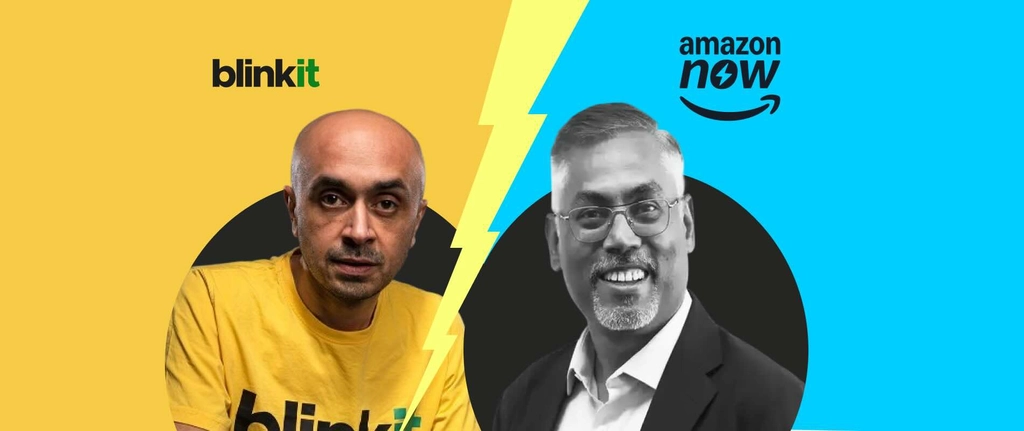
Amazon Now vs Blinkit, Swiggy Instamart & Zepto: Inside India’s Fiercest Quick Commerce Battle of 2026
Amazon Now is growing at 25% month-over-month with Prime members tripling their shopping frequency. It’s targeting 100 cities and 1,000+ micro-fulfilment centres. But Blinkit already has 2,243 dark stores, a 50% market share, and a five-year head start. Can Amazon’s Prime flywheel rewrite the rules of India’s ₹11,000 crore quick commerce market?
The Incumbents
India’s quick commerce market has become one of the most intensely contested battlegrounds in global e-commerce — and it just got a formidable new challenger. Amazon, the world’s largest online retailer, is now betting heavily on ultra-fast delivery in India through its Amazon Now service, targeting 30-minute or less deliveries across 100 cities. But it is entering a market where the incumbents have already built fortress-like networks. Blinkit has 2,243 dark stores. Swiggy Instamart has 1,143. Zepto has raised $450 million at a $7 billion valuation. And all of them have been at this for years while Amazon was focused elsewhere.
Yet Amazon’s leadership is making a confident noise. On the Q1 2026 earnings call, CEO Andy Jassy did not lead with dark store counts or city expansion numbers. He led with one striking figure: Prime members who start using Amazon Now triple their shopping frequency on the platform. Orders are growing 25 percent month-over-month. That is a different kind of growth story — one rooted not in geography, but in behaviour change among India’s highest-value consumers.
The question for the Indian quick commerce market is whether Amazon’s Prime flywheel — which has reshaped consumer habits in the US, UK, and Japan — can do the same in a market where Blinkit, Zepto, and Instamart have a commanding head start. This is a battle worth watching very carefully.
India’s Quick Commerce Market: A ₹11,000 Crore Monthly Machine
The numbers behind India’s quick commerce boom are staggering. In January 2026, the market’s gross merchandise value reached ₹11,000 crore per month — growing 100 percent year-on-year, according to consulting firm Redseer. Daily order volumes climbed 95 percent to 7.8 million orders per day. Monthly transacting users expanded 95 percent year-on-year to 5.2 crore people. The market is projected to be a $40 billion opportunity by 2030.
The entire ecosystem — dark stores, delivery fleets, inventory management, demand forecasting — has been built at breakneck speed. As of April 2026, more than 5,700 to 6,000 dark stores operated by leading players collectively serve roughly 2,600 pincodes and approximately 230 million people, or about 17 percent of India’s population. This build-out has been concentrated largely in large cities, creating what analysts describe as a “delivery density” dynamic where profitability improves as orders per dark store per day increases.
Quick commerce — or q-commerce — refers to ultra-fast delivery services that promise to deliver groceries, essentials, and everyday items within 10 to 30 minutes of placing an order. Unlike traditional e-commerce which optimises for selection and price, quick commerce optimises for speed and convenience. The entire supply chain is redesigned around dark stores — small, neighbourhood-level warehouses closed to the public — stocked with the top 2,000–5,000 SKUs most frequently ordered in that locality.
India’s quick commerce market is unique globally because of the country’s dense urban geography, low delivery labour costs, very high mobile internet penetration, and a culture of daily fresh grocery shopping — all of which make the economics of 15 to 30 minute delivery more viable than in most Western markets.
Amazon Now: The Late Entry with a Powerful Wildcard
Amazon launched Amazon Now in India in June 2025 — more than five years after Zepto and Blinkit first began capitalising on ultra-fast delivery. The initial pilot was in Bengaluru. By the festive season, it had expanded to Delhi NCR and Mumbai with approximately 100 micro-fulfilment centres. By mid-2026, Amazon Now operates around 350 MFCs across these three cities.
The expansion plan is aggressive: Amazon is targeting 100 cities and over 1,000 micro-fulfilment centres, backed by an investment of over ₹2,800 crore in logistics and fulfilment infrastructure. New cities in the expansion pipeline include Pune, Hyderabad, Chennai, Kolkata, Jaipur, Lucknow, Kanpur, Chandigarh, Ahmedabad, Meerut, Kochi, Amritsar, Mangaluru, and Visakhapatnam.
“We continue to expand our ultra-fast delivery service, Amazon Now, which offers delivery in 30 minutes or less. It started last year in India, where orders are increasing 25% month-over-month, with Prime members tripling their shopping frequency once they start using it.”
— Andy Jassy, CEO Amazon · Q1 2026 Earnings CallBut the most important thing Amazon is doing is not the city count or the MFC target. It is the Prime flywheel. Amazon already owns one of the most powerful consumer loyalty engines in commerce history — the Prime subscription. India’s Prime base represents the country’s highest-value online shoppers: people who buy frequently, buy across categories, and trust Amazon’s delivery promises. By adding quick commerce to the Prime value proposition, Amazon is converting these high-value shoppers into daily grocery buyers — a fundamental shift in shopping frequency and basket type.
Amazon Now is currently clocking over 350,000 quick commerce orders per day. Critically, it is not limiting itself to groceries and milk. The platform is pushing high-margin direct-to-consumer brands, premium cosmetics, activewear, and small appliances through its 15 to 30 minute delivery pipelines — categories where Blinkit and Zepto are only now beginning to compete seriously.
The Dark Store Gap: Amazon’s Biggest Challenge
In quick commerce, the number of dark stores — and their density within a city — is the single most important determinant of delivery speed, geographic coverage, and ultimately, market share. Here is how the major players compare as of mid-2026:
The gap is stark. Blinkit has roughly 6x more dark stores than Amazon Now today. But Amazon’s plan to add hundreds of MFCs — reportedly opening two new centres per day at its expansion peak — suggests the company is treating this like a logistics infrastructure problem, not a marketing problem. The question is whether Amazon can close this gap fast enough before the incumbents cement consumer habits in new cities ahead of Amazon’s arrival.
Quick Commerce Competitive Landscape: Full Comparison
| Platform | Parent | Dark Stores | Cities | Key Edge | Status |
|---|---|---|---|---|---|
| Blinkit | Eternal (Zomato) | 2,243+ | 200+ | Market leader, density, speed, non-grocery push | Market Leader |
| Swiggy Instamart | Swiggy (Listed) | 1,143 | 129 | High SKU variety, food + grocery bundle | Strong #2 |
| Zepto | Zepto (Private) | 700+ | Multiple metros | 10-min delivery promise, AI-driven ops, IPO-bound | Growing Fast |
| Flipkart Minutes | Flipkart (Walmart) | ~800 | 50+ | Electronics + grocery combo, standalone app planned | Scaling |
| Amazon Now | Amazon India | ~350 MFCs | 3 (→100) | Prime subscriber base, 25% MoM growth, D2C brands | Late Entrant |
Why the Prime Flywheel Changes Everything
The most strategically significant aspect of Amazon Now’s entry is not the number of MFCs or even the order growth. It is the structural advantage of the Prime subscriber base. Amazon CEO Andy Jassy on the Q1 2026 earnings call deliberately chose not to talk about dark store counts or delivery time improvements. He talked about Prime member behaviour — and that choice was revealing.
Blinkit, Zepto, and Instamart have all built their customer bases from scratch, spending heavily on customer acquisition, discounts, and retention. Amazon does not need to do this for its Prime base. These customers already exist inside Amazon’s ecosystem. They already trust Amazon for delivery. They already have their payment details saved. When Amazon Now becomes available in their neighbourhood, the conversion from “Amazon shopper” to “Amazon Now daily shopper” is frictionless — and the data shows that once they convert, they shop dramatically more often.
Prime members who adopt Amazon Now triple their shopping frequency on the platform. This is not just a growth metric — it is a signal about the depth of habit formation. When someone moves from buying once a week on Amazon to buying daily milk, vegetables, and household essentials, their lifetime value as a customer multiplies dramatically.
Amazon Now is also uniquely positioned to push high-margin non-grocery categories — premium cosmetics, D2C health brands, small appliances, activewear — through the same 15-minute delivery infrastructure. These categories have significantly higher gross margins than commodity groceries, potentially giving Amazon Now a more profitable unit economics profile than its grocery-first competitors over the medium term.
Amazon currently clocks over 350,000 quick commerce orders per day in India — meaningful scale for a service less than a year old in most of its operating cities.
How the Incumbents Are Responding
The incumbents are not standing still. Blinkit’s parent Eternal has secured a ₹600 crore investment and is targeting 3,000 dark stores by March 2027. Blinkit is actively pushing into non-grocery categories — electronics, toys, apparel, pharmacy — to drive higher average order values and better unit economics in its existing dense metro markets. This directly addresses Amazon Now’s potential advantage in high-margin categories.
Zepto raised $450 million at a $7 billion valuation and is widely expected to file for an IPO estimated at around $1 billion. Its operational focus on AI-driven inventory management and 10-minute delivery windows has established it as the speed benchmark in the market — the platform that sets the standard everyone else has to match.
Swiggy raised board approval for up to ₹10,000 crore in additional capital for Instamart’s expansion. Having doubled its dark store count from 523 to 1,143 in a single year, Instamart is now focused on deepening city coverage and using its food delivery network to cross-sell grocery to existing Swiggy users — a bundling strategy that Amazon Now will find difficult to replicate without a food delivery platform of its own.
Flipkart Minutes, Amazon’s direct rival as a fellow e-commerce giant, has scaled to 800 dark stores in the first quarter of 2026 and is reportedly planning a standalone app to give its quick commerce service more independent brand identity. Flipkart is leveraging its existing seller network and electronics supply chain as differentiation — a category where Amazon Now has strong overlap.
The Tier-2 City Battleground: Where the Next Chapter Is Written
The metro quick commerce market — Delhi NCR, Mumbai, Bengaluru — is approaching saturation in terms of dark store density. The next phase of the war will be fought in Tier-1 and Tier-2 cities: Pune, Hyderabad, Jaipur, Lucknow, Chandigarh, Ahmedabad, Kochi, and beyond. Amazon’s 100-city expansion targets precisely these markets.
In these cities, the competitive dynamics are different. Brand recognition and trust matter more because consumers have less experience with quick commerce. Infrastructure build-out is cheaper because real estate costs for dark stores are lower. And the competitive intensity is lower because the incumbents have shallower penetration outside the top five metros.
Amazon has a distinct advantage here: its Prime brand is trusted across India, including in smaller cities where consumers may never have used Blinkit or Zepto. If Amazon can establish Amazon Now before the incumbents build significant density in these markets, it could create a durable geographic moat — particularly for the high-value Prime subscriber segment that skews urban but is increasingly present in emerging cities.
India’s quick commerce players are still overwhelmingly loss-making at the aggregate level. The path to profitability runs through two variables: higher average order values (driven by non-grocery categories) and higher orders per dark store per day (driven by density and repeat purchase behaviour). Bernstein’s analysis suggests dark-store network consolidation is necessary in metros for improving margins.
Amazon Now’s push into premium D2C brands, cosmetics, and small appliances suggests it is deliberately building toward high-AOV from the start — rather than competing on commodity groceries where margins are thin and competition from Blinkit is overwhelming. This may be Amazon’s most intelligent strategic choice: not to fight on Blinkit’s turf, but to find the premium lane within quick commerce where its brand fits naturally.
The Road Ahead: Five Dynamics to Watch
1. Prime Conversion Rate. The most important metric for Amazon Now’s trajectory is not total orders — it is the percentage of India’s Prime base that converts to regular Amazon Now users. If even 10–15% of Prime subscribers adopt Amazon Now for weekly grocery shopping, the scale implications are enormous.
2. MFC Ramp Speed. Amazon’s claim of 1,000+ MFCs as the target needs to be translated into monthly deployment numbers. At 300 MFCs today and 1,000 as the target, Amazon needs to open hundreds more — the pace of that build-out will determine whether Amazon Now is a credible national player by 2027.
3. Blinkit’s 3,000-Store Target. If Blinkit reaches 3,000 dark stores by March 2027, it will have solidified an infrastructure lead that will be very expensive for any challenger to close. The next 12 months are therefore critical for every player trying to close the gap.
4. Zepto’s IPO. Zepto’s planned IPO will be a defining moment for investor sentiment toward India’s quick commerce sector. If it lists successfully at its $7 billion valuation or higher, it will validate the category and accelerate capital flows into all players including Amazon.
5. Category Expansion Beyond Groceries. All five major players are now racing to expand beyond grocery into electronics, fashion, pharmacy, and premium products. The platform that builds the best high-margin non-grocery basket will likely win the long-term profitability battle — even if it does not win the pure grocery market share battle.
Amazon is late to India’s quick commerce battle — there is no disputing that. Blinkit’s 2,243 dark stores versus Amazon Now’s 350 MFCs captures the infrastructure gap in a single number. The incumbents have built powerful, deeply entrenched networks over five years of relentless execution.
But Amazon has something none of them have: a pre-existing pool of India’s most valuable online shoppers, already locked into its ecosystem through Prime, already trusting its brand, already habituated to Amazon’s delivery promises. The fact that Prime members triple their shopping frequency after adopting Amazon Now is not just a growth metric — it is evidence that the Prime flywheel works in India’s quick commerce context, just as it has in every other market Amazon has entered.
The war for India’s quick commerce market is not over. If anything, Amazon’s aggressive entry into 100 cities with ₹2,800 crore in committed investment suggests it is only now beginning its most intense phase. Blinkit has every reason to watch Amazon Now closely — and to keep building fast.
Frequently Asked Questions
Amazon Now launched in India in June 2025, starting with a pilot in Bengaluru. It subsequently expanded to Delhi NCR and Mumbai. As of mid-2026, it operates around 350 micro-fulfilment centres (MFCs) across these three cities, with plans to expand to 100 cities and 1,000+ MFCs backed by over ₹2,800 crore in investment.
Amazon CEO Andy Jassy confirmed during the Q1 2026 earnings call that Amazon Now orders are growing 25% month-over-month in India. Prime members who start using Amazon Now triple their shopping frequency on the platform. Amazon Now currently processes over 350,000 quick commerce orders per day.
Blinkit, owned by Eternal (formerly Zomato), is the clear market leader in India’s quick commerce space in 2026 with approximately 50% market share. It operates over 2,243 dark stores serving more than 200 cities. Swiggy Instamart is second with 1,143 dark stores across 129 cities, followed by Zepto and Flipkart Minutes.
India’s quick commerce market reached a GMV of ₹11,000 crore per month in January 2026, growing 100% year-on-year according to Redseer. Daily order volumes climbed 95% to 7.8 million orders per day. Monthly transacting users reached 5.2 crore. The market is projected to grow to a $40 billion opportunity by 2030.
Amazon Now’s biggest competitive advantage is its Prime subscriber base — India’s highest-value, most loyal online shoppers already locked into the Amazon ecosystem. Unlike Blinkit or Zepto which must acquire customers independently, Amazon Now converts existing Prime members into daily quick commerce shoppers at near-zero acquisition cost. Once they convert, Prime members triple their shopping frequency, creating a powerful retention flywheel.
Amazon Now is expanding beyond its current metros (Delhi NCR, Mumbai, Bengaluru) to cities including Pune, Hyderabad, Chennai, Kolkata, Jaipur, Lucknow, Kanpur, Chandigarh, Ahmedabad, Meerut, Kochi, Amritsar, Mangaluru and Visakhapatnam, as part of its 100-city expansion plan backed by over ₹2,800 crore in investment.
A dark store is a small warehouse closed to the public, used exclusively for fulfilling online orders. Located in dense urban neighbourhoods, dark stores are stocked with the top 2,000–5,000 most frequently ordered SKUs in that locality. The number and density of dark stores directly determines delivery speed and geographic coverage — making them the single most important infrastructure variable in quick commerce competition.
Yes. Zepto raised $450 million at a $7 billion valuation and is widely expected to file papers for an IPO estimated to be around $1 billion in the coming months of 2026. Zepto competes with Blinkit, Swiggy Instamart, Flipkart Minutes and Amazon Now in India’s quick commerce market, operating 700+ dark stores with a focus on 10-minute delivery.

Pankaj Dubey is an entrepreneur, business analyst, digital marketer, financial researcher, and brand strategist. He specializes in developing marketing strategies, building and positioning brands, and conducting in-depth business and financial research. He is also known for creating detailed case studies on reputed brands, analyzing market trends, and sharing insights through his writing and blogging. His work combines business intelligence, strategic thinking, and digital innovation to help businesses grow and strengthen their market presence.