
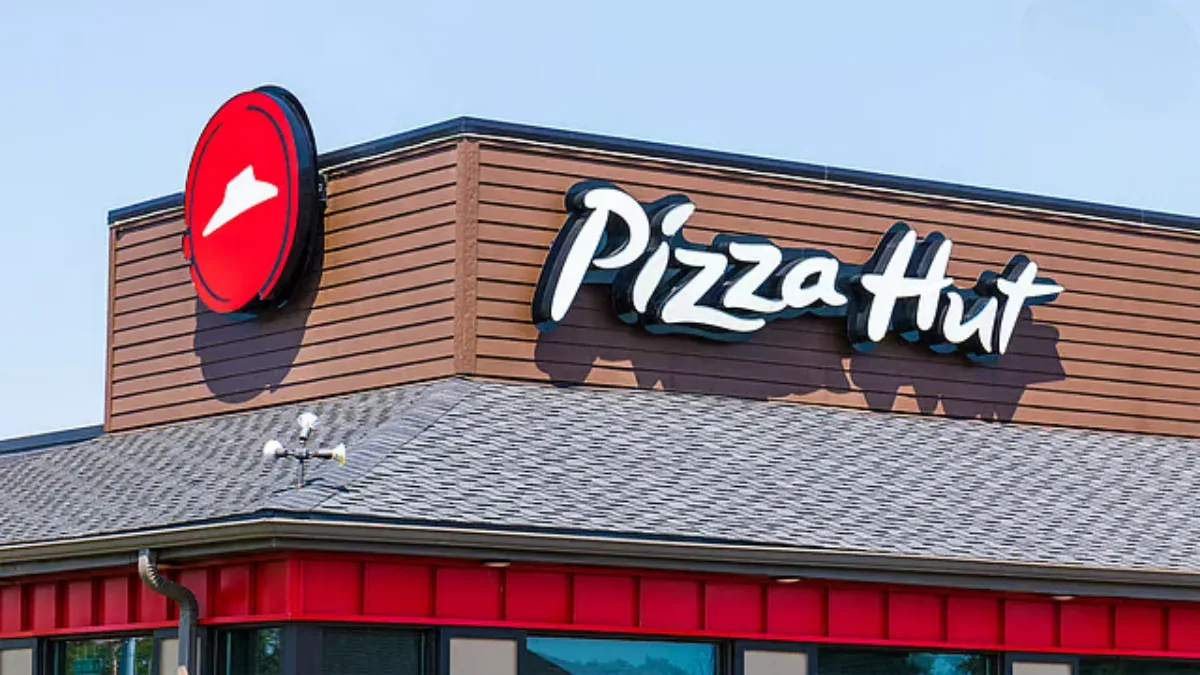
The Rise and Fall of Pizza Hut: From a $600 Loan and 8 Letters on a Sign Board to a $1.7 Billion Sale
A pizza ordered over the internet in 1994. A pizza launched into space in 2001. A crust stuffed with molten cheese that boosted sales by 68%. And then — the slow, painful unravelling of a brand that once owned the world. This is the complete story of Pizza Hut, all the way to June 2026.
The year was 1994. In the small California city of Sages, a man sat in front of his computer screen. On the screen, he could see a very simple black-and-white web page — no pictures, no colors, just a few lines of text. That’s what the internet looked like back then. Barely a few thousand websites existed in the entire world, and most people hadn’t heard of the internet at all. But what this man did that day went down in history.
He bought something on the internet. Not a book. Not a piece of clothing. Not a song. He ordered a pizza — large size, mushroom, extra cheese. And the company that made it was Pizza Hut. This is widely considered one of the very first things — perhaps the first thing — ever purchased online by a human being. (Whether it was truly the absolute first is still debated, but it was certainly among the very earliest commercial transactions on the internet.)
Seven years later, in 2001, the same company pulled off another remarkable stunt — this time, not just across the internet but across the atmosphere itself. Partnering with Russia’s space programme, Pizza Hut sent a 6-inch pizza to the International Space Station. A Russian cosmonaut warmed it up in orbit, ate it on camera in front of the entire world, and that pizza became the first in history to travel from Earth to space.
Pizza Hut was a company ahead of its time — experimenting with the internet, with technology, with marketing in ways nobody else was trying. And yet, today, this very company has been sold. Yum Brands — the group that also owns KFC and Taco Bell — cut Pizza Hut into two pieces and sold it for a combined total of $1.7 billion.
So what happened? How did the brand that was once practically a synonym for pizza around the world become so weakened that its own parent company needed to be rid of it? How did Domino’s — which was once tiny compared to Pizza Hut — race so far ahead? What was the one critical mistake that truly sank Pizza Hut? What happened to the brand in India? And why is it actually thriving in China? And most importantly — what comes next for Pizza Hut?
Let’s find out.
Wichita, Kansas, 1958 — A Building, $600, and No Idea How to Make Pizza
The story begins in Wichita, Kansas — right in the middle of America. Open plains, prairies, aircraft factories, and hardworking people. That’s Wichita. And it was here that two brothers lived: Frank and Dan Carney. Both were college students. Their family was large — a dozen children.
The story goes that in 1958, there was a small, empty building next to where they lived. Someone suggested they should open a pizza shop there. Now, back then, pizza was Italian food, and in this part of America — in Kansas — it was practically unknown. Italians brought pizza to the US, but it was found mostly in big cities on the East Coast. The heartland had never really tasted it.
The Carney brothers thought: why not try? The suggestion was good enough. But they had very little money. So they borrowed $600 from their mother. With that $600, they bought a used pizza oven, picked up some tables and chairs, painted the walls, and hung a couple of bottles to give the place an Italian feel.
Here’s the delightful part — they didn’t know how to make pizza. No one had taught them. So they did what determined people do: they found a recipe book and figured it out on the job, learning by doing.
The name that a sign board decided
With the shop taking shape, they needed a name. And that’s where one of the most famous accidents in branding history happened. Outside the building hung an old sign board left over from the previous occupant — a standard-sized board of the kind where you slot in letters one by one. That board had space for exactly eight letters and one space. Not a single character more.
Both brothers agreed the name had to include the word “Pizza” — so customers passing by would immediately understand what was on offer. That used up five letters. Three letters and one space remained.
The brothers sat thinking: what three-letter word goes with “Pizza”? Then someone glanced at the building itself — a small structure with a low, sloping roof — and said: “You know, this place kind of looks like a hut.” The word “hut” is three letters. Pizza Hut fit the sign board perfectly.
No marketing agency. No brainstorming session. No strategy meeting. One of the most recognizable brand names in the history of food was born because the sign board was too small for anything longer.
From One Shop to the World’s Biggest Pizza Chain
In 1959 — just one year after the first shop opened — the first franchise outlet launched in the city of Topeka. That was the spark. From there, Pizza Hut spread across the entire United States through the franchise model, growing at remarkable speed. But an early problem emerged: every franchise outlet looked completely different, because each franchisee simply used whatever building was available to them. The brand had no visual identity that customers could recognize from the street.
That changed in 1969, when the company locked in a standardized design that would eventually make Pizza Hut one of the most recognizable buildings in the world. The formula: a compact brick building topped by a dramatically sloping, vivid red roof. The genius of that red roof was that it could be spotted from a distance on any ordinary road — it was, in itself, a billboard, an advertisement, a visual identity that needed no words.
The interior was just as carefully considered: comfortable red sofas, red-and-white checkered tablecloths on every table, and a colorful stained-glass lamp hanging above each table. This was not a grab-and-go spot. It was designed for families to sit down, take their time, talk, and enjoy a meal together. That atmosphere was Pizza Hut’s greatest strength — and, as we will see, it was also setting up to be its greatest weakness.

The very thing that made Pizza Hut a family destination — large, comfortable, dine-in spaces — would one day become the weight that dragged it under.
By 1977, Pizza Hut had become the largest pizza chain in the world, with around 4,000 outlets. That same year, a company with deep pockets and an eye for opportunity came calling. PepsiCo — the same company that makes Pepsi — bought Pizza Hut for approximately $32 crore. The Carney brothers became millionaires. Pizza Hut now had the resources of one of the world’s biggest consumer companies behind it.
The Invention That Defined a Generation: Stuffed Crust Pizza
For a long time, Pizza Hut held its position through one very specific thing that made it stand apart from every other pizza brand. The story of how it came to exist is worth telling in full.
Pizza Hut had a food scientist named Patty Scheibmeyer. In 1992, she was sitting in on a customer focus group — a session where real customers are asked what they think about the product. At one point, a man said, half-jokingly: “Your pizza is fine, but that dry bread at the edges? The crust? We never eat it. It’s like the bones of the pizza — useless.”
That throwaway comment sparked something in Patty’s mind. What if we filled those useless edges with melted cheese? What if the crust became the best part?
It took two and a half years and hundreds of failed experiments before the idea could be made to work reliably and consistently. But in 1995, Stuffed Crust Pizza was launched — and its impact was immediate and enormous. Within just a few months of launch, it boosted Pizza Hut’s sales by 68%. It became the single most successful new product launch in the history of any pizza company at that time.
By the late 1990s, Pizza Hut was at the absolute top. More than 7,500 outlets in the US alone. Roughly a quarter of the entire American pizza market belonged to this one brand. In 1997, PepsiCo spun off its restaurant businesses into a separate company that came to be known as Yum Brands — the parent that held Pizza Hut, KFC, and Taco Bell under one roof.
Domino’s Was Struggling — and Then It Did Something Nobody Expected
While Pizza Hut was enjoying its red-roofed, stuffed-crust success, a competitor from Michigan was quietly reinventing itself. Domino’s was an old pizza company too — but in the early 2000s, it was in serious trouble. Its pizza wasn’t particularly popular. Sales were falling. It looked like a brand in decline.
Then Domino’s made a decision that changed everything. Its own executives began saying something that sounded strange at the time: “Domino’s is a technology company that also happens to sell pizza.” This wasn’t just talk. Domino’s put its full force behind one idea: make ordering pizza the easiest thing in the world.
They built their own website — early, when most food companies hadn’t thought of it. They launched a mobile app before apps were standard. They created a real-time order tracking system: customers could see exactly what was happening — pizza being prepared, pizza in the oven, pizza on its way. These things feel obvious today, but Domino’s was doing them while Pizza Hut was still selling the atmosphere of its red sofas.
But the real shift was philosophical. Domino’s had a clear picture of where the world was going: people no longer want to drive to a restaurant, sit in a dining hall, and wait for food. They want a hot pizza delivered fast to their door, while they watch TV, while they talk with friends, while a party happens in the living room. No hassle, no fuss — one click and done. Domino’s built its entire business around delivering on that exact promise.
Small outlets. Lean costs. Big margins.
Domino’s outlet design reflected this thinking. Their outlets were small — mostly just a kitchen where pizzas are made and out they go. If there was any dine-in space at all, it was minimal. Think about it: have you ever seen a Domino’s with a massive dining hall? Rarely. Their outlets avoid expensive real estate, avoid large seating areas, avoid large staffing costs. This meant a lower investment to open an outlet and comparatively higher profit margins.
Pizza Hut, meanwhile, was carrying the weight of its past. Its large, family-dining outlets — often in prime, expensive locations — made complete sense when people were coming in to sit for two hours. But when footfall dropped and customers shifted to delivery, those same big halls became a nightmare: empty floors with running air conditioning, maintenance bills, staff costs, rent on premium space — and no customers sitting in them.
The market had changed. Pizza Hut’s greatest asset had become its greatest liability.
March 2025: The Last Wall Falls
Even as it lost ground to Domino’s, Pizza Hut still had one thing uniquely its own — the very product that had defined it for thirty years. If you wanted Stuffed Crust pizza, you went to Pizza Hut. Nobody else had it. That was still bringing in loyal customers who would choose Pizza Hut over everything else precisely for that one item.
Then, in March 2025, Domino’s launched its own Stuffed Crust pizza.
Why did it take Domino’s 30 years to do this? Because it was genuinely difficult to make. The process was messy and technically demanding. But Domino’s eventually had a reason it simply couldn’t ignore: their own internal research showed that roughly 1.3 crore (13 million) customers per year were leaving Domino’s specifically to go somewhere else for Stuffed Crust pizza. And where those customers were going was not hard to guess. Losing 13 million customers a year because of one product? That was no longer acceptable.
So Domino’s spent 12 weeks training the staff at all 7,000 of its outlets to make Stuffed Crust pizza correctly. Then they brought it to market. And with that, the last thing that had been uniquely Pizza Hut’s — the one product that made it irreplaceable to millions of customers — was now available from its biggest competitor too.
How the Franchise Model Turned Into a Trap
There is an important structural fact about Pizza Hut that makes its story more complicated: the company doesn’t run most of its own outlets. The majority operate under the franchise model — independent business owners pay Pizza Hut for the right to use its name and brand, and a share of their earnings flows back to the company.
This worked well on the way up. But on the way down, it created a terrible trap. These franchisees — particularly the older ones — were locked into those same large, expensive dine-in outlets that had become liabilities. Their margins were already thin. They didn’t have enough left over to invest in new technology, upgrade their delivery capabilities, or adapt to what customers now wanted. They were slowly drowning.
The drowning became literal in July 2020, when the United States saw a dramatic example of exactly this. NPC International, the single largest Pizza Hut franchisee in the US — which operated more than 1,200 outlets on its own — filed for bankruptcy. It was buried under approximately $900 million in debt. Around 300 of its outlets — mostly the old sit-down dining locations — closed permanently. In the court documents, the company cited the Pizza Hut brand itself as a major reason for its collapse, pointing to declining sales and a brand that had fallen far behind its competition.
The Third-Party Delivery Trap
With franchise holders collapsing and its own delivery infrastructure weak, Pizza Hut turned to third-party delivery apps — DoorDash and Uber Eats. There was an initial small benefit: Pizza Hut became visible to the millions of people already browsing those apps for food. But this solution created two serious new problems.
First, the commissions were brutal. These apps charge a significant percentage of every order they process, slicing into margins that were already dangerously thin for franchisees.
Second, and worse, delivery was no longer Pizza Hut’s own. The rider who brought the pizza to your door wasn’t a Pizza Hut employee — he was a contractor for a delivery app, delivering dozens of different brands’ food every day. He had no investment in whether your pizza arrived hot, whether the box was intact, whether you were happy with the experience. For him, it was a package — nothing more. If the pizza arrived cold and 45 minutes late, you didn’t blame DoorDash. You blamed Pizza Hut. And you didn’t come back.
When AI Made Things Worse: The Dragon Tail Lawsuit
In 2021, Yum Brands acquired an AI company called Dragon Tail, during a period when AI was being applied to everything across industries. Dragon Tail’s purpose was to intelligently manage kitchen and delivery operations — figuring out when each order should be made, when a rider should be called, when a pizza should be picked up. This was supposed to speed up delivery and win back the customers Pizza Hut was losing. Yum made it mandatory for all franchisee outlets to use this software.
But in May 2026, a large franchise company that operated about 525 Pizza Hut outlets on the US East Coast filed a lawsuit against Pizza Hut. What it alleged was damning.
Before Dragon Tail, the story goes, outlet managers could manually decide when to call a delivery driver. They could track driver performance and block poorly-rated drivers from being assigned to their orders. That human judgment — flexible, contextual, protecting the customer experience — was the system’s backbone.
After Dragon Tail took over, control moved from the human manager to the software. According to the lawsuit, the system shared detailed order information with delivery drivers — including, crucially, how much tip the customer had left. In the US, tipping delivery drivers is culturally expected; customers generally leave tips as part of the ordering process.
What allegedly followed was predictable: drivers began selectively picking high-tip orders and ignoring low-tip ones. They also waited at outlets for a second order to come in so they could carry two deliveries in one trip — saving themselves time and fuel, but meaning the first pizza sat cooling on a shelf after coming out of the oven.
The results, according to the franchise’s lawsuit, were catastrophic:
- Delivery times that had previously been under 30 minutes climbed to over 45 minutes — a 50% increase in wait time.
- Outlets that had been among Pizza Hut’s best performers — growing at 10% — swung to a 10% decline in sales.
- The franchise claimed significant damages from Pizza Hut for what it described as a deeply harmful mandatory technology rollout.
First Pizza Hut failed to adopt technology when it should have. Then, when it finally did, the technology created new problems it hadn’t anticipated. It was a brutal double failure.
India: Both Arrived in 1996. The Gap Is Now 8x.
After the US, the two biggest markets for any global food company are China and India. In India, the Pizza Hut story has a particularly striking angle: there was no head start for either side. Pizza Hut and Domino’s both entered India in 1996, in the same year, almost simultaneously. They started together. Thirty years later, the gap between them is almost incomprehensible.

Pizza Hut brought its family-diner model to India — sit-down restaurants with a premium feel, full table service, and a dining room designed for families to linger. In the early years, when eating out was still a novelty for many Indians, this worked. But the Indian market evolved quickly. People wanted pizza to be affordable. They wanted it fast. They wanted it at home.
Domino’s — operated in India by Jubilant FoodWorks — grabbed that opportunity with both hands. They rolled out a network of small, lean outlets across the country, from large cities to smaller towns. They built their own in-house delivery network, with delivery executives who were their own employees — not gig workers for a third-party app. They cared about whether the pizza was hot. They made a famous promise that caught the country’s imagination: “30 minutes or free.” They adapted their menu to Indian tastes. They kept prices accessible.
Pizza Hut, by contrast, came to the delivery game late and halfheartedly — and by the time it arrived, the battle was already over. The numbers say it all.
| Brand | India Revenue (FY2025) | Operator in India |
|---|---|---|
| Domino’s India | ~₹6,100 crore | Jubilant FoodWorks |
| Pizza Hut India | ~₹730 crore | Devyani International & Sapphire Foods |
Domino’s India is roughly 8 times larger than Pizza Hut India by revenue. Pizza Hut operates around 980 stores in India, but a single Domino’s outlet delivers more pizza in a day than a Pizza Hut outlet manages to sell in its entirety — dine-in and delivery combined.
China: The One Place Pizza Hut Is Winning
The story is strikingly different on the other side of Asia. China is the only major market in the world where Pizza Hut was going up, not down — and the reason reveals something fascinating about why the brand failed everywhere else.
Pizza Hut’s China business was never run by its American parent company. It was operated by a separate entity called Yum China, which in 2016 became an independent publicly listed company, entirely separate from the US parent. And Yum China did something that nobody in America thought to do: it made a completely different set of choices for Pizza Hut in China.
In the US, Pizza Hut was slowly being pushed toward becoming cheap fast food — because it was watching Domino’s and trying to compete on speed and price. In China, Yum China took the opposite direction. It positioned Pizza Hut as a slightly upscale, relaxed, sit-down Western dining experience — aspirational but accessible, a place to have an evening out rather than grab food on the run.
- The menu was adapted to include items suited to Chinese tastes.
- Prices were calibrated to what Chinese customers would consider good value for a Western dining experience.
- Ordering was integrated smoothly with China’s popular local apps.
The result? China became Pizza Hut’s second-largest market in the world. Approximately 19% of Pizza Hut’s total global sales come from China alone — and profits there are growing, not shrinking. The brand that was dying in its home country was thriving, in a different form, on a different continent.
This contrast gave Yum Brands a clear realization: the only place Pizza Hut worked well was the one place it was being run by a completely different company in a completely different way. That insight became the foundation for what came next.
The Final Chapter: How Pizza Hut Was Sold for $1.7 Billion
In recent years, Yum Brands’ other two brands — KFC and Taco Bell — were growing with confidence. Pizza Hut alone was contracting. In 2025, even as Yum Brands’ overall revenues grew, Pizza Hut’s own sales fell. It had become, in corporate terms, a liability — a division actively pulling down the performance and reputation of the group it belonged to, making the healthy parts look worse.
In February 2026, Yum announced it would permanently close approximately 250 Pizza Hut outlets in the US. A few months earlier, in November 2025, the company had quietly begun what corporate language calls a “strategic review” — which in plain English means: we are exploring selling this, or finding someone else to run it.
Then came the date that closed a chapter: June 16, 2026. Yum Brands formally announced the sale of Pizza Hut. Total value: $1.7 billion. But it wasn’t sold as one piece. It was split into two:
The rest of the world’s business (outside China and the US) was sold to a private equity firm called Long Range Capital for approximately $1.5 billion. Long Range Capital specializes in acquiring distressed or underperforming businesses, investing years of focused effort to revive them, and eventually selling them at a profit.
What Comes Next: Is There Any Hope for Pizza Hut?
For all the trouble Pizza Hut is in, there is one genuine reason for hope — and it comes from an unlikely direction. When Pizza Hut was part of Yum Brands, a publicly listed company, it faced a relentless pressure common to all listed companies: show profit every three months. Quarterly results. Constant short-term scrutiny. This kind of pressure makes it nearly impossible to undertake the kind of slow, painful, expensive, long-term restructuring that a brand in this kind of trouble genuinely needs. Quick fixes. Patch jobs. Nothing that truly solves the underlying problem.
But Pizza Hut’s new private-equity owner has no quarterly earnings to report to the stock market. Long Range Capital can take its time. It can be patient. And that patience may be exactly what this brand needs to have a chance.
What might a real revival look like? A few possibilities:
- Close the bleeding without panic: The new owners can shut down old, large, loss-making dine-in outlets methodically, without the pressure of needing to show good numbers every quarter.
- Exit expensive real estate: Move out of premium locations that cost more than they earn, and right-size the outlet model.
- Rebuild delivery from scratch: The third-party delivery experiment didn’t work. A genuine in-house delivery infrastructure, built with patience and investment, might.
- Technology that actually helps: The Dragon Tail experience was a cautionary tale. But that doesn’t mean technology is the enemy — it means poor implementation is. Done right, technology can still be a powerful ally.
- Learn from China: The China playbook — local adaptation, right positioning, tech integration — is proof that Pizza Hut can work in the modern world. The question is whether that lesson can be applied elsewhere.
Frequently Asked Questions
What was the world’s first internet pizza order?
In 1994, a man in the California city of Sages ordered a large mushroom pizza with extra cheese from Pizza Hut online — widely considered one of the very first internet purchases in history, though whether it was the absolute first is still debated.
How did Pizza Hut get its name?
Entirely by accident. The old sign board outside the building had space for only 8 letters and 1 space. The brothers wanted “Pizza” in the name (5 letters), leaving just 3. Someone looked at the small sloped-roof building and said it looked like a hut. “Pizza Hut” fit the board exactly — and that became the name, with no branding agency involved.
Who invented the Stuffed Crust pizza?
Pizza Hut food scientist Patty Scheibmeyer, inspired by a customer’s 1992 joke about pizza crust being like “bones nobody eats.” She spent 2.5 years and hundreds of failed attempts perfecting the recipe before launching it in 1995, boosting sales by 68%.
How did Domino’s overtake Pizza Hut?
By betting on delivery, technology, and small lean outlets at a time when Pizza Hut was still investing in large dine-in spaces. In 2017, Domino’s overtook Pizza Hut in US sales despite having a similar number of outlets, earning almost double the revenue per year across its network.
How does Pizza Hut India compare to Domino’s India?
Both entered India in 1996. By FY2025, Domino’s India had revenues of ~₹6,100 crore while Pizza Hut India had ~₹730 crore — roughly 8 times smaller. A single Domino’s outlet outperforms a Pizza Hut outlet in daily orders.
Why is Pizza Hut successful in China but struggling everywhere else?
In China, an independent company called Yum China positioned Pizza Hut as a slightly upscale Western casual dining experience, adapted its menu to Chinese tastes, and integrated ordering with popular local apps. China now accounts for about 19% of Pizza Hut’s total global revenue — its second-largest market — and profits are growing.
Why was Pizza Hut sold in 2026?
Pizza Hut had become a liability for Yum Brands, dragging down the group while KFC and Taco Bell grew. On June 16, 2026, Yum sold it in two pieces: China to Yum China for ~$1.2 billion, and the rest of the world to private equity firm Long Range Capital for ~$1.5 billion.
From a $600 loan borrowed from a mother in Wichita to a $1.7 billion sale 68 years later. From the world’s first internet pizza order to a lawsuit over an AI system that let pizzas go cold. From the world’s largest pizza chain to number two in its own home market. Pizza Hut’s story is a masterclass in both extraordinary creation and the cost of failing to evolve. Whether its new private owners can write a better ending — or whether the red roof becomes a museum piece — is the one chapter that remains to be told.

Pankaj Dubey is an entrepreneur, business analyst, digital marketer, financial researcher, and brand strategist. He specializes in developing marketing strategies, building and positioning brands, and conducting in-depth business and financial research. He is also known for creating detailed case studies on reputed brands, analyzing market trends, and sharing insights through his writing and blogging. His work combines business intelligence, strategic thinking, and digital innovation to help businesses grow and strengthen their market presence.