
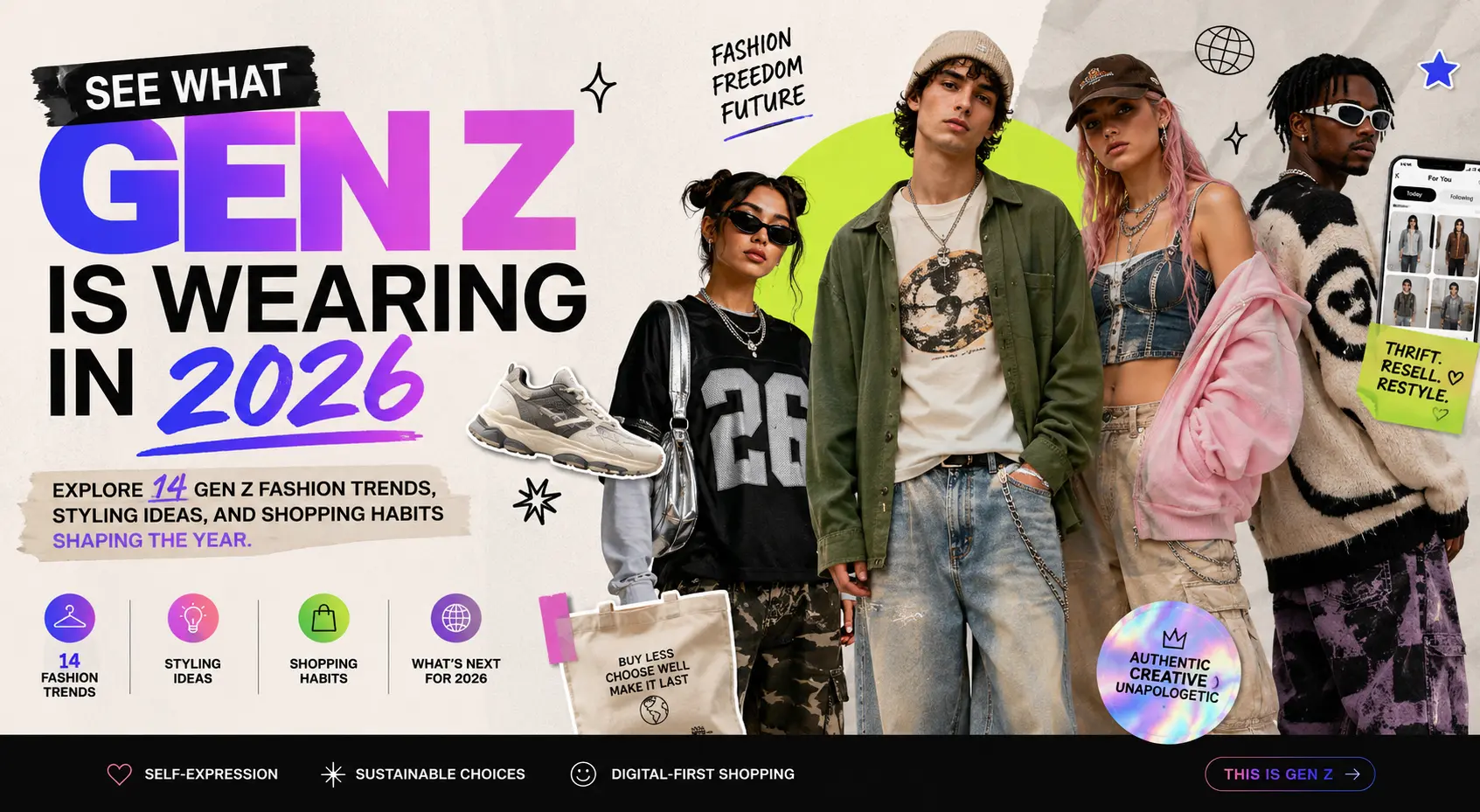

Gen Z Fashion Trends 2026: The Complete Style Guide
From Y2K nostalgia and quiet luxury to sustainable thrifting — a deep-dive into exactly how the most style-savvy generation on the planet is dressing right now.
Gen Z fashion in 2026 is built on self-expression, comfort, and individuality rather than strict trend-following. The biggest trends include Y2K revival (low-rise jeans, rhinestones, baby tees), oversized streetwear (cargo pants, graphic hoodies, chunky sneakers), quiet luxury (neutral tones, tailored silhouettes, no logos), cottagecore (crochet, florals, linen), and sustainable thrifting.
Key characteristics: loose silhouettes, bold accessories, gender-fluid styling, and a strong preference for secondhand shopping. Gen Z treats clothes as a tool for identity — not just appearance.
What Is Gen Z Fashion & What Actually Drives It?
Generation Z — loosely defined as people born between 1997 and 2012 — has grown up entirely in the digital age. Their fashion choices aren’t shaped by a single magazine editor or a handful of TV stars. Instead, they’re influenced by thousands of micro-creators, aesthetic communities, vintage hunters, and cultural movements all happening simultaneously across TikTok, Instagram Reels, Pinterest boards, and Depop listings.
The result is a fashion culture unlike anything the industry has seen before: decentralised, fast-moving, deeply personal, and surprisingly values-driven. Gen Z cares about why they’re buying something just as much as what they’re buying. That makes them a challenging market for brands — and a fascinating subject for anyone interested in where fashion is heading.
The Five Core Values Driving Gen Z Style
Understanding Gen Z fashion starts with understanding what this generation actually values. Five themes come up again and again:
Self-Expression Over Conformity
Gen Z doesn’t want to look like everyone else — they want to look like themselves. Fashion is a communication tool. An outfit tells a story about personality, mood, interests, and identity before a single word is spoken. This is why Gen Z gravitates towards unique, personalised, or rare pieces over mass-produced mainstream fashion.
Comfort Without Sacrificing Style
Tight jeans, pointed heels, and restrictive silhouettes belong to another era. Gen Z has normalised dressing for comfort first — but they’ve done it without making fashion boring. Oversized, relaxed fits are styled deliberately, with attention to proportion, colour, and layering.
Sustainability & Ethical Awareness
Climate anxiety is real for Gen Z. Fast fashion’s environmental cost — water usage, textile waste, worker exploitation — is not abstract to this generation. Thrifting, clothing swaps, rental fashion, and choosing sustainable brands are genuinely mainstream behaviours, not niche ones.
Gender Fluidity in Dressing
The binary between “men’s fashion” and “women’s fashion” is dissolving. Oversized fits, vintage pieces, earrings, nail art, and bold accessories are increasingly gender-neutral choices. Gen Z is the first generation to largely reject gendered dressing norms as a mainstream preference rather than a countercultural one.
Nostalgia Remixed with Modernity
Gen Z mines the past — 90s grunge, 2000s Y2K, 70s bohemian, even Victorian-era details — but always remixes them with contemporary pieces. Wearing something vintage doesn’t mean dressing in a costume. It means finding old things and making them new again through creative combination.
Top 15 Gen Z Fashion Trends of 2026 — Full Breakdown
These aren’t trends plucked from a runway nobody watched. These are styles genuinely showing up in street photography, campus wardrobes, social media feeds, and thrift store hauls right now. Each one is explained in detail — what it looks like, what key pieces you need, and how to actually wear it.

Y2K Revival: The 2000s Are Back and Gen Z Owns Them
If you had to pick just one trend that defines Gen Z style in 2026, Y2K revival would be a strong candidate. Low-rise jeans, butterfly clips, rhinestone-embellished sunglasses, chunky platform sneakers, Von Dutch-style caps, micro bags, and baby tees have all made a roaring comeback — and Gen Z wears them with far more confidence than the original 2000s generation did.
What separates this revival from pure nostalgia is the way it’s being remixed. A Y2K-era corset top gets paired with contemporary wide-leg trousers and chunky sneakers. An early 2000s graphic tee is tucked into a modern midi skirt. The vintage piece is the anchor; the rest of the outfit is thoroughly current. This mixing is what makes the trend feel fresh rather than like a costume.
Key Y2K Pieces to Own in 2026
- Low-rise or mid-rise straight-leg denim (not skinny)
- Baby tees with small logos, graphics, or band names
- Rhinestone-detail sunglasses or accessories
- Tiny Y2K-silhouette handbags (barrel bag, mini baguette)
- Platform chunky sneakers or platform sandals
- Butterfly clips and colourful hair accessories
- Metallic or holographic accent pieces

Oversized Streetwear: The Uniform That Refuses to Leave
Oversized streetwear isn’t a passing phase — it’s become the foundational language of Gen Z dressing. Baggy hoodies, wide-leg cargo pants, boxy graphic tees, relaxed track jackets, and chunky sneakers form what you could call the “Gen Z uniform.” It’s what gets worn to class, on weekends, at casual hangouts, and increasingly to low-key events.
The trick that elevates this look beyond simply wearing clothes that are too big is proportional styling. Something very oversized on top is balanced with something more structured or slim-fitting on the bottom — and vice versa. An enormous hoodie works with fitted joggers. Very wide cargo pants pair with a more fitted tee tucked in slightly at the front. The contrast creates shape and intention even within a deliberately relaxed silhouette.
Graphic tees deserve special mention here. Original band tees, vintage sports graphics, archive streetwear prints, and custom typography are all prized. The graphic itself communicates identity — what you listen to, what you’re interested in, what culture you’re part of.
Building the Perfect Oversized Streetwear Look
- Choose one oversized hero piece (hoodie, jacket, or tee)
- Balance with something proportionally different below
- Layer: zip-up under a coat, tee under an open shirt
- Finish with chunky or statement footwear — never thin-soled
- Add one accessory that does the talking (chain, cap, rings)

Quiet Luxury: Looking Rich Without Showing Off
Quiet luxury is the antithesis of logomania. It says wealth and taste not through brand names but through exceptional fabric quality, precise tailoring, and a restrained colour palette. Think of brands like The Row, Toteme, and Loro Piana — or the way old-money families actually dress in real life, not in the movies.
Gen Z’s relationship with quiet luxury is interesting because it doesn’t always require real luxury prices. Many Gen Z practitioners of this aesthetic source their pieces from quality secondhand finds — a barely-worn cashmere sweater from a charity shop, perfectly-tailored vintage trousers from Depop, or a genuine leather loafer found in an estate sale. The result looks expensive because the pieces are high quality — just not necessarily new.
The palette is almost exclusively: camel, cream, oatmeal, warm white, chocolate brown, deep navy, and forest green. Structure matters enormously — slouchy or shapeless pieces don’t fit this aesthetic. Everything should look like it was made specifically for your body.
Cottagecore & Soft Romanticism
Crochet tops, prairie-style midi dresses, linen co-ords, floral prints, puff sleeves, and Mary Jane heels — cottagecore is the aesthetic of slowing down, romanticising the everyday, and dressing like you live in a picturesque countryside even if you don’t. Gen Z’s version of this trend tends to pair soft, feminine pieces with darker boots, layered jewellery, or a worn-in denim jacket to give it edge and modernity. It dominates spring and summer wardrobes and photographs beautifully in natural settings.
Futuristic Techwear & Urban Utility
Structured utility jackets, waterproof fabric layers, modular cargo vests, harness-style accessories, tactical trousers with multiple pockets — techwear brings function and fashion together in a distinctly urban, forward-looking way. The colour palette stays dark: black, charcoal, deep olive, and graphite. Think of it as streetwear that looks like it was designed for a mission. It’s practical, purposeful, and oddly photogenic in city environments.
Athleisure 2.0 — Elevated Gym-to-Street
Athleisure has evolved from basic leggings-and-trainers into something considerably more intentional. In 2026, athleisure means premium seamless sets in interesting textures, oversized performance hoodies in muted or earthy tones, tailored athletic trousers, and elevated sports bras worn as tops. The pieces still function as workout wear — but they’re cut, coloured, and constructed well enough to wear all day without changing. Brands like Alo, Vuori, and various Korean activewear labels are leading this elevated direction.
Maximalist Accessorising
Where previous generations might wear one necklace, Gen Z wears five — layered at different lengths, mixing chain styles, metals, and pendants. Multiple rings on the same hand, chunky earrings, wrist stacks of bracelets and beads, and retro sunglasses with coloured lenses all fall into this trend. The philosophy is that accessories complete the look rather than finish it — they’re the visual punctuation mark. This trend allows even a plain white tee and jeans to become a complete, expressive outfit through jewellery and accessories alone.
Co-ord Sets — Style Without the Effort
Matching two-piece sets have become one of the most reliably popular Gen Z choices because they solve the biggest daily problem in fashion: figuring out what goes together. Co-ords can range from soft knit crop-and-skirt combinations to bold printed shorts-and-shirt sets to tailored blazer-trouser combos. The matching fabric and colour eliminates styling anxiety — the pieces are designed to work together, and they do. They also photograph extremely well, which matters to a generation that frequently shares their outfits online.
Vintage & Thrift-First Dressing
Shopping secondhand is no longer a compromise — it’s a point of pride. Finding a unique vintage cardigan, a deadstock pair of 90s jeans, or a rare archive print from a defunct brand feels like winning. The uniqueness factor is enormous: nobody else at the party has exactly the same piece. Platforms like Depop, Vinted, Thredup, and local thrift stores are all major parts of the Gen Z shopping ecosystem. In India specifically, kabadi markets and local vintage sellers in cities like Mumbai, Delhi, and Bangalore are having a moment.
Micro-Aesthetics & Mood Dressing
Instead of having one fixed personal style, many Gen Zers maintain multiple micro-aesthetics and switch between them based on mood, occasion, or even the day’s playlist. Dark academia on Monday (tweed, turtlenecks, vintage books as accessories). Coastal grandmother on Tuesday (linen, neutral tones, woven bags). Streetwear on Wednesday. Soft girl on Thursday. This fluidity is made possible by building a wardrobe of versatile basics that can be re-styled across aesthetics — and it reflects the way Gen Z presents different facets of themselves across different social media platforms.
Tailoring & Structured Blazers
Structured tailoring — oversized blazers, wide-lapel suit jackets, tailored trousers in interesting fabrics — has found a strong home in Gen Z wardrobes. The key is wearing these pieces in unexpected ways: a blazer over a hoodie, a suit jacket with cargo shorts, tailored trousers paired with a basketball vest. The contrast between formal structure and casual styling creates the tension that makes the look interesting. Checked, plaid, and pinstripe fabrics are especially popular for blazers.
Dark Academia & Intellectual Aesthetics
Tweed blazers, turtleneck knits, corduroy trousers, leather oxfords, plaid scarves, and dark-toned palettes (dark brown, forest green, burgundy, black) define dark academia — an aesthetic with a literary, studious, Gothic undertone. It’s heavily influenced by the visual language of old European universities and books like “Dead Poets Society” or “The Secret History.” Gen Z has adapted it into an everyday wearable style with a strong following on Pinterest and Tumblr-adjacent communities.
Dopamine Dressing — Bold Colour & Print
As a counterpoint to quiet luxury and neutral palettes, dopamine dressing is all about wearing colours and prints that make you feel good. Bright primary colours, clashing patterns, maximalist prints, colour-blocked combinations — this trend is rooted in the idea that what you wear can genuinely affect your mood. Gen Z is leaning into this particularly in festival contexts, on nights out, and in creative or social-media-focused environments. Bright yellow, electric blue, tangerine, and vivid green are all colours with strong dopamine-dressing energy right now.
Denim on Denim — The Canadian Tuxedo Returns
Double denim — once a fashion faux pas — is now entirely endorsed by Gen Z. Wide-leg jeans with a denim jacket, or a denim skirt with a chambray shirt, worn in contrasting washes to create texture and depth rather than head-to-toe matching indigo. The key to wearing denim-on-denim well in 2026 is tonal variation: light-wash bottom, dark-wash top (or vice versa). The result is one of the most effortlessly cool combinations in the current wardrobe — versatile, sustainable (denim lasts forever), and endlessly remixable.
Clean Girl Aesthetic — Effortless Minimalism
Sleek low buns, gold hoop earrings, subtle contoured skin, white or beige cropped tanks, tailored wide-leg trousers, simple gold jewellery, and a quality leather tote — the clean girl aesthetic is about looking like you woke up flawless without obviously trying. It shares some DNA with quiet luxury (the neutral palette, the quality-over-quantity mindset) but is less about money and more about a certain pared-down, healthy, put-together energy. Hailey Bieber is often cited as the aesthetic’s main reference point, though Gen Z has thoroughly made it their own.
“Fashion for Gen Z isn’t about wearing the right thing — it’s about wearing your thing, confidently and unapologetically.”
How to Build a Gen Z Wardrobe from Scratch (Without Breaking the Bank)
The good news: Gen Z fashion is one of the most budget-friendly aesthetics in recent memory, because so much of it revolves around thrifting, remixing existing pieces, and investing in basics rather than trend-driven purchases. Here’s a practical, step-by-step approach.
Step 1 — Start with the Foundation Wardrobe
Before buying anything statement, build a base of versatile pieces you’ll actually reach for every day. These are the canvas onto which everything else is layered:
- 2–3 oversized plain tees (white, black, grey or a muted tone)
- 1 wide-leg or straight-leg denim in a mid-wash
- 1 pair of cargo trousers (olive, beige, or black)
- 1 quality hoodie in a neutral colour
- 1 plain-coloured oversized knit or crewneck sweater
- 1 good coat or jacket that works over most of your wardrobe
- 1 versatile sneaker (white, black, or a clean neutral)
A well-proportioned piece from a budget retailer will almost always look better than a poorly-fitting expensive one. Gen Z knows this — which is why proportion and silhouette are treated as more important than labels. Before buying anything, ask: does this fit the way it’s supposed to, or am I compromising?
Step 2 — Build in Versatile Statement Pieces
Once your foundations are solid, add 3–5 pieces that have personality — a distinctive graphic tee, a printed co-ord set, an interesting vintage blazer, or a crochet top. These are the pieces that make outfits memorable. Critically: every statement piece should work with at least three of your existing basics.
Step 3 — Invest in Accessories Seriously
In Gen Z fashion, accessories are not optional extras — they’re the point. A completely plain outfit (white tee, straight-leg jeans, white sneakers) becomes interesting with the right accessories. Spend real time and effort here. Good places to start:
- 2–3 layered chains of different lengths and styles
- Statement rings you can stack across multiple fingers
- One pair of interesting earrings (hoops, sculptural, vintage-style)
- A quality bag — mini, baguette, or woven tote depending on aesthetic
- Retro sunglasses with character (geometric frames, tinted lenses)
- A cap, bucket hat, or beanie depending on season
Step 4 — Learn the Art of Layering
Layering is the most powerful and cost-effective Gen Z styling technique. It multiplies your outfit options without multiplying your spending. Core layering principles that actually work:
- Wear a long-sleeve under a short-sleeve tee for instant visual interest
- Layer an open flannel or button-down shirt over a tee
- Add a vest or knit over a collared shirt
- Throw a structured blazer over a hoodie or sweatshirt
- Use a coat as the outermost layer that ties everything together
Step 5 — Shop Secondhand First
Before clicking “buy now” on anything new, search for it secondhand. You’ll almost always find it cheaper and sometimes in better condition. Platforms to use in India: OLX (for vintage finds), international shipping from Depop and Vinted for specific archive pieces, local thrift stores and kabadi markets in metros, and Instagram sellers in cities like Mumbai, Delhi, Pune, and Bangalore who source and curate vintage pieces.
Gen Z Style in 2026: Boys vs. Girls — A Detailed Comparison

Gen Z style in 2026 — expressive, effortless, and increasingly gender-fluid.
One of the most significant shifts in Gen Z fashion is the dissolving of hard gender lines in dressing. Many of the biggest 2026 trends — oversized silhouettes, vintage pieces, layered accessories, wide-leg denim — are genuinely gender-neutral and worn by everyone. Still, there are some distinct patterns worth noting.
- Co-ord sets in soft florals, prints, or pastels
- Wide-leg jeans + fitted crop top or oversized shirt
- Crochet tops and linen midi dresses for warm months
- Oversized blazers over simple basics
- Platform Mary Janes, ballet flats, or lug-sole boots
- Layered fine chains + sculptural earrings
- Mini bags (barrel, baguette, woven)
- Soft palettes: lavender, sage, dusty rose, butter yellow
- Cottagecore florals remixed with dark accessories
- Clean girl aesthetic with gold hoops + tinted moisturiser
- Cargo trousers (olive, beige, washed black) + oversized tee
- Graphic tees — vintage bands, archive sports, typography
- Wide-leg straight-leg denim (not slim, never skinny)
- Layered zip-up hoodie + coat or overshirt on top
- Chunky sneakers: New Balance 550, Air Max, dad-shoe silhouettes
- Caps, beanies, or bucket hats as essential headwear
- Minimalist chain necklaces and small hoop earrings
- Linen or textured shirts for elevated casual looks
- Techwear utility pieces for the right aesthetic
- Plaid or checked overshirts as a layering anchor
In 2026, many of the most-discussed Gen Z looks blur or completely ignore these categories. Oversized hoodies, vintage cardigans, cargo trousers, platform sneakers, and layered accessorising are worn by Gen Zers of all gender identities — and that cross-pollination is producing some of the most interesting style combinations of the decade.
Gen Z Fashion Trends 2026 — Complete Reference Table
Use this table to quickly compare all 15 trends at a glance — key pieces, colour palettes, who it suits, seasonal timing, and current momentum.
| Trend | Key Pieces | Palette | Best For | Season | Status |
|---|---|---|---|---|---|
| Y2K Revival | Low-rise jeans, baby tees, rhinestones, mini bags | Pink, silver, powder blue | All genders | Year-round | 🔥 Hottest |
| Oversized Streetwear | Cargo, baggy hoodies, graphic tees, chunky sneakers | Black, grey, earth | All genders | Year-round | 🔥 Dominant |
| Quiet Luxury | Camel coat, cashmere knit, tailored trousers, loafers | Camel, cream, navy | 22–28 yr olds | Autumn/Winter | ↑ Rising Fast |
| Cottagecore | Crochet, floral dresses, linen, Mary Janes | Dusty rose, sage, butter | Girls / All | Spring/Summer | ↑ Rising |
| Techwear | Utility jackets, cargo vests, harness bags | Black, charcoal, olive | Urban youth | Year-round | ↑ Rising |
| Athleisure 2.0 | Seamless sets, premium hoodies, bike shorts | Neutral, mauve, green | Active lifestyle | Year-round | ✔ Evergreen |
| Bold Accessories | Layered chains, chunky rings, retro sunglasses | Gold, silver, mixed | All genders | Year-round | 🔥 Essential |
| Co-ord Sets | Matching top + bottom in prints or pastels | Pastels, bold prints | Girls / All | Spring/Summer | 🔥 Growing |
| Vintage & Thrift | Archive band tees, retro cardigans, deadstock denim | Washed, faded, earthy | All genders | Year-round | ↑ Surging |
| Micro-Aesthetics | Versatile basics, mood-based layering | Varies by day | All | Year-round | ↑ Very Strong |
| Structured Tailoring | Oversized blazer, wide-lapel jacket, plaid trousers | Neutral, check, plaid | All genders | Autumn/Winter | ↑ Growing |
| Dark Academia | Tweed, turtleneck, corduroys, oxfords | Brown, green, burgundy | Bookish / niche | Autumn/Winter | ✔ Stable |
| Dopamine Dressing | Bold colour, clash prints, bright accessories | Bright: yellow, blue, tangerine | Events, festivals | Spring/Summer | ↑ Growing |
| Denim on Denim | Wide-leg jeans + denim jacket in contrasting wash | Light + dark denim | All genders | Year-round | ✔ Classic Remix |
| Clean Girl Aesthetic | Neutral basics, gold hoops, tote bag, sleek hair | White, beige, cream | Girls / All | Spring/Summer | ↑ Still Growing |
Sustainability & Thrifting: The Gen Z Shopping Revolution

Thrifted, swapped, and secondhand — Gen Z is rewriting what “new” means in fashion.
For Gen Z, sustainability in fashion isn’t a marketing tick-box — it’s a genuine value that influences real purchasing decisions. This generation has grown up reading about the Rana Plaza collapse, watching documentaries about textile waste in the Atacama Desert, and consuming content about fast fashion’s carbon footprint. That background context changes how they approach buying clothes.
How Gen Z Actually Shops Sustainably
- Thrift-first approach: Searching secondhand before buying new is now a default behaviour, not a niche one
- Clothing swaps: Organising or attending swaps with friends to exchange pieces without spending money
- Capsule wardrobe thinking: Buying fewer, more versatile pieces that last longer and work harder
- Rental fashion: Renting special occasion pieces through platforms rather than buying and wearing once
- Resale value awareness: Buying pieces that hold or appreciate in resale value (vintage, quality basics, archive pieces)
- Brand accountability: Actively researching brands’ ethical credentials, supply chain transparency, and environmental policies before buying
Where Gen Z Shops in India
In India specifically, the sustainable and vintage fashion market is growing rapidly. Platforms and locations worth knowing:
- Local kabadi and raddiwala markets for raw finds (Delhi’s Lajpat Nagar, Mumbai’s Chor Bazaar)
- Instagram-based vintage curators and resellers in metro cities
- Swap meets and pop-up events in Delhi, Mumbai, Bangalore, and Hyderabad
- Indian sustainable fashion brands: No Nasties, Doodlage, SAHA, Nicobar (natural materials)
- International secondhand: Depop and Vinted with international shipping to India
Brands that fail to address sustainability concerns are increasingly losing Gen Z customers. A brand without a clear environmental story, transparent supply chain, or ethical manufacturing story struggles to build long-term Gen Z loyalty — regardless of how aesthetically on-trend their products are.
5 Common Gen Z Styling Mistakes to Avoid in 2026
Understanding a trend is one thing — executing it well is another. Here are the five mistakes that most often undermine an otherwise good attempt at Gen Z-style dressing.
Mistake 01: Proportion Without Intention
Oversized doesn’t mean wearing anything that’s too big. Genuine oversized dressing involves deliberate proportional play — very large on top, balanced below (or vice versa). Wearing everything oversized at once, without a proportional anchor, reads as shapeless rather than intentional. Choose one big silhouette per outfit and contrast it.
Mistake 02: Trend Stacking
Wearing every current trend simultaneously in one outfit almost never works. Y2K accessories AND cottagecore dress AND techwear vest AND dopamine-dressing colour AND clean girl accessories is too much. Pick one trend as the anchor, then support it with basics and simple accessories. Less is more — even in maximalist Gen Z fashion.
Mistake 03: Buying New When Secondhand Is Better
Authenticity matters enormously in this aesthetic context. A genuine vintage piece found at a thrift store carries more cultural currency than a brand-new mass-produced “vintage-inspired” version at three times the price. Especially for Y2K pieces, dark academia staples, and graphic tees — go secondhand first, always.
Mistake 04: Neglecting Fit Finishing
Gen Z pays attention to small details — whether jeans are hemmed to the right length, whether a shirt tail is tucked in the right amount, whether layering pieces sit correctly. These finishing details separate a genuinely polished Gen Z look from someone who just bought oversized clothes. Take your time with the final 10% of getting dressed.
Mistake 05: Copying Without Personalising
The whole point of Gen Z fashion is individuality. Recreating an influencer’s exact outfit misses the spirit of the aesthetic entirely. Use inspiration as a starting point, then add something personal — a family piece, a find from a local thrift store, an accessory that reflects something you actually care about. That’s what makes an outfit genuinely Gen Z rather than just trend-compliant.
Frequently Asked Questions About Gen Z Fashion 2026
These are the questions people are actually searching for. Detailed, honest answers below.
In 2026, oversized streetwear and the Y2K revival are the two most dominant Gen Z fashion trends, with consistent presence across TikTok, Instagram, campus wardrobes, and street style photography worldwide. Bold layered accessories are the essential finishing element that turns any look into a full Gen Z statement. Quiet luxury is the fastest-growing emerging trend, particularly among Gen Z in professional or social contexts.
The core Gen Z wardrobe in 2026 includes: wide-leg or straight-leg denim, cargo trousers, oversized graphic tees, co-ord sets, crochet tops, tailored blazers, vintage band tees, techwear utility jackets, and seamless athleisure sets. For footwear: chunky sneakers (New Balance, Nike Air Max), platform Mary Janes, and lug-sole boots. For accessories: layered chains, multiple rings, retro sunglasses, and mini bags.
The differences are significant. Millennial fashion (2010s) was characterised by: skinny jeans, pointed-toe heels, heavily curated influencer looks, fast fashion hauls, and logomania. Gen Z has rejected almost all of this. Instead: loose and oversized silhouettes, a strong preference for secondhand shopping, gender-fluid styling as a mainstream norm, micro-aesthetics rather than one dominant trend, and a genuine sustainability conscience that affects real purchasing decisions. Gen Z also has a much more critical relationship with brand marketing.
Trending Gen Z colours in 2026 fall into a few distinct families: warm neutrals (cream, sand, oatmeal, warm white) dominate everyday wear. Muted pastels (lavender, dusty rose, sage green, butter yellow) are strong for cottagecore and clean girl aesthetics. Earth tones (terracotta, rust, burnt orange, olive green) bring warmth. Classic black and charcoal remain essential for streetwear. Bright accent colours — hot pink, cobalt blue, electric yellow — appear in Y2K and dopamine dressing contexts. Deep, dark tones (burgundy, forest green, chocolate) carry dark academia.
Top Gen Z footwear choices in 2026: New Balance 550 (the most popular sneaker of the year), Nike Air Max silhouettes, chunky dad sneakers from various brands, platform Mary Janes (particularly for feminine-leaning looks), lug-sole Chelsea boots, chunky combat boots, and ballet flats for minimalist or clean girl aesthetics. Thin-soled, minimalist sneakers have largely fallen out of favour — visual weight and comfort are the main criteria.
Yes, definitively. Quiet luxury — understated elegance through quality fabrics, neutral palettes, tailored silhouettes, and zero visible branding — has been enthusiastically adopted by Gen Z, particularly the older cohort (22–28 year olds). The key insight is that Gen Z practices quiet luxury in a uniquely accessible way: sourcing cashmere from thrift stores, finding tailored vintage trousers on Depop, investing in one or two genuinely quality pieces rather than buying from luxury brands at retail. The aesthetic is about looking refined — not about spending refined amounts of money.
Dressing like Gen Z on an Indian budget is very achievable: Start with thrift shops, kabadi markets, and OLX for vintage and unique finds in cities like Delhi, Mumbai, Bangalore. Build a foundation of versatile oversized basics from affordable brands — plain tees, neutral hoodies, wide-leg trousers. Invest in accessories from local markets or fashion streets rather than lots of new clothing. Follow Indian Gen Z Instagram creators who show outfit-of-the-day looks at accessible price points. Learn to layer creatively — it multiplies your outfit count without extra spending. And focus relentlessly on proportion and fit — a well-proportioned budget outfit always looks better than an expensive ill-fitting one.
Gen Z aesthetic in fashion isn’t one look — it’s a philosophy: dress to express yourself, not to impress others. The defining characteristics are: individuality over conformity, comfort without sacrificing visual interest, willingness to mix multiple aesthetics and eras, strong accessorising, gender-fluid choices, and a preference for secondhand or unique pieces. Specific micro-aesthetics include Y2K, dark academia, cottagecore, clean girl, streetwear, quiet luxury, and cottagecore — and most Gen Zers move between several of these depending on their mood.
The Real Secret Behind Gen Z Fashion in 2026
Strip away all the specific trends, the micro-aesthetics, the TikTok creators, and the Depop hauls, and you’re left with something refreshingly simple at the core of Gen Z fashion: dress like you mean it. Every choice — whether that’s a thrifted vintage blazer, a hand-stacked accessory arrangement, or a deliberately proportioned streetwear fit — should feel intentional and personal.
Gen Z has rejected the idea that fashion is something that happens to you — that a brand or a magazine tells you what to wear and you obey. Instead, fashion is something you do — actively, thoughtfully, and with a clear sense of who you are and what you want to communicate. That’s a genuinely powerful shift, and it’s producing some of the most interesting style combinations we’ve seen in a long time.
Whether you’re drawn to the Y2K energy, the quiet restraint of luxury minimalism, or the joyful chaos of dopamine dressing — the most important Gen Z styling principle remains the same: wear it like you chose it. Because you did.
The best Gen Z outfit in 2026 isn’t the most expensive, the most on-trend, or the most TikTok-approved. It’s the one that looks unmistakably like you — assembled with care, worn with confidence, and built around genuine self-expression rather than external validation.
Keep Reading

Pankaj Dubey is an entrepreneur, business analyst, digital marketer, financial researcher, and brand strategist. He specializes in developing marketing strategies, building and positioning brands, and conducting in-depth business and financial research. He is also known for creating detailed case studies on reputed brands, analyzing market trends, and sharing insights through his writing and blogging. His work combines business intelligence, strategic thinking, and digital innovation to help businesses grow and strengthen their market presence.

How Social Media Shapes Gen Z Fashion in 2026
It’s impossible to understand Gen Z fashion without understanding how social media works as a trend engine. But it’s more nuanced than “TikTok tells them what to wear.” Here’s the actual dynamic at play.
TikTok — The Trend Accelerator
TikTok has compressed the trend lifecycle dramatically. What might previously have taken 2–3 years to move from runway to street can now happen in weeks. A creator posts a “get ready with me” video featuring a specific vintage find, and within days that item is sold out across every secondhand platform. TikTok also gives micro-niches a mainstream audience — dark academia, cottagecore, and clean girl all achieved cultural visibility partly through TikTok’s algorithm surfacing niche content to wider audiences.
Instagram — The Aesthetic Curation Platform
While TikTok drives discovery, Instagram is where Gen Z curates and refines their aesthetic identity. Pinterest boards, Instagram saves, and “inspo” grids are how young people build visual mood boards for their personal style. Brands and creators who nail Instagram’s visual language — clean photography, cohesive colour palette, intentional styling — build the deepest Gen Z brand relationships there.
Depop, Vinted & the Resale Economy
Social commerce and resale platforms have become genuinely central to Gen Z fashion discovery. Finding, buying from, and even selling to other Gen Zers on these platforms is a social activity as much as a commercial one. Some Gen Z creators have built entire personal brands around their Depop shops or Instagram vintage resale accounts.
A fascinating counter-movement has also emerged: “de-influencing” — creators actively telling their audiences NOT to buy certain overhyped products. This reflects Gen Z’s scepticism of overt consumerism and their preference for authenticity over sponsored recommendation. Brands that lean too heavily on traditional influencer marketing are finding diminishing returns with Gen Z audiences.