
Remember when opening a bank account meant rushing to the branch with a folder of documents? A photocopy, a signature, and a wait of several hours in line? Well, those days are largely behind us.
With C-KYC, you only need to complete your KYC once. Your details are securely stored in the central registry, making it easier to open accounts or apply for financial services without repeating the process. One-time KYC, multiple uses – simple, hassle-free, and efficient. Airtel Payments Bank makes this even smoother by letting you complete your KYC digitally, without stepping into a branch.
In case you ever thought about what C-KYC is or how it functions, let us make it easy for you.
What is C-KYC?
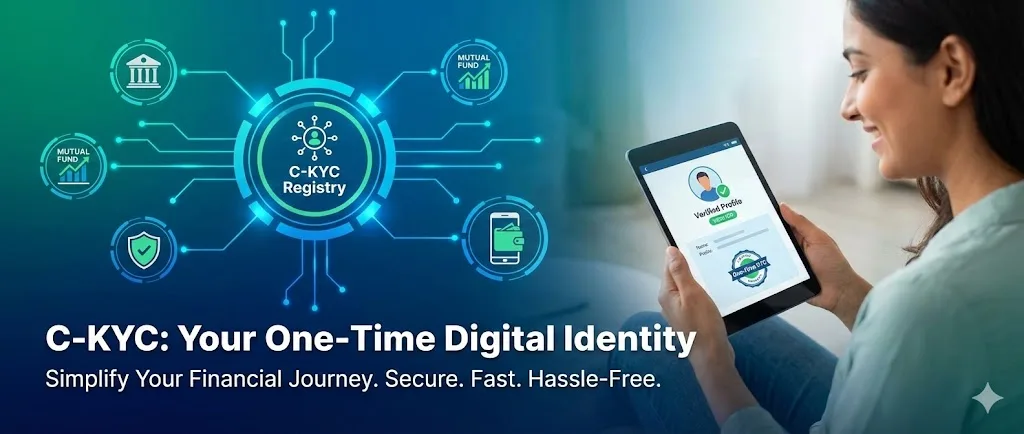
C-KYC, or Central Know Your Customer, is a one-time process to verify who you are and store it in a central registry maintained by the government. Once you’ve completed C-KYC with any regulated financial institution, your details are saved securely and can be used across banks, mutual fund companies, insurance providers, and other financial services.
That means you don’t have to submit your documents again and again every time you open an account or apply for a service. One KYC, multiple uses – it’s that simple.
C-KYC is commonly required for:
- Opening a bank account
- Registering for digital wallets
- Investing in mutual funds
- Getting insurance
Basically, anywhere you need to prove your identity online or offline, C-KYC steps in to save you time.
Why is C-KYC Important?
Whenever you save, invest, or buy financial products, companies are legally required to confirm your identity. Earlier, this used to mean carrying the same set of documents to every bank, insurer, or fund house – again and again.
With C-KYC, you only need to complete the process once. Your verified details are stored, making it easier to open accounts or access services without repeating the paperwork. One-time effort, long-term convenience.
How does the C-KYC Process Work?
Here’s how the C-KYC process usually goes:
Step 1. Fill out a KYC form once
When you open a bank account, invest in mutual funds, or buy insurance, you’ll be asked to complete a KYC form just once.
Step 2. Submit documents
Provide a valid ID proof (like Aadhaar, PAN, voter ID, or passport), address proof, and a photograph.
Step 3. Verification by the institution
The bank or financial institution verifies your details and uploads them to the Central KYC Registry (CKYCR).
Step 4. Get a KYC Identification Number (KIN)
Once verified, you receive a unique 14-digit KIN. This number is linked to your records in the central database.
Step 5. Use it anywhere
Now, whenever you need to open another account or apply for financial services, you just quote your KIN. No need to repeat the entire process.
Documents Needed for C-KYC
For Central KYC (C-KYC), you’ll need a few basic documents at the time of first registration:
- Proof of Identity – Aadhaar, PAN, Passport, Voter ID, or Driving Licence
- Proof of Address – Aadhaar, Passport, Voter ID, Driving Licence, or Utility Bill
- Photograph – A recent passport-sized photo
Once these are submitted and verified, your details are stored in the Central KYC Registry. From then on, you don’t need to resubmit documents every time – just share your KYC Identification Number (KIN).
Is C-KYC Safe?
Yes, C-KYC is secure. Your details are collected only once, verified by authorised institutions like banks, and then stored safely in the Central KYC Registry managed by CERSAI (Central Registry of Securitisation Asset Reconstruction and Security Interest of India).
Every time you use your KYC Identification Number (KIN), financial institutions fetch your details directly from this central database – no repeated document sharing, no duplicate uploads.
The data is encrypted, access is permission-based, and only regulated entities can use it. As long as you share your KIN only with trusted institutions, C-KYC is a safe, standardised, and government-backed way to manage your identity.
To Sum It Up
C-KYC has revolutionised the way we enrol for financial services. Whether you’re opening a bank account, experiencing a new digital wallet, or investing online, the process is now faster, simpler, and completely digital.
No stacks of paperwork. No standing in line. No back-and-forth with documents.
Want to try it out for yourself? Just head to the Airtel Thanks app. You can open a savings account with Airtel Payments Bank, complete your C-KYC, and start using your account – all from your phone. It’s fast, safe, and built for everyday convenience.
So the next time someone asks what C-KYC is, just tell them:
“It’s how I did my KYC once and used it everywhere – without repeating documents again and again.
❓ What is C-KYC?
C-KYC (Central Know Your Customer) is a one-time identity verification process where your KYC details are stored in a central government registry and reused across financial institutions.
❓ Is C-KYC mandatory in India?
Yes, C-KYC is mandatory for most financial services like opening bank accounts, investing in mutual funds, or buying insurance, as per regulatory guidelines.
❓ What documents are required for C-KYC?
You need:
- Proof of identity (Aadhaar, PAN, Passport, Voter ID, Driving Licence)
- Proof of address
- Recent photograph
❓ What is a KYC Identification Number (KIN)?
A KIN is a unique 14-digit number issued after completing C-KYC. It allows banks and financial institutions to fetch your verified details instantly.
❓ How can I check my C-KYC status?
You can check your C-KYC status online through your bank, financial institution, or via platforms linked with the Central KYC Registry.
❓ Is C-KYC safe and secure?
Yes. C-KYC data is encrypted and stored with CERSAI, and only authorised institutions can access it with permission.
❓ What is the difference between KYC and C-KYC?
Regular KYC is done separately with each institution. C-KYC is a one-time process where your verified details are centrally stored and reused everywhere.
❓ Can I do C-KYC online?
Yes. Many banks, including Airtel Payments Bank, allow you to complete C-KYC digitally using Aadhaar and PAN.