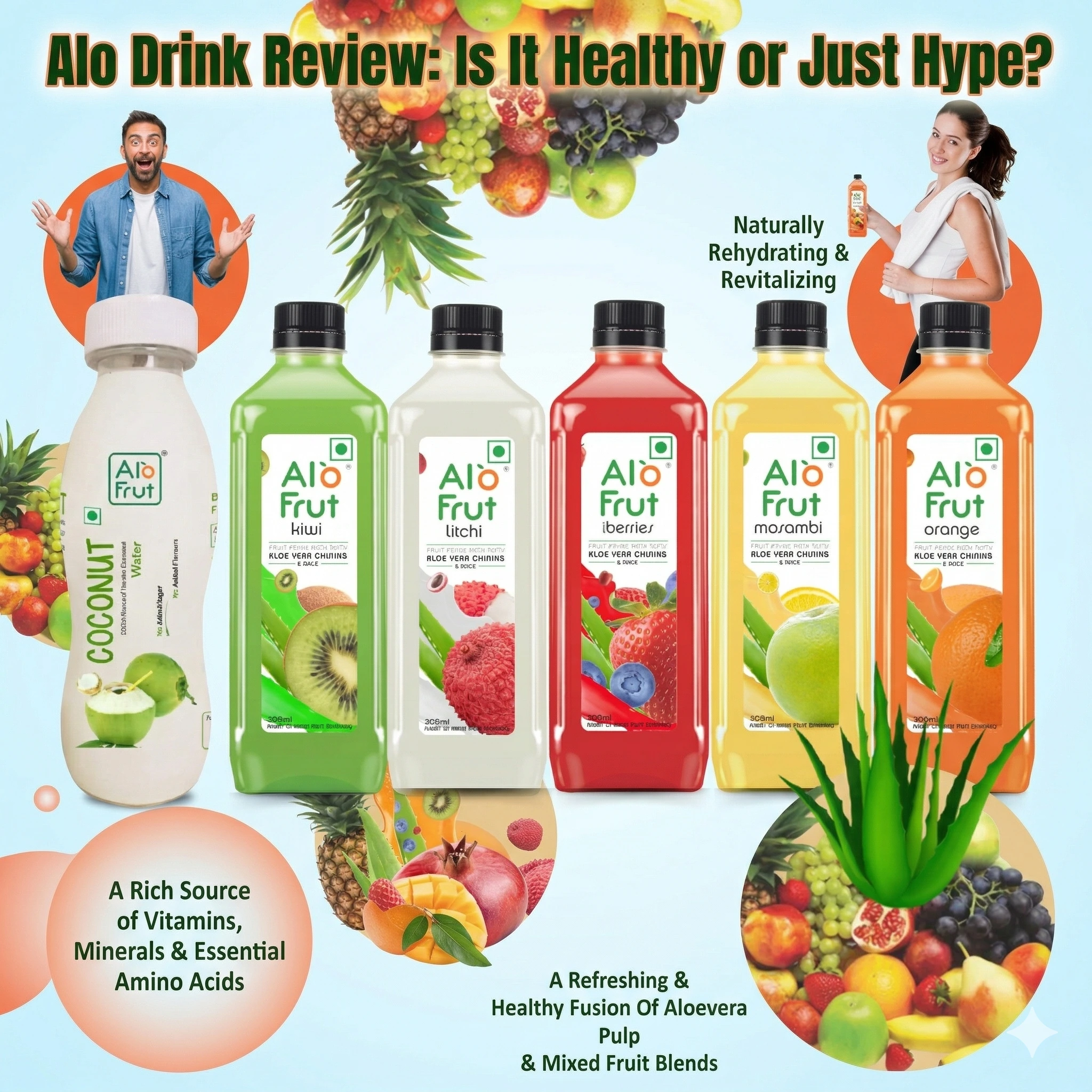


Alo Frut
14% Aloe Vera, 10% Sugar, and a long list of additives — is this actually a health drink?
14% Aloe Vera — The Genuine Differentiator
Alo Frut contains 14% Aloevera Juice and Pulp — this is the second ingredient after water, meaning it’s a meaningful quantity, not a trace. Aloe vera in food/beverage form is associated with digestive support, gut soothing properties, and hydration. The visible chunks floating in the drink are real aloe vera gel pieces — not starch-based imitations. This is genuinely what sets Alo Frut apart from standard fruit drinks and makes the “health drink” positioning at least partially valid.
10% Added Sugar — Plus More from Fruit — in Every Bottle
Every Alo Frut flavour contains 10% Cane Sugar as a declared ingredient. On top of this, the fruit pulp/juice contributes natural sugars. The result: ~10–15g total sugar per 100ml depending on the flavour. A standard 250ml glass delivers 25–37g sugar — comparable to a glass of Coca-Cola (39g/355ml). The “added sugar” per serving ranges from 30–35% of RDA per 150ml serving. This is the primary nutritional concern with regular daily use.
All 6 Flavours at a Glance
Here’s how the six Alo Frut flavours compare on key nutrition markers per 100ml:
Mixed Fruit
58.52 kcal · 11.41g sugar · 34.9% added sugar RDA · Vit C 6%
Litchi
42.68 kcal · 10.56g sugar · 30.1% added sugar RDA · Vit C 24.2%
Kiwi
59.90 kcal · 13.37g sugar · 35.6% added sugar RDA · Vit C 40.8%
Anaar (Pomegranate)
62.44 kcal · 11.05g sugar · 31.5% added sugar RDA · Vit C 53.3%
Orange
53.08 kcal · 11.95g sugar · 34.1% added sugar RDA · Vit C 39.3%
Pineapple
53.16 kcal · 10.42g sugar · 31.2% added sugar RDA · Vit C 24.4%
Nutrition Comparison — All 6 Flavours Per 100ml
| Nutrient | Mixed Fruit | Litchi | Kiwi | Anaar | Orange | Pineapple |
|---|---|---|---|---|---|---|
| Energy (kcal) | 58.52 | 42.68 | 59.90 | 62.44 | 53.08 | 53.16 |
| Protein (g) | 0.41 | 0.0 | 0.37 | 0.51 | 0.40 | 0.37 |
| Total Carbs (g) | 14.22 | 10.67 | 14.60 | 15.10 | 12.87 | 12.36 |
| Total Sugar (g) | 11.41 | 10.56 | 13.37 | 11.05 | 11.95 | 10.42 |
| Added Sugar (g / % RDA) | 11.0 / 34.9% | 10.03 / 30.1% | 11.37 / 35.6% | 10.5 / 31.5% | 11.36 / 34.1% | 10.42 / 31.2% |
| Total Fat (g) | 0.0 | 0.0 | 0.08 | 0.0 | 0.0 | 0.0 |
| Sodium (mg) | 88.0 | 21.62 | 76.0 | 226.0 | 92.0 | 60.0 |
| Vitamin C (mg / % RDA) | 2.7 / 6% | 6.46 / 24.2% | 10.88 / 40.8% | 14.22 / 53.3% | 10.49 / 39.3% | 6.52 / 24.4% |
| Aloe Vera | 14% | 14% | 14% | 14% | 14% | 14% |
| Fruit Content | ~10% reconstituted | 10% pulp | 10% reconstituted | 10% reconstituted | 11.60% reconstituted | 10% reconstituted |
Every Ingredient Decoded
All Alo Frut variants share a common base structure. Here’s a complete breakdown of every ingredient category across the range:
| Ingredient | % in Product | What It Is | Role | Verdict |
|---|---|---|---|---|
| Water | ~60–65% (est.) | Purified water — the primary base of all fruit drink formulations | Carrier for all other ingredients. Responsible for the drink being a beverage rather than a concentrate | ✓ Clean Standard purified water. No concerns. |
| Aloevera Juice and Pulp | 14% | Juice extracted from Aloe vera (Aloe barbadensis) leaves, combined with the gel pulp — the visible chunks in the bottle | The signature differentiator of Alo Frut. Provides gel chunks, aloe polysaccharides (acemannan), and the brand’s health positioning. 14% is a meaningful inclusion | ✦ Standout Real aloe vera at 14% — not token amounts. Aloe has evidence-backed benefits for digestion, gut lining, and hydration support. |
| Cane Sugar | 10% | Refined sucrose from sugarcane — the primary sweetener across all flavours | Sweetness and palatability. At 10%, it contributes ~10g sugar per 100ml — before natural fruit sugars are added on top | ✖ Primary concern 10% cane sugar plus fruit sugar = 30–35% of daily added sugar RDA in one 150ml serving. The main nutritional flag. |
| Flavour | Fruit Ingredient | Content % | Type | Note |
|---|---|---|---|---|
| Mixed Fruit | Orange, Pomegranate, Apple, Banana, Mango, Pineapple, Guava (reconstituted) | ~10% | Reconstituted juice | ⚠ Reconstituted “Reconstituted” means concentrate + water — less fresh than direct cold-press juice but acceptable. |
| Litchi | Litchi Pulp | 10% | Direct pulp | ✓ Real pulp Direct fruit pulp — better than reconstituted. Contributes natural litchi flavour and some fibre. |
| Kiwi | Reconstituted from Kiwi & Apple Juice | ~10% (4.7% kiwi est.) | Reconstituted + Apple blend | ⚠ Apple blend Kiwi content is blended with cheaper apple juice to hit the 10% target. Authentic kiwi content may be lower. |
| Anaar (Pomegranate) | Reconstituted Pomegranate Juice + Lemon | 10% + 0.7% | Reconstituted | ✓ Best Vit C Pomegranate juice is naturally rich in polyphenols and Vitamin C. This flavour has the highest nutritional fruit value. |
| Orange | Reconstituted Orange Juice + Floating Pulp Cells | 11.60% + 0.2% | Reconstituted + pulp | ✓ Good Slightly higher fruit content than others. Floating pulp cells add texture authenticity. |
| Pineapple | Reconstituted Pineapple Juice + Apple Juice | 10% total | Reconstituted | ⚠ Apple blend Similar to Kiwi — pineapple blended with apple juice. Good taste, moderate nutritional value. |
| INS Code | Name | Category | Found In | Purpose & Safety | Verdict |
|---|---|---|---|---|---|
| INS 330 | Citric Acid | Acidity Regulator | All flavours | Controls pH, adds tartness, acts as natural preservative. Derived from citrus fermentation. GRAS status globally. Can contribute to dental erosion with frequent sipping | ✓ Safe One of the most widely used and well-studied food additives. No health concerns at food levels. |
| INS 331/332 | Sodium/Potassium Citrate | Acidity Regulator | Mixed Fruit, some flavours | Buffers and stabilises pH. The sodium version contributes to sodium content in the drink | ✓ Safe Food-grade salts. No concerns. |
| INS 440 | Pectin | Stabiliser | All flavours | Natural polysaccharide from fruit peels — suspends aloe chunks and pulp evenly, prevents separation. Pectin is a soluble dietary fibre with prebiotic properties | ✦ Natural positive Pectin is a natural ingredient from fruit — adds mild fibre and is beneficial for gut health. A genuinely good additive. |
| INS 414 | Gum Arabic | Stabiliser | All flavours | Natural gum from Acacia tree sap — provides emulsification and body to the drink. Prebiotic fibre with proven gut health benefits | ✦ Natural positive Gum Arabic is a prebiotic fibre. Safe and beneficial — actually adds fibre value to the drink. |
| INS 419 | Guar Gum | Stabiliser | All flavours | Natural gum from guar beans — thickens and stabilises the drink, helps aloe chunks stay suspended. High fibre content, used in food globally | ✓ Natural Plant-derived. Safe and fibre-rich. No concerns. |
| INS 445 | Glycerol Esters of Wood Rosin | Stabiliser / Weighting agent | All flavours | Keeps citrus oil flavours dispersed in water-based drinks (prevents oil separation and clouding). Used in all citrus-flavoured beverages | ⚠ Note FSSAI and CODEX approved at max 100mg/kg. Some studies suggest high doses affect thyroid in animals — at food levels, considered safe by regulatory bodies. |
| INS 211 | Sodium Benzoate | Preservative | All flavours | Antimicrobial agent — prevents growth of bacteria, yeast, and mould. Extends shelf life significantly. Important note: when combined with Vitamin C (ascorbic acid), can form trace amounts of benzene | ⚠ Key note Alo Frut contains both INS 211 AND Vitamin C — the benzene-forming combination. At typical food levels, regulatory bodies consider it safe, but it’s worth noting for regular daily consumption. |
| INS 202 | Potassium Sorbate | Preservative | All flavours | Broad-spectrum antimicrobial. Works alongside sodium benzoate for comprehensive preservation. Considered one of the safest preservatives in food use | ✓ Safe One of the most studied, safest preservatives. GRAS status. No significant health concerns. |
| INS 110 | Sunset Yellow FCF | Synthetic Colour | Mixed Fruit, Orange, Pineapple, Anaar | Synthetic azo dye that gives orange/yellow colour. One of the “Southampton Six” dyes studied for hyperactivity links in children | ✖ Concern for children Linked to hyperactivity in some children in UK FSA studies. Banned in Norway. EU requires warning label when used. FSSAI permits it in India — but worth avoiding for young children. |
| INS 122 | Azorubine (Carmoisine) | Synthetic Colour | Anaar flavour | Red synthetic azo dye — gives the deep pomegranate-red colour to Anaar. Also a Southampton Six dye with hyperactivity concerns | ✖ Concern for children Same concerns as INS 110 — synthetic azo dye with hyperactivity links. Worth noting for parents giving Anaar flavour to children. |
| Type | What It Means | Verdict |
|---|---|---|
| Nature Identical Flavouring Substances | Chemical compounds that are identical to naturally occurring fruit flavour molecules but are manufactured synthetically — e.g. vanillin, citral, limonene. Not extracted from real fruit but chemically identical to natural equivalents | ⚠ Synthetic Legal, safe, and widely used. Not derived from real fruit however — the authentic fruit taste comes primarily from nature-identical compounds, not the 10% fruit content alone. |
The INS 211 + Vitamin C Issue — Explained
This is the most important technical detail in Alo Frut’s ingredient list. Sodium Benzoate (INS 211) + Ascorbic Acid (Vitamin C) can react under certain conditions — heat, light, and acidic pH — to form trace amounts of benzene, a known carcinogen. Alo Frut contains both INS 211 and Vitamin C (either naturally from fruit or added).
The Honest Verdict
Alo Frut sits in an interesting middle ground — it’s genuinely better than a standard soft drink or synthetic fruit drink. The 14% real aloe vera, natural stabilisers (pectin, gum arabic, guar gum), and meaningful Vitamin C content (particularly in Anaar and Kiwi flavours) are real positives. It’s a more thoughtful product than most fruit-flavoured beverages on Indian shelves.
However, it should not be confused with actual fruit juice or a health supplement. The 10% added sugar, synthetic colours (INS 110 and 122 — concerning for children), nature-identical flavours, and the INS 211 + Vitamin C combination are points worth knowing. The fruit content (10%) is mostly reconstituted from concentrate — not fresh-pressed. For hydration with a flavour, it’s a reasonable occasional choice. As a daily wellness drink for adults, the sugar content needs to be counted in your daily budget.
👍 What Works
- 14% real aloe vera pulp and juice — visible chunks, meaningful quantity
- Natural stabilisers — pectin, gum arabic, guar gum add actual fibre value
- Good Vitamin C in Anaar (53.3%), Kiwi (40.8%), Orange (39.3%) per serving
- Zero fat across all flavours
- Cane sugar (not HFCS) — better quality sweetener than corn syrup
- Genuinely better than Coca-Cola, Sprite, or synthetic squash
- Reasonable calorie count (42–62 kcal/100ml)
👎 The Concerns
- 30–35% of daily added sugar RDA per 150ml serving
- INS 211 (sodium benzoate) + Vitamin C — benzene-forming combination
- INS 110 and INS 122 — synthetic azo dyes, hyperactivity concerns for children
- Fruit content is 10% reconstituted — not fresh juice
- Nature identical flavours — not real fruit taste
- Anaar flavour: 226mg sodium per 100ml — high for a fruit drink
- Not suitable as a daily replacement for water or plain fruit
⚠️ This review is based on ingredient label analysis and food science literature. It is not medical advice. Parents of young children should note the synthetic colour concerns (INS 110, 122). Individuals managing blood pressure should note sodium levels, especially in Anaar flavour.