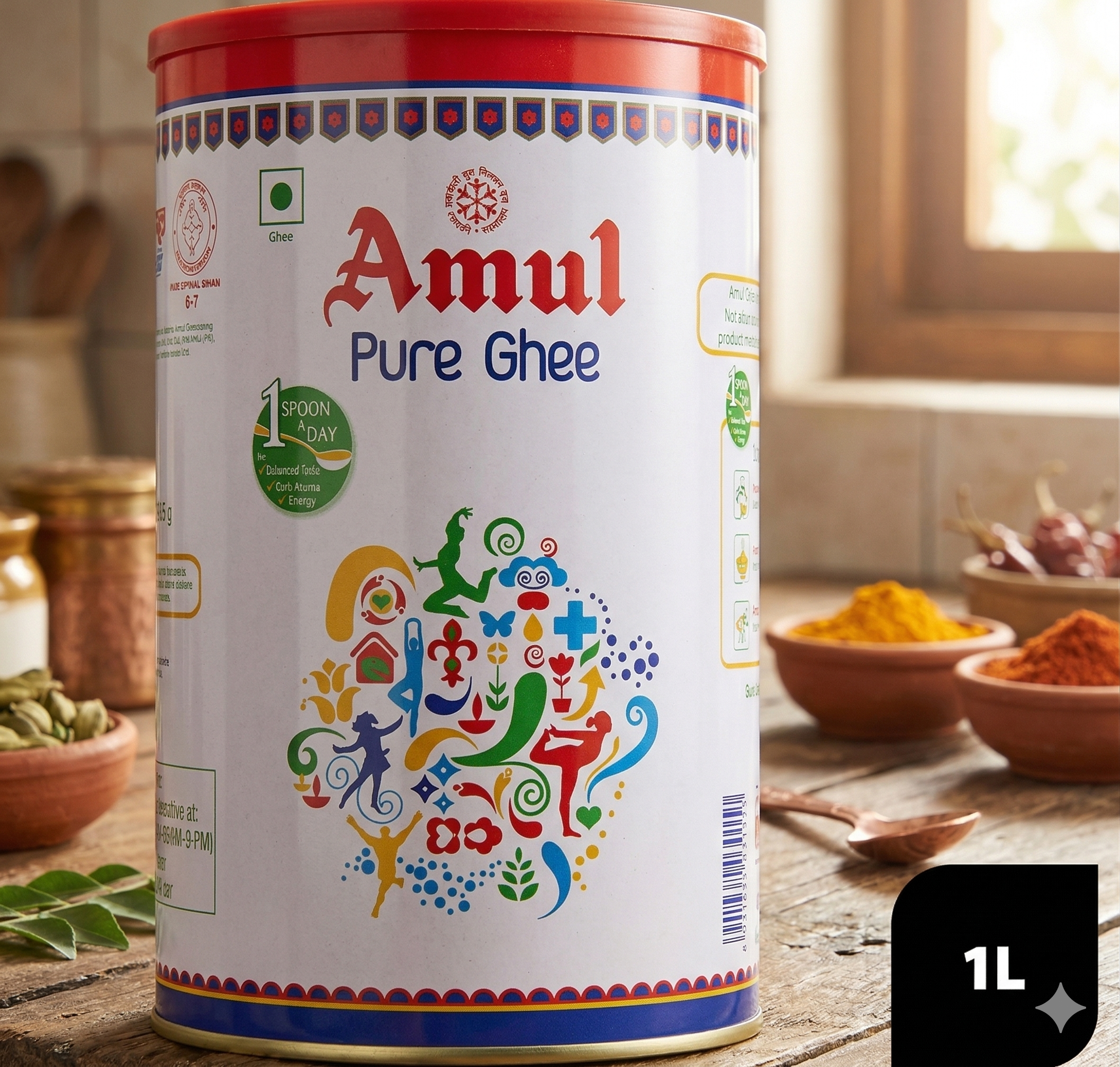


Amul Pure Ghee — Is 1g Trans Fat a Deal Breaker?
The Trans Fat Question — Read This First
The label shows 1g trans fat per serving. This is naturally occurring ruminant trans fat (primarily vaccenic acid and CLA) — not the industrial partially-hydrogenated trans fat found in vanaspati and margarine. Natural ruminant trans fats behave differently in the body and are not linked to the same cardiovascular risks as industrial ones. However, at 1g per tablespoon, it’s worth monitoring your total daily intake.
Full Nutrition Facts Decoded
All values are per 1 tablespoon serving (14g). % Daily Value based on a 2,000 calorie diet.
| Nutrient | Per Serving (14g) | % Daily Value | What It Means | Verdict |
|---|---|---|---|---|
| Calories | 130 kcal | — | 100% from fat — no protein or carb calories at all | ⚠ Dense One of the most calorie-dense foods. A tablespoon is the right serving — don’t pour. |
| Calories from Fat | 130 kcal | — | All 130 calories come purely from fat | Note Unlike oils that have 120 cal/tbsp, ghee has 130 — slightly denser due to no water content. |
| Total Fat | 14 g | 22% | Virtually all is fat — ghee is ~99.5% fat by weight | ⚠ High 22% of your daily fat in one tablespoon. Use measured amounts. |
| Saturated Fat | 9 g | 45% | Short, medium and long-chain saturated fats — energy-dense, stable for cooking | ⚠ High 45% DV in one serving. Safe in moderation but don’t exceed 2 tbsp/day if sedentary. |
| Trans Fat | 1 g | — | Naturally occurring ruminant trans fat (vaccenic acid + CLA) — NOT industrial trans fat | ⚠ Read note above Natural trans fat ≠ harmful trans fat. Still, 1g is notable and warrants mindful use. |
| Cholesterol | 30 mg | 10% | Dietary cholesterol from butterfat — less impactful on blood cholesterol than previously believed | Note 30mg per tbsp is moderate. Research shows dietary cholesterol has limited effect on most healthy adults. |
| Sodium | 0 mg | 0% | Naturally sodium-free | ✓ Clean Safe for people managing blood pressure or sodium intake. |
| Total Carbohydrate | 0 g | 0% | Lactose is removed during clarification — zero carbs remain | ✓ Zero Keto-friendly, diabetic-safe from a carb perspective. |
| Protein | 0 g | — | All milk proteins removed during ghee-making | ✓ Zero Not a protein source — use alongside protein-rich foods. |
| Vitamin A | 3% DV | 3% | Fat-soluble vitamin — supports vision, immunity and skin | ✦ Present Lower than Cow Ghee (600mcg) — Pure Ghee uses a buffalo+cow milk blend with less carotene. |
Fat Composition Breakdown
Not all fat is the same. Here’s what the 14g of fat in Amul Pure Ghee actually consists of, and what each type does for — or to — your body.
| Fat Type | Approx. Amount | Role in Body | Verdict |
|---|---|---|---|
| Saturated Fat | 9g / serving | Energy, cell membranes, hormone precursors. Stable at high heat — doesn’t oxidise during cooking | Moderate High but stable. Better for cooking than polyunsaturated oils which oxidise at heat. |
| Monounsaturated Fat | ~3.5g / serving | Heart-healthy fats — same family as olive oil. Raises HDL (good cholesterol) | ✓ Positive About 25% MUFA is a genuine cardiovascular positive in ghee’s profile. |
| Butyric Acid (Short-chain sat fat) | ~0.4g / serving | Feeds colon cells, reduces gut inflammation, supports the intestinal lining | ✦ Standout Ghee is one of the richest food sources of butyrate — excellent for gut microbiome health. |
| CLA (Conjugated Linoleic Acid) | ~0.3g / serving | Linked to fat metabolism, muscle preservation, and anti-inflammatory effects | ✦ Beneficial Natural ruminant CLA — associated with health benefits in multiple studies. |
| Vaccenic Acid (natural trans fat) | ~0.7g / serving | Ruminant-origin trans fat — body converts some to CLA. Different from industrial trans fat | ⚠ Natural Not the same as hydrogenated trans fat. Still, limit total intake to 2–3g/day max. |
Amul Pure Ghee vs Amul Cow Ghee — Key Differences
Many people confuse these two products. Here’s how they compare side by side:
| Parameter | Amul Pure Ghee (Tin) | Amul Cow Ghee (Tetrapack) |
|---|---|---|
| Source | Cow + Buffalo milk blend | 100% Cow milk only |
| Serving size | 14g (1 tbsp) | 13.5g |
| Calories/serving | 130 kcal | ~121 kcal |
| Saturated Fat | 9g (45% DV) | 8.1g (per serving, 37% per 100g) |
| Trans Fat | 1g (natural) | ~0g (trace) |
| Vitamin A | 3% DV (~15mcg) | 600mcg Beta Carotene |
| Colour | Whiter/off-white (buffalo influence) | Golden yellow (cow Beta Carotene) |
| Smoke point | ~250°C | ~250°C |
| Lactose content | Negligible (trace) | Negligible (trace) |
| Best for | High-heat cooking, daily use | Nutrition + cooking, higher Vitamin A |
The Honest Verdict
Amul Pure Ghee is a high-quality, traditional Indian cooking fat that earns its place in the kitchen — but it’s not a perfect nutrition product. The natural trans fat (1g/serving) is from ruminant sources and is not directly comparable to dangerous industrial trans fats, but it’s something to be aware of if you’re using ghee generously.
The real concern is portion size. One tablespoon is fine. Three tablespoons on parathas is not — that’s 45% saturated fat and 3g of ruminant trans fat in one meal.
👍 What Works
- Zero carbs, zero sugars — diabetic-friendly
- Zero sodium — safe for blood pressure management
- Butyric acid content — excellent gut health support
- High smoke point (~250°C) — safer than refined oils for Indian cooking
- Lactose-free — suitable for most lactose-intolerant people
- CLA content — natural fat metabolism support
👎 Watch Out For
- 1g trans fat per serving — natural but adds up with heavy use
- 45% DV saturated fat in just one tablespoon
- Only 3% Vitamin A — much lower than Cow Ghee
- 130 cal/tbsp — easy to overconsume without measuring
- Cholesterol at 10% DV — monitor if managing lipid levels
⚠️ This review is based on nutritional label analysis and published food science. It is not medical or dietary advice. People with cardiovascular disease, high cholesterol, or specific dietary needs should consult a registered dietitian before making changes.