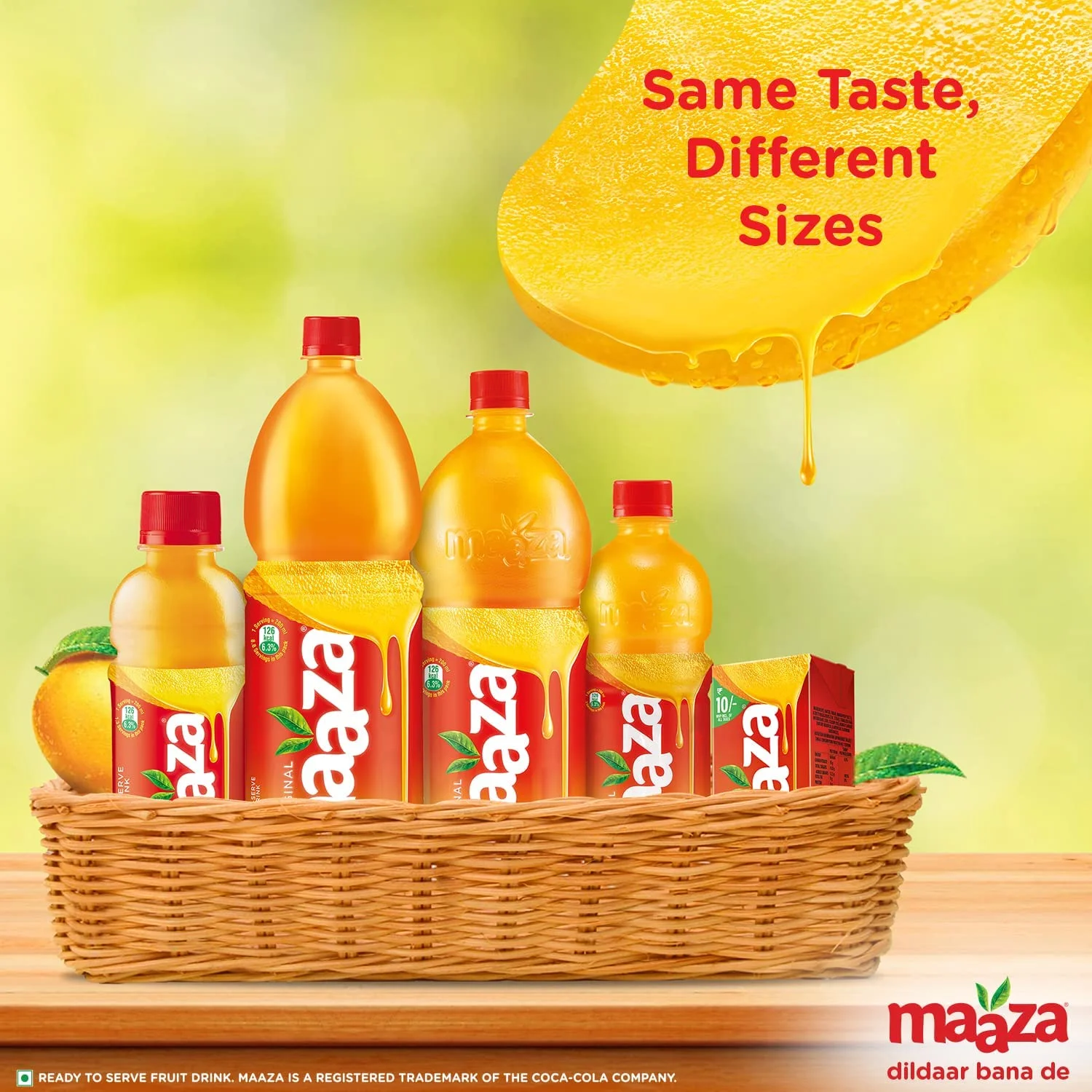


MAAZA
19.5% Mango Pulp, 13g Sugar, and a Synthetic Colour — the full honest breakdown
19.5% Mango Pulp — The Best Number on This Label
At 19.5% mango pulp, Maaza is listed as a “fruit drink” — a category that requires a minimum of 10% fruit content under FSSAI rules. Maaza nearly doubles that minimum, which makes it genuinely more fruit-forward than most mango-flavoured beverages. Real mango pulp provides beta carotene (Vitamin A precursor), small amounts of Vitamin C, and natural mango flavour compounds. This is the key differentiator from synthetic mango squash or soda.
13g Sugar Per 100ml — 52% of WHO Daily Limit in a 250ml Glass
Maaza contains 13g of sugar per 100ml. A standard 250ml serving delivers 32.5g sugar — 130% of the WHO’s recommended 25g daily free sugar limit, all in one drink. A 1-litre bottle contains 130g sugar — 32.5 teaspoons. This sugar comes from both the mango pulp and added cane sugar. The label does not separately disclose “added sugar” vs natural mango sugar, but given that mango pulp at 19.5% would contribute ~3–4g sugar and the drink has 13g total — approximately 9g is added refined sugar.
Sugar teaspoons in a 250ml glass of Maaza (32.5g = ~8 teaspoons, each cube = 4g)
■ Orange = within WHO daily limit (25g) · ■ Red = above WHO daily limit · Total per 250ml: 32.5g (8+ tsp)
Full Nutrition Facts — Per 100ml
Based on the label values. Serving size is not declared — typical consumption is 200–250ml per glass or a full 600ml–1L bottle.
| Nutrient | Per 100ml | Per 250ml Glass | Per 600ml Bottle | What It Means | Verdict |
|---|---|---|---|---|---|
| Energy | 54 kcal | 135 kcal | 324 kcal | All calories from sugar — zero fat or protein calories. A 600ml bottle is like eating 5 teaspoons of sugar | ⚠ Empty calories 135 kcal per glass — manageable, but purely from sugar with no fibre or protein to slow absorption. |
| Carbohydrates | 13.5 g | 33.75 g | 81 g | Nearly all carbs are sugar — 13g of 13.5g total carbs is sugar (96%) | ✖ Almost all sugar Negligible fibre or starch — rapid glycaemic spike similar to a soft drink. |
| Sugar | 13 g | 32.5 g | 78 g | Combination of natural mango sugar (~3–4g) and added cane sugar (~9g) per 100ml | ✖ High 130% of WHO daily free sugar limit in one standard glass. The dominant health concern. |
| Protein | 0 g | 0 g | 0 g | All milk proteins, fibre, and complex nutrients removed in the fruit drink processing | Zero Not a protein source. |
| Fat | 0 g | 0 g | 0 g | No fat of any kind | ✓ Zero Not a fat concern. |
Every Ingredient Decoded
Full ingredient list: Water, Mango Pulp (19.5%), Sugar, Acidity Regulator (INS 330), Antioxidant (INS 300), Preservative (INS 202), Permitted Synthetic Food Colour (INS 110), Added Mango Flavours (Natural, Nature Identical and Artificial Flavouring Substances).
| Ingredient | Amount | What It Is | Role | Health Note | Verdict |
|---|---|---|---|---|---|
| Water | ~65–70% (est.) | Purified water — the base of the drink | Carrier and dilutant for all other ingredients | Standard purified water — no concerns | ✓ Clean |
| Mango Pulp | 19.5% | Real mango pulp — likely from Alphonso or Kesar variety. Contains natural mango sugars, beta carotene, and trace Vitamin C | Primary flavour and “fruit drink” qualifier. Provides natural mango taste, texture, colour, and trace micronutrients | Real fruit pulp is a genuine positive — contributes beta carotene (Vitamin A precursor), natural antioxidants. At 19.5%, it’s a meaningful amount — nearly 50g per 250ml serving | ✦ Best ingredient Nearly double the FSSAI minimum for fruit drinks. The nutritional hero of this product. |
| Sugar | Undisclosed % | Refined cane sugar — primary sweetener added to boost sweetness beyond what mango pulp provides | Sweetness, palatability, and calorie contribution. Estimated ~8–10% of the formulation based on 13g sugar/100ml minus mango natural sugar | The main nutritional concern — free sugar added on top of natural mango sugar. The label doesn’t disclose the exact added sugar quantity separately | ✖ Primary concern Undisclosed quantity of added sugar. The two-sugar stack (natural + added) creates a high glycaemic load. |
| INS Code | Name | Category | Purpose | Safety Note | Verdict |
|---|---|---|---|---|---|
| INS 330 | Citric Acid | Acidity Regulator | Controls pH, adds tartness to balance the sweetness, improves shelf stability. The sour note in mango drinks | Derived from citrus fermentation. GRAS status globally. Can contribute to dental enamel erosion with regular sipping — drink quickly rather than slowly | ✓ Safe One of the most widely used and studied food additives. |
| INS 300 | Ascorbic Acid (Vitamin C) | Antioxidant | Prevents oxidation and browning of the mango pulp — preserves the orange-yellow colour and fresh mango aroma during storage | Vitamin C — genuinely beneficial. Adds to the drink’s Vitamin C content. Important note: combined with sodium benzoate (INS 211) it can form benzene — but Maaza uses potassium sorbate (INS 202), NOT sodium benzoate, so this combination risk does not apply here | ✦ Genuinely positive Vitamin C as antioxidant — adds nutritional value while serving a functional role. No concerns. |
| INS 202 | Potassium Sorbate | Preservative | Broad-spectrum antimicrobial — prevents mould, yeast, and bacterial growth. Extends shelf life without refrigeration | One of the most studied and safest food preservatives. GRAS status with FDA, EFSA, and FSSAI. No toxicity at food levels. Does NOT form benzene with Vitamin C (unlike sodium benzoate) | ✓ Safe A thoughtful choice of preservative — potassium sorbate over sodium benzoate is a better option. Well-tolerated. |
| INS 110 | Sunset Yellow FCF | Synthetic Food Colour | Amplifies and standardises the bright orange-yellow colour of the drink — makes every batch visually consistent regardless of mango season variation | One of the “Southampton Six” synthetic azo dyes studied in a 2007 UK FSA study linking these colours to hyperactivity in children. Banned/restricted in several countries. EU requires a warning label: “may have an adverse effect on activity and attention in children.” FSSAI permits it in India with no warning requirement | ✖ Concern for children The main flag in Maaza’s label. Real mango pulp already provides natural colour — this synthetic dye is used purely for visual enhancement. Avoidable. Parents should note for young children. |
| Type | What It Means | Role | Verdict |
|---|---|---|---|
| Natural Mango Flavours | Flavour compounds extracted directly from real mango or other natural sources | Enhances and intensifies the real mango taste — the natural fraction | ✓ Natural Derived from real sources. No concerns. |
| Nature Identical Mango Flavours | Synthetic molecules that are chemically identical to natural mango flavour compounds (e.g. mangifera lactone, myrcene) | Provides consistent, intense mango flavour independent of seasonal variation in pulp quality | ⚠ Synthetic but identical Not from real mango but chemically the same as natural molecules. Safe, widely used. |
| Artificial Mango Flavours | Synthetic compounds that create mango-like taste but are not chemically identical to natural mango flavour molecules | Boosts the mango taste profile — the “artificial” fraction of the three-part flavour blend | ⚠ Fully synthetic Legal and safe at food levels. Presence of artificial flavours alongside real pulp indicates the natural fruit taste is supplemented significantly. |
Maaza vs Competitors — How Does It Compare?
| Parameter | Maaza | Frooti | Slice | Raw Pressery Mango |
|---|---|---|---|---|
| Mango Content | 19.5% | ~13% | ~13–15% | ~50%+ |
| Calories/100ml | 54 kcal | ~58 kcal | ~60 kcal | ~70 kcal |
| Sugar/100ml | 13g | ~14g | ~14g | ~15g (mostly natural) |
| Added sugar disclosure | Not separate | Not separate | Not separate | Minimal added |
| Synthetic colour | INS 110 ⚠ | INS 110 ⚠ | INS 110 ⚠ | None ✓ |
| Preservative type | INS 202 (sorbate) ✓ | INS 211 + 202 ⚠ | INS 211 + 202 ⚠ | None / cold chain |
| Carbonated | No ✓ | No ✓ | No ✓ | No ✓ |
| Price tier | Budget/mainstream | Budget/mainstream | Budget/mainstream | Premium |
The Honest Verdict
Maaza is one of the better options in the mass-market Indian mango drink category. The 19.5% mango pulp is a genuine positive — nearly double Frooti and Slice — and the choice of potassium sorbate (INS 202) over sodium benzoate (INS 211) is a responsible formulation decision that avoids the benzene-forming combination. The Vitamin C antioxidant (INS 300) adds actual nutritional value.
The concerns are real: 13g sugar per 100ml makes a 250ml glass comparable to a soft drink in glycaemic terms. The INS 110 synthetic colour is unnecessary given the real mango pulp content — and is specifically worth noting for parents of young children. And the three-part flavour system (natural + nature identical + artificial) means the “mango taste” you’re drinking is substantially engineered, not purely fruit-derived.
👍 What Works
- 19.5% mango pulp — best fruit content among mainstream brands
- Potassium sorbate (INS 202) — safer preservative, no benzene risk
- Vitamin C antioxidant (INS 300) — genuinely beneficial additive
- Zero fat, zero protein concerns
- Not carbonated — gentler on teeth and stomach than cola
- Beta carotene from real mango — natural Vitamin A contribution
👎 The Concerns
- 13g sugar/100ml — 130% of WHO daily limit in a 250ml glass
- Added sugar not separately disclosed on label
- INS 110 (Sunset Yellow) — synthetic azo dye, hyperactivity concern for children
- Three-part flavour system includes artificial compounds
- Zero protein, zero fibre — empty calorie profile despite fruit content
- Not suitable as daily beverage — occasional treat only
⚠️ This review is based on ingredient label data and published food science. It is not medical advice. Parents of young children should note the INS 110 colour concern. Individuals managing diabetes or blood sugar should note the high sugar content.