DuckDuckGo’s ‘No AI’ Search
Is Having Its Moment —
And It’s Growing Fast
After Google pushed AI into every corner of its Search at I/O 2026, millions of users started asking a simple question: where do I go if I just want results without the AI? DuckDuckGo had an answer ready.
There is a quiet irony in what happened in the last two weeks of May 2026. Google — the company that essentially invented modern web search, the one whose name became a verb — went so hard on AI that it pushed a measurable chunk of its own users toward a competitor that barely registers in the market share charts. That competitor is DuckDuckGo. And the feature those users ran to? Something called No AI search.
It is easy to dismiss DuckDuckGo’s numbers. The company has about 2% of the US search market. Google has the rest. But the speed and the pattern of what happened after Google’s I/O 2026 announcement on May 19 is worth paying attention to — not because DuckDuckGo is suddenly going to eat Google’s lunch, but because it tells you something real about how people feel about having AI forced on them without a say.
Between May 20 and May 25, DuckDuckGo’s US app installs grew for six straight days in a row. Traffic to noai.duckduckgo.com — the dedicated AI-free search page — averaged 22.7% above baseline week-over-week, peaking at 27.7%. By May 28, visits to that page had tripled. And the numbers held through the Memorial Day weekend, when internet traffic usually drops off. That last detail is the most interesting one. People do not change their search habits during a long weekend. Unless they actually mean it.
What triggered all of this? On May 19, 2026, at Google’s annual I/O conference in Mountain View, the company announced it was replacing traditional search results with an AI-first experience — AI Overviews, AI Mode, agent-style tools. Google’s VP of Search called it the biggest upgrade in 25 years. Plenty of users called it something else entirely.
What Google Actually Changed — And Why It Bothered People
To understand why DuckDuckGo saw such a sharp uptick, you have to understand what Google announced. This was not a minor tweak. Google effectively told users that the familiar list of blue links — the search format that has existed since 1998 — was being replaced with something new and AI-powered. The new experience includes AI Overviews that generate a direct answer at the top of the page, an AI Mode for back-and-forth conversational search, Personal Intelligence that can connect to your Gmail and Google Photos, and Search agents that can independently complete tasks and run background monitoring on your behalf.
Google framed this as progress. And in some ways, it is. AI Mode has crossed one billion monthly users. The company’s VP Elizabeth Reid noted that queries are more than doubling every quarter. For millions of people, the AI-assisted experience works well and they are fine with it.
But for another group — harder to quantify, clearly real — the new Google Search crossed a line. The complaints fell into a few categories. First, that AI Overviews make simple searches unnecessarily complicated. Second, that generated summaries sometimes surfaced wrong information, presented confidently. Third, and perhaps most importantly: there was no obvious way to opt out. If you searched on Google, you got the AI. That was now the default, like it or not.
“Google is force-feeding AI with no way to opt out.”
— Gabriel Weinberg, CEO, DuckDuckGoWeinberg was not being delicate about it, and his users agreed. There is also the open web concern, which is not about personal preference but about money and the future of online publishing. When AI Overviews answer a question directly on the results page, fewer users click through to the website that actually wrote the content. Publishers, bloggers, and news organisations have been watching AI Overviews eat into their referral traffic for a while. Google’s I/O 2026 announcements made it clear this trend was accelerating, not reversing.
The Numbers: What DuckDuckGo’s Data Actually Shows
DuckDuckGo shared its growth data with TechCrunch and MacRumors following the surge. Here is what the numbers look like, laid out plainly:
The Memorial Day detail is the one analysts will keep coming back to. Internet usage tends to dip over long weekends in America. People go outside, spend time with family, and are generally less glued to their phones for work-related tasks. The fact that DuckDuckGo’s growth held — and in some metrics continued climbing — through that period suggests this was not just a news-cycle reaction. These users made a deliberate decision and stuck with it.
The signal that matters most: Sustained 84% above-baseline traffic, even through a holiday weekend, suggests this is genuine behaviour change — not just curiosity clicks driven by a viral news story.
What the No AI Extension Actually Does When You Install It
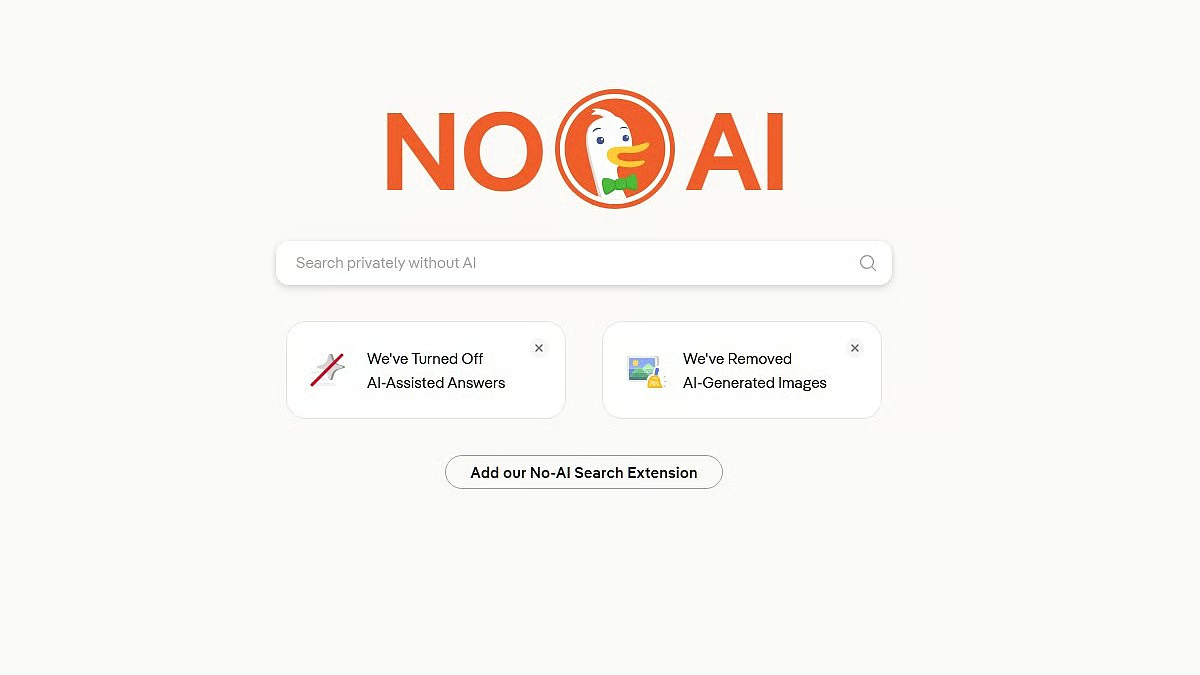
The mechanics are simple. DuckDuckGo has released browser extensions for Chrome and Firefox that, once installed and enabled, set noai.duckduckgo.com as your default search engine. Every time you search from that point forward, you land on an AI-free results page.
What does AI-free actually mean on that page? No AI-generated answer at the top. No chat interface asking if you want to have a conversation with a bot about your query. No AI-generated images mixed into the results. What you get is a clean, ranked list of web links — organised by relevance, without any AI layer sitting between you and the actual content.
For people who grew up searching the internet before AI Overviews existed, this will feel familiar in a way that is oddly refreshing. For people who have only ever searched in the AI era, it might feel sparse. That difference in reaction is itself a useful signal about how divided users have become on this question.
- AI Overviews replace top results
- AI Mode gives conversational answers
- Agent tools run background tasks
- No opt-out from AI by default
- Personal Intelligence links your Gmail and Photos
- Search queries inform AI training
- AI images mixed into results
- Traditional ranked web link results
- No AI-generated answer summaries
- No chat prompts or AI conversation
- Full opt-in — your choice, your setting
- IP address never shared with anyone
- No search history stored or tracked
- Fewer AI-generated images in results
There is also something worth noting about DuckDuckGo browser users specifically. If you already use DuckDuckGo’s own browser — not just the extension on Chrome or Firefox — your AI search preferences are preserved even when you clear your browsing history. That is a detail that matters more than it sounds. Many privacy-conscious users routinely clear their browser data. On most browsers, this resets extension preferences and site settings. DuckDuckGo’s browser treats AI search preferences as something that should survive that kind of reset, by design.
One limitation worth flagging honestly: Safari users on iOS and macOS cannot currently set the No AI URL as their default search engine. Apple’s OS-level architecture limits which search configurations can be set as true defaults. So if you are on an iPhone and want to use DuckDuckGo’s No AI experience, the best path is to switch to DuckDuckGo’s own browser app rather than relying on Safari.
The Rollout Plan: Chrome and Firefox First, Edge and Opera Next
Right now, the dedicated No AI search extensions are available for Chrome and Firefox. That covers a large majority of desktop users globally — Chrome alone accounts for roughly 65% of the browser market. But DuckDuckGo is not stopping there.
The company has confirmed it will be updating its existing DuckDuckGo Privacy Essentials extensions — already installed by many users on Chrome, Firefox, Edge, and Opera — to include AI search toggle controls. This means Edge and Opera users will not need to install a separate No AI extension. They will be able to manage their AI search preferences directly through the Privacy Essentials extension they may already have.
No exact release date has been confirmed for the Privacy Essentials update. DuckDuckGo described the rollout as happening “in the coming weeks.”
| Browser | Dedicated No AI Extension | Privacy Essentials AI Toggle | Status |
|---|---|---|---|
| 🌐 Google Chrome | Live now | Coming soon | Live |
| 🦊 Mozilla Firefox | Live now | Coming soon | Live |
| 🔷 Microsoft Edge | Not yet available | Coming soon via update | Soon |
| 🎭 Opera | Not yet available | Coming soon via update | Soon |
| 🦆 DuckDuckGo Browser | Built-in, always on | Native (survives history clears) | Always On |
| 🍎 Safari (iOS / macOS) | Cannot be set as default | OS limitation applies | Limited |
Privacy Is the Point — Here Is Exactly What DuckDuckGo Does and Does Not Do
DuckDuckGo’s promise has always been simple: we do not track you. But in 2026, with AI training data becoming one of the most valuable commodities in the technology industry, that promise has taken on new dimensions. It is not just about whether advertisers can target you based on your searches. It is about whether your searches are feeding AI models that you have never consented to train.
DuckDuckGo is very specific about what it does and does not collect. Unlike Google, it does not store your search history. It does not share your IP address with advertisers. It does not track your location. It does not require you to create an account to use any part of the service. And it does not use what you search for — or what you type into its AI tools — to train AI models.
On the AI chat side, DuckDuckGo’s own tool Duck.ai strips your IP address before the request ever reaches the AI model provider. Conversations are deleted within 30 days. The company’s chief communications officer Kamyl Bazbaz confirmed that both the No AI search experience and Duck.ai are among the most-used features on the platform. Users are not choosing between privacy and AI — they are using both, on their own terms.
DuckDuckGo Is Not Anti-AI — It Offers AI Too, Just Differently
This is probably the most misunderstood part of DuckDuckGo’s current positioning. The company is not making a principled stand against artificial intelligence. It offers its own AI assistant, Duck.ai, for free, without requiring an account. Through Duck.ai, users can access several of the best language models available right now:
DuckDuckGo also has a paid subscription that goes beyond AI model access — it includes a VPN service, identity theft restoration, and tools to remove your personal information from data broker sites. The company is building a real business around privacy, not just a protest search engine.
The philosophical difference between what DuckDuckGo is doing and what Google has done is not about whether AI belongs in search. It is about who gets to decide. Google’s new default is: AI is on, it is prominent, and you cannot easily turn it off. DuckDuckGo’s model is: here are your options, including a version with no AI at all, and you pick what works for you. That difference — opt-in versus opt-out — is what the current user migration is really about.
“DuckDuckGo is getting a fresh lift from users who want search without mandatory AI. The spike is small next to Google, but it shows how quickly control has become the real product.”
— Startup Fortune, June 2026The Bigger Question: Will the Users Stay?
Every time Google has done something that annoyed people — a privacy scandal, a product redesign, an antitrust revelation — DuckDuckGo has seen a bump. And every time, the bump has faded. People went back to Google because it was still sitting in their browser bar by default, still the fastest path to the answer they needed.
This time might be different, and this time might not. The honest answer is that nobody knows yet.
The argument for “this time is different” is that the trigger is not a news event — it is a permanent product change. Google has not said it is reverting its AI overhaul. It has said AI Mode now has a billion users and is growing. The AI experience is Google’s strategy, not a temporary test. So users who left because they disliked the new Google Search are not going to find a reason to come back because the old Google Search returns. It will not return. That changes the calculus for long-term retention in a way that a privacy scandal or an antitrust story does not.
The argument against is Google’s distribution advantage, which is enormous and structural. Chrome comes with Google Search built in. Android ships with Google. Countless routers, smart devices, and workplace laptops default to Google without anyone consciously choosing it. DuckDuckGo CEO Gabriel Weinberg testified during Google’s antitrust trial in 2023 that Google’s exclusive default search agreements had actively prevented DuckDuckGo from growing. Those agreements still exist, in various forms.
What to watch: If DuckDuckGo’s No AI numbers remain elevated three months from now — not just in the immediate post-I/O period — that will be a meaningful signal that something structural has changed in how a segment of users relates to AI-first search. If the numbers drift back to baseline by September, it was a bump, not a turning point.
There is also a quieter story running alongside the consumer one, which is about the open web. When AI Overviews answer questions directly on the results page, fewer users click through to the publisher that wrote the article, ran the study, or built the tool being described. That is a real financial problem for the websites and creators who generate the content that AI systems consume. DuckDuckGo’s No AI positioning is not just appealing to individual privacy preferences. It is appealing to everyone who depends on search traffic as part of their livelihood — publishers, writers, independent website owners, and small businesses. That is a broader coalition than DuckDuckGo has historically been able to reach.
People Also Ask — DuckDuckGo No AI Search
What exactly is DuckDuckGo’s No AI search?
It is a dedicated version of DuckDuckGo’s search engine available at noai.duckduckgo.com that removes all AI-generated content from your results. No AI summary at the top, no chat interface, no AI images — just a clean list of web links, the way search worked before generative AI entered the picture. Browser extensions for Chrome and Firefox set it as your default so every search goes there automatically.
Why did DuckDuckGo suddenly start growing in May 2026?
Google’s I/O 2026 conference on May 19 was the trigger. Google announced the most dramatic overhaul to its Search product in 25 years — replacing traditional results with AI Overviews, an AI Mode, and Search agents. Many users disliked the change and started looking for alternatives. DuckDuckGo’s No AI search page, which had existed quietly for a while, suddenly became the obvious destination for people who wanted search without the AI layer. Traffic tripled within days.
Which browsers currently support the No AI extension?
Chrome and Firefox have the dedicated No AI extension right now. DuckDuckGo has confirmed that Edge and Opera support is coming, as part of an update to its existing Privacy Essentials extensions on those browsers. DuckDuckGo’s own browser has AI settings built in and they persist even when you clear your history. Safari users face an Apple limitation — you cannot set the No AI URL as default in Safari, so the DuckDuckGo browser app is the better option on iPhone and Mac.
Does DuckDuckGo track searches or sell data?
No. DuckDuckGo does not store your search history, does not log your IP address, does not track your location, and does not require an account. It does not sell your data to advertisers and does not use your searches to train AI models. When you use Duck.ai, your IP is stripped before the request reaches the AI model provider, and your conversation is deleted within 30 days. The whole model is built around not collecting what it does not need.
Is DuckDuckGo against AI altogether?
Not at all. DuckDuckGo has its own AI assistant called Duck.ai, which gives free access to Claude 4.5 Haiku, Meta’s Llama 4 Scout, Mistral Small 3 24B, and OpenAI’s GPT-5 mini — no account needed. The company also offers a paid subscription with a VPN, identity theft restoration, and personal data removal tools. The No AI search option exists alongside these. DuckDuckGo’s position is that users should choose whether they want AI in their search results, not have it imposed on them.
Will DuckDuckGo’s growth last, or will people go back to Google?
Nobody knows for certain. Previous DuckDuckGo surges have faded when the news cycle moved on. But this one is different in one key way: the trigger is a permanent product change at Google, not a news event. Google is not reverting its AI-first Search. So users who left because they disliked the new experience have less reason to return than they did in past surges. Whether that is enough to break Google’s distribution advantage — built into browsers, phones, and devices by default — remains the unanswered question.
What did Google announce at I/O 2026 that caused the backlash?
Google replaced its traditional blue-link search results with an AI-first experience including AI Overviews (auto-generated answer summaries), AI Mode (conversational back-and-forth search), Personal Intelligence (AI that connects to your Gmail and Google Photos), and Search agents (autonomous tools that can complete tasks and run background monitoring). Critics said it complicated simple searches, generated inaccurate answers with false confidence, reduced transparency about sources, and eliminated meaningful user control over whether AI appeared in results.

Pankaj Dubey is an entrepreneur, business analyst, digital marketer, financial researcher, and brand strategist. He specializes in developing marketing strategies, building and positioning brands, and conducting in-depth business and financial research. He is also known for creating detailed case studies on reputed brands, analyzing market trends, and sharing insights through his writing and blogging. His work combines business intelligence, strategic thinking, and digital innovation to help businesses grow and strengthen their market presence.