Your complete, plain-English guide to India’s Central Bank Digital Currency — what it is, how it works, how to get it, and why it matters for every Indian.
What Exactly Is the Digital e-Rupee (e₹)?
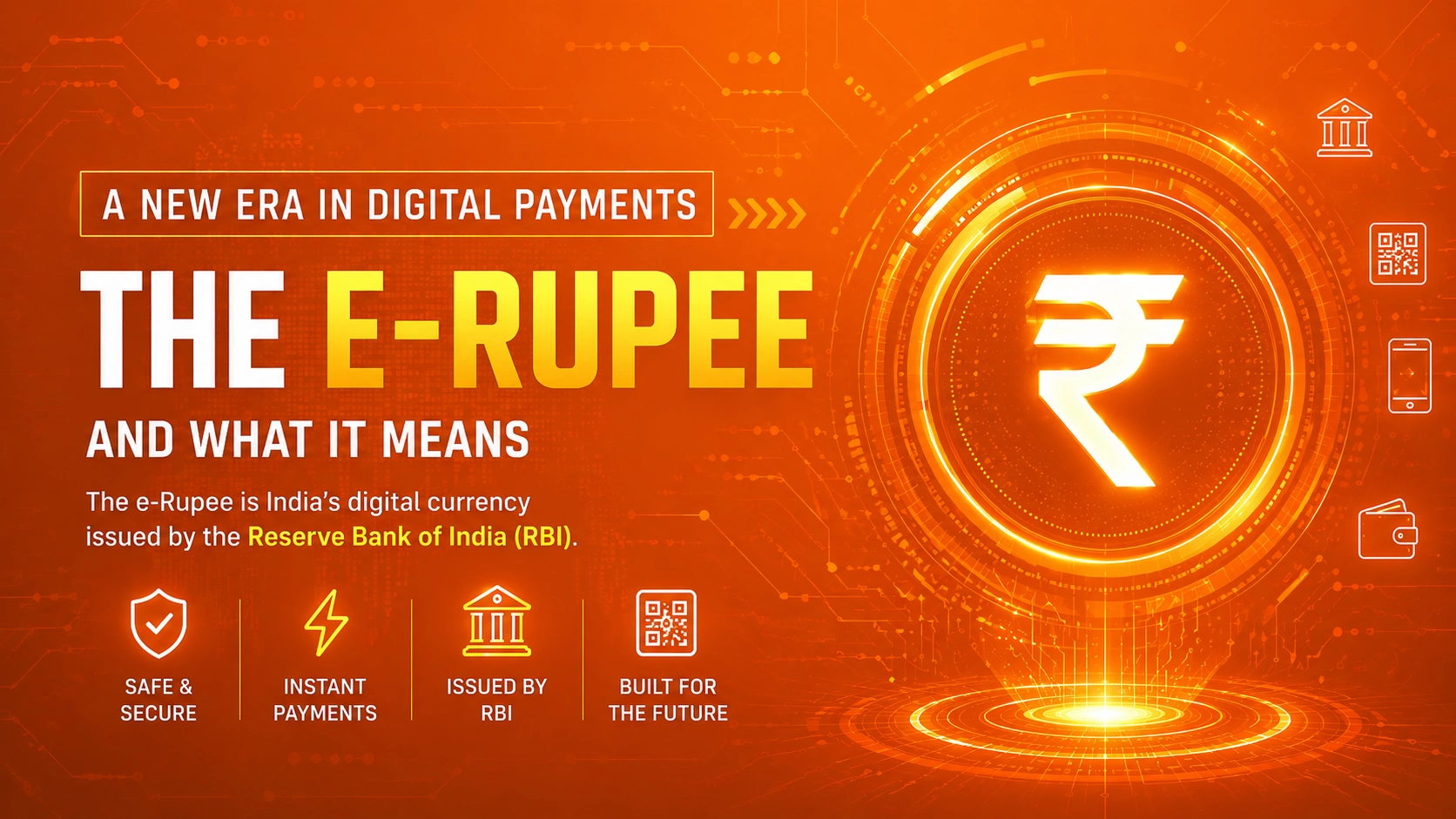
Simply put, the Digital e-Rupee, also known as e₹, is a legal tender and digital version of physical cash issued directly by the Reserve Bank of India (RBI). It has the exact same value as paper money — 1 digital rupee = ₹1 cash, no more, no less.
The Retail Digital Rupee (CBDC-R)
The retail e-rupee — formally called Central Bank Digital Currency (Retail) or CBDC-R — is a digital version of physical cash. It is issued in the same denominations as current banknotes and coins (₹50, ₹100, ₹200, ₹500, etc.) but exists entirely in electronic form. Unlike money in your bank account, the e₹ is a token — it is the money itself, not a representation of it.
The e-rupee is available in electronic form and works as a prepaid digital token sent to the beneficiary’s mobile phone via an SMS or a QR code. The beneficiary can redeem it at any merchant that accepts UPI e-prepaid vouchers — without needing a card, payment app, or even internet banking. It is authorised by a verification code shared by the beneficiary.
(always)
the pilot
voucher
validity
earned
Important: The e-rupee is not a cryptocurrency. It does not fluctuate in value, is not decentralised, carries no investment risk, and is fully backed and issued by the RBI — just like physical currency. Think of it as a digital banknote, not Bitcoin.
The e-rupee was launched to promote digital payments, reduce dependence on physical currency, and enable a new class of programmable, traceable welfare disbursements by the government — all while keeping the currency firmly under the control of India’s central bank.
How to Buy / Get the RBI Digital e₹
You don’t “buy” the e-rupee the way you buy shares or crypto. You load it into a digital wallet by converting your regular bank balance. Here’s how to get access:
Phase-wise rollout of banks
The RBI launched the e₹ pilot in a phased approach, selecting banks gradually before a full rollout. The pilot began in four cities — Mumbai, Bengaluru, New Delhi, and Bhubaneswar — before expanding nationwide.
Pro tip: The e₹-R wallet is separate from your UPI apps or bank account. It stores the digital tokens directly — like physical notes in a physical wallet. You can also download the standalone e-RUPI app from the Google Play Store or Apple App Store and link it to your bank account.
How to Use the Digital e-Rupee in India
Using the digital rupee is designed to feel as simple as handing over physical cash — but entirely from your smartphone. Here is how the system works end to end:
Government & Welfare Use: The e-rupee is especially powerful for government agencies. It enables programmable, transparent welfare payments and subsidies — for example, an e₹ voucher for cooking gas subsidies can only be spent on LPG, preventing leakage and corruption. This is a game-changer for India’s Direct Benefit Transfer (DBT) architecture.
How is the Digital e-Rupee Different from UPI?
This is the most common question — and the answer is more fundamental than most people expect. UPI and e₹ are not competing technologies; they are fundamentally different in nature.
UPI is a payment rail — a system for moving money between bank accounts. When you pay via UPI, you instruct your bank to debit your account and credit another bank’s account. The money travels through multiple settlement systems (RBI, NPCI, banks). It is always “in transit” until the inter-bank settlement is complete. This introduces a small but real settlement risk.
e₹ is the money itself in digital form. When you send someone e₹, the digital token moves directly from your wallet to theirs — just like handing over a physical banknote. There is no intermediary bank, no settlement delay, no transit risk. The money is the receiver’s property the instant the transaction completes. This is settlement finality — the same guarantee physical cash provides.
| Parameter | 🔵 UPI | 🟢 Digital e₹ |
|---|---|---|
| What is it? | Payment messaging rail | Digital currency (token) |
| Intermediary needed? | Yes — banks & NPCI | No — direct wallet-to-wallet |
| Settlement | Deferred (T+1 or intraday) | Instant (settlement finality) |
| Settlement risk | Exists (small) | Zero |
| Bank account required? | Yes | No (wallet only) |
| Works offline? | No | Yes (RBI offline feature) |
| Interest earned? | Yes (on bank balance) | No (like physical cash) |
| Anonymity | Limited | Possible for small values |
| Programmability | Limited | High (earmarked for specific uses) |
| Issued by | NPCI (infrastructure) | RBI directly |
“With e-rupee, there is no intermediary. It is the electronic equivalent of handing cash over to another person — the money is never ‘in transit’, and there is no need for inter-bank settlement.”
Why Did the RBI Launch the Digital e-Rupee?
The RBI’s concept document, published ahead of the e₹ launch, outlined four principal motivations:
Cut physical cash costs Printing, storing, transporting, and destroying physical currency costs the government thousands of crores each year. A digital rupee eliminates much of this overhead while maintaining sovereign legal tender status.
Accelerate digital payments India’s digital payments revolution via UPI has been transformational, but cash still dominates in rural and semi-urban areas. e₹ — especially with its offline feature — can reach where UPI still struggles.
Drive financial inclusion The Offline feature of e₹ enables transactions in remote areas with poor connectivity. Even without a bank account, a citizen can hold and spend e₹ via a basic mobile phone.
Safe alternative to crypto Private cryptocurrencies like Bitcoin carry extreme volatility and regulatory uncertainty. e₹ gives Indians a safe, RBI-backed digital currency with zero investment risk and full legal standing.
Who benefits most? Government agencies using it for targeted welfare delivery · Remote and rural citizens gaining access via offline mode · Businesses wanting instant, guaranteed settlement · Individuals seeking anonymous small-value transactions
Who Can Use the Digital e-Rupee?
The digital e-rupee is designed to be accessible to every Indian citizen, business, and government body. Here’s a breakdown of who benefits most and how:
Digital e-rupee is especially useful for government agencies and regulatory bodies. It enables them to provide welfare benefits and subsidies to the intended beneficiaries transparently and efficiently. e-RUPI also ensures that the funds are used for the specific purpose or activity for which they are issued — thus preventing leakage and corruption. For example, a fuel subsidy voucher can only be redeemed at a fuel pump, and an education voucher only at a school.
You can use e-RUPI for personal or business transactions — buying goods and services, paying bills, booking tickets, or making everyday payments. Any Indian citizen with a mobile phone and an account with a participating bank can register for a digital rupee wallet. Even those without a traditional bank account can hold and spend e₹ using a basic mobile device, making it a powerful tool for financial inclusion.
Unbanked & Underbanked Citizens Those without access to traditional banking can hold and spend e₹ using just a mobile phone — no bank account required.
Rural & Remote Residents With the offline feature, e₹ can be transacted without internet or mobile network — reaching India’s most connectivity-challenged regions.
Merchants & Small Businesses Any UPI-enabled merchant can accept e₹ via QR code — no separate hardware or app needed beyond existing QR infrastructure.
Corporates & Institutions Businesses can use the wholesale CBDC (CBDC-W) for large-value inter-bank and intercompany settlements with instant settlement finality.
Key use case — Government Welfare: The government can issue e₹ earmarked for specific schemes — cooking gas subsidies, food coupons, education fees, healthcare — ensuring every rupee reaches the right beneficiary and is spent on the right purpose. This makes e-RUPI a revolutionary tool for India’s Direct Benefit Transfer (DBT) architecture.
What Does the Digital e-Rupee Mean for Everyday Users?
With the digital rupee, we could be looking at a whole new era of convenience in digital payments. Transferring funds will be the literal equivalent of handing cash over — totally instantaneous, with no intermediary involved. Here is what the e₹ means for you in practice:
“A digital currency would reduce dependence on cash, reduce fraud in digital transactions, and let the government improve the direct transfer of funds to scheme beneficiaries — with zero leakage.”
Benefits of the Digital e-Rupee
The digital rupee brings a set of advantages that make it a convenient and efficient option for both consumers and businesses. Here are the core benefits:
In addition to the above core benefits, the digital e-rupee also delivers:
Note on interest: Like physical cash, the digital e-rupee does not earn any interest. This is by design — the RBI wants e₹ to function as a medium of exchange (spending money), not a savings instrument. If you want your money to earn returns, keep it in a savings account, FD, or mutual fund.
Which Banks Support Digital e-Rupee?
The RBI’s e₹ pilot has expanded steadily. Here are all 19 banks currently participating in the digital rupee programme:
| # | Bank Name | Type | Pilot Phase |
|---|---|---|---|
| 1 | State Bank of India (SBI) | Public Sector | Phase 1 |
| 2 | ICICI Bank | Private Sector | Phase 1 |
| 3 | Yes Bank | Private Sector | Phase 1 |
| 4 | IDFC FIRST Bank | Private Sector | Phase 1 |
| 5 | HDFC Bank | Private Sector | Phase 2 |
| 6 | Union Bank of India | Public Sector | Phase 2 |
| 7 | Bank of Baroda | Public Sector | Phase 2 |
| 8 | Kotak Mahindra Bank | Private Sector | Phase 2 |
| 9 | Punjab National Bank (PNB) | Public Sector | Expanded |
| 10 | Canara Bank | Public Sector | Expanded |
| 11 | Indian Bank | Public Sector | Expanded |
| 12 | UCO Bank | Public Sector | Expanded |
| 13 | Bank of Maharashtra | Public Sector | Expanded |
| 14 | Bank of India | Public Sector | Expanded |
| 15 | Axis Bank | Private Sector | Expanded |
| 16 | IndusInd Bank | Private Sector | Expanded |
| 17 | Federal Bank | Private Sector | Expanded |
| 18 | Karnataka Bank | Private Sector | Expanded |
| 19 | IDBI Bank | Public Sector | Expanded |
To use the e₹, simply look for the Digital Rupee or e₹ section within your bank’s official mobile app. Alternatively, download the dedicated e-RUPI app from the Google Play Store or Apple App Store, register with your mobile number, and link your bank account to begin.
The Future of Digital e-Rupee in India
The e-rupee could have a transformative effect, deepening and widening the reach of digital payments across India’s farthest corners. It is important to note that the RBI intends the e₹ to complement — not replace — existing forms of money, including physical cash and UPI.
From 4 in Phase 1, the programme now spans all major public and private banks across India.
The offline feature will allow e₹ transactions in remote areas with zero connectivity — a first in digital payments.
Current cap is ₹1 lakh per voucher, though regulators can revise this as the programme matures.
Every Indian with a mobile phone is a potential e₹ user — the largest addressable market for any CBDC globally.
“In the next few years, will the e-rupee become as much a way of life for businesses and consumers as UPI? India’s track record with digital payments — from 0 to ₹20 lakh crore monthly via UPI — suggests the answer may well be yes.”
What to watch for
Cross-border payments: The RBI is actively exploring e₹ for international remittances and trade settlements, which could significantly reduce forex costs for Indian exporters and the diaspora.
Programmable money at scale: Imagine PM Kisan funds that can only be spent on agricultural inputs, or education subsidies that can only be used for school fees. e₹’s programmability could eliminate subsidy leakage entirely.
Interoperability with UPI: Future developments are expected to integrate e₹ seamlessly with existing UPI rails, so users won’t even notice a distinction — they’ll just pay and receive, faster and safer than ever.