The 2009 Document That Predicted UPI, Years Before Anyone Believed It Was Possible
How a quiet RBI vision paper, written when most of India still ran on cash and the iPhone had just landed in the country, sketched out the exact infrastructure that now processes more real-time payments than any system on Earth.
Somewhere in the RBI’s archives sits a document that looks, at first glance, like nothing special. It’s a vision paper. Dry, bureaucratic, easy to skim past. But the date on it is the strange part: July 2009. And buried on its second-last page, under a section titled “New Projects / Major Initiatives,” is a line that shouldn’t exist in a document from that year.
It talks about a “mobile payments settlement network.” It talks about facilitating real-time transfer of funds. It talks about building a national infrastructure for mobile payments.
Read that again, and then remember what 2009 actually looked like in India. Cash was still king. Smartphones were a luxury item. Mobile internet crawled. The iPhone 3GS had only just become the first officially launched iPhone in the country. And yet, somehow, the RBI was already describing something that reads almost exactly like UPI.
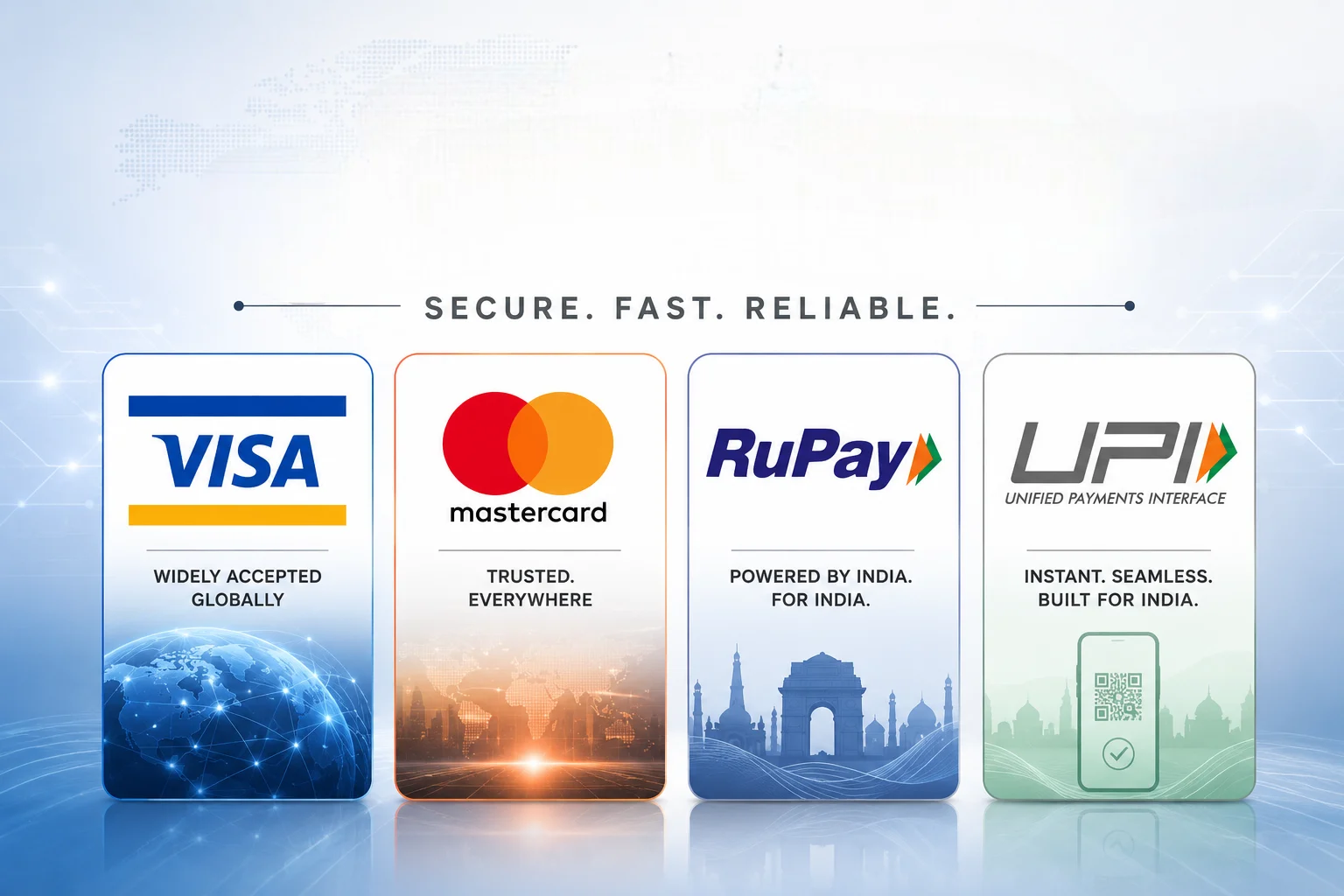
It doesn’t stop there. Two bullet points above that entry sits another project, simply named “India Card.” Years later, that idea would become RuPay — India’s own card network. Long before India’s digital payments revolution had even begun, the blueprint for it was already sitting in a government file.
Fast-Forward: What That Blueprint Became
Today, that blueprint runs at a scale that would have sounded like fiction in 2009. Every single day, Indians make more than 76 crore UPI transactions. Roughly one out of every two real-time digital payments on the planet now happens through UPI.
Zoom into a single month and the pace becomes even clearer: in June 2026 alone, UPI processed over 22 billion transactions, up 23% year-on-year, moving more than ₹28 lakh crore in value. That works out to well over 8,700 payments going through every single second of every single day.
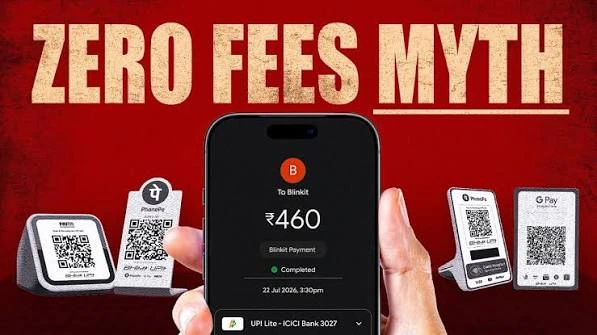
Think about what actually happens in the background every time someone scans a QR code. A payment has to be authenticated, routed, cleared and settled. Money has to move securely between two different banks — all within a few seconds. And yet, you don’t pay a single rupee for it.
So who is actually paying for all of this? The RBI governor himself has openly warned that UPI cannot remain free forever.
To understand why that warning matters, we first need to understand how the rest of the world’s payment networks make their money — because what Visa and Mastercard spent decades building is precisely the model India chose not to copy.
The Visa & Mastercard Playbook
Here’s the strange part about Visa and Mastercard: neither of them actually issues a card. They simply put their logo on cards issued by banks. So what exactly are they charging for?
Imagine buying a 100-rupee burger at McDonald’s with an SBI credit card. You’d expect McDonald’s to receive the full 100 rupees. It doesn’t. McDonald’s receives only 97. That missing 3 rupees is called the Merchant Discount Rate, or MDR — and it gets split three ways: a share to SBI for issuing the card, a share to the merchant’s bank for accepting the payment, and a share to Visa or Mastercard for operating the network the payment travelled on.
Three rupees sounds trivial, until the scale kicks in. Visa processed over 311 billion transactions last year. Mastercard processed another 204 billion. A tiny fee, multiplied across those numbers, becomes one of the most durable, profitable business models ever built — which is exactly why investors nickname these companies “forever stocks.”
Why the same model breaks in India
This model works beautifully in New York. It falls apart on a roadside stall in India. Picture a vendor selling a 10-rupee pen or a 20-rupee cup of tea — giving away a few rupees on every single sale quietly destroys their margin. Add to that the upfront cost of an expensive POS machine, and the math simply never works. For millions of small merchants, cash stayed the rational choice, because cash was cheaper.
This is exactly the gap the 2009 vision document had already spotted. RBI understood that India could not simply import the Western card model — if it tried, digital payments would stay confined to malls, airports and large retail chains, and everyone else would remain locked out. There was a second worry too: at the time, every digital payment in the country ultimately depended on a foreign network. One of India’s most critical pieces of financial infrastructure wasn’t actually controlled by India.
Building an Alternative, Brick by Brick
- NPCI is born RBI and the Indian Banks’ Association set up the National Payments Corporation of India — structured, unlike Visa or Mastercard, as a non-profit. That single design choice would shape everything that followed.
- UPI launches quietly In April 2016, NPCI rolls out the Unified Payments Interface. Person-to-person transfers are free from day one; merchant payments still carry a 0.3% MDR — a fraction of the roughly 2% charged by traditional cards, but still enough to make small shopkeepers hesitate.
- The first nudge The government begins reimbursing MDR on transactions under ₹2,000, softening the cost for smaller merchants.
- The MDR is scrapped entirely In January 2020, merchant MDR on UPI is removed completely. Overnight, UPI payments become genuinely free for merchants — and adoption among shopkeepers explodes. Transaction volumes visibly inflect upward from this point on.
What looked like a small policy tweak turned out to be the single biggest lever in UPI’s growth story. Once the cost barrier disappeared, so did the last reason for small merchants to stick with cash.
UPI, By the Numbers, Today
The scale is only half the story — the shape of that scale is the more interesting part. Today, 85.5% of all transactions in India happen on UPI, while only 2.6% happen on credit cards of any kind. FY2025-26 alone saw 24,161.69 crore transactions go through UPI, worth ₹314.23 lakh crore — up from 18,586.60 crore transactions worth ₹260.56 lakh crore the year before. Person-to-merchant payments now make up 63% of that volume, and within that, 86% of all merchant payments are for less than ₹500 — proof that UPI’s real growth story is happening at the smallest end of the economy, not the largest.
People clearly use UPI for everyday spending, while large-ticket purchases still gravitate toward credit cards. There’s an even more telling number hidden in the trend line: the average UPI transaction value has actually fallen, from around ₹1,700 to about ₹1,300 over time.
On the surface, a shrinking average ticket size might look like weakness. It isn’t. It’s the opposite. It means UPI is pushing deeper into places cards never reached — tea stalls, vegetable carts, neighbourhood kirana stores. The smaller the average payment gets, the deeper the network has penetrated into everyday India. A payments network doesn’t prove itself when the wealthy use it; it proves itself the day someone pays for a ₹30 packet of milk digitally instead of in cash. That was the RBI’s goal all along.
So, Who Actually Pays for UPI?
Running this system is anything but free. It needs servers online every hour of every day, engineers on call around the clock, and terabytes of bandwidth moving continuously. Someone has to fund that.
1. The Government
For 2026, the Government of India is budgeting around ₹2,000 crore in subsidy, split between banks and third-party app providers to compensate for the lost MDR revenue. It sounds substantial — until you realise it covers only about 11% of the system’s total cost. The remaining 89% has to come from somewhere else entirely.
2. The Banks — through deposits, not fees
On paper, banks look like they’re losing money on every UPI transaction. But compare it to what used to happen before UPI: people withdrew cash, and that cash left the banking system entirely. With UPI, money simply rotates between bank accounts — it never truly leaves. That keeps deposits higher, a metric banks track closely as CASA (Current Account and Savings Account balances). Banks pay roughly 3% on savings balances and nothing on current account balances, then lend that same money out as home loans, business loans and personal loans at 10–12%. Higher deposits, quietly, mean higher bank revenue.
3. The Apps — by monetising the customer, not the payment
Third-party app providers — Google Pay, PhonePe, Paytm and others — don’t hold deposits, so they can’t profit the way banks do. Instead, they monetise the data. Together, PhonePe, Google Pay and Paytm process about 85% of all UPI volume in the country, giving them a detailed view of spending habits, transaction patterns and geography. That data feeds into personalised credit card offers, loan products and insurance pitches. In 2025 alone, this data-driven lending helped originate more than ₹1 lakh crore — roughly $12.5 billion — in loans.
4. Paytm’s Sound Box — a small idea with an outsized payoff
Paytm pushed this model one step further with the sound box: a small, battery-powered speaker that announces every payment out loud the instant it lands — “Received Paytm payment of ₹215.” It’s portable, it needs almost no upkeep, and it removes nearly all friction between a shopkeeper and their next sale. Each device costs about ₹400 to install and roughly ₹60 a month afterward. Paytm has deployed over 1.3 crore of these devices, generating close to ₹1,000 crore a year in subscription revenue — device rentals alone now make up about 18% of Paytm’s total revenue. A tiny speaker turned into a genuine revenue engine.
The Quiet Comeback of RuPay
And then there’s the second idea buried in that 2009 document — “India Card,” which grew into RuPay. RuPay is now the only credit card network permitted to link directly with UPI, meaning a RuPay credit card can be used to pay by simply scanning a QR code, with no need for an expensive POS machine at all.
Today, 38% of all card transactions in India run on RuPay, second only to Visa — up from under 5% just a few years ago. And unlike UPI transactions, RuPay transactions do carry an MDR on larger payments, which finally gives banks and app providers a real, sustainable revenue stream instead of relying purely on subsidies and data.
The Real Innovation Was Never the QR Code
It’s easy to look at UPI as just another payments app on a phone. It isn’t. One QR code scan sets off a longer chain than it appears to: a street vendor starts building a digital transaction history. That history becomes eligible for a loan. That loan lets the business grow. Growth means hiring. A single scan, multiplied across hundreds of millions of people, quietly reshapes the economy underneath it.
UPI is, in many ways, a masterclass in second-order effects — the kind of outcome that isn’t visible in the first transaction, only in the thousandth. People who learn to see those second-order effects tend to move ahead. Countries that build for them tend to shape a better future for their citizens.
It was the decision, back in 2009, to treat payments as public infrastructure.