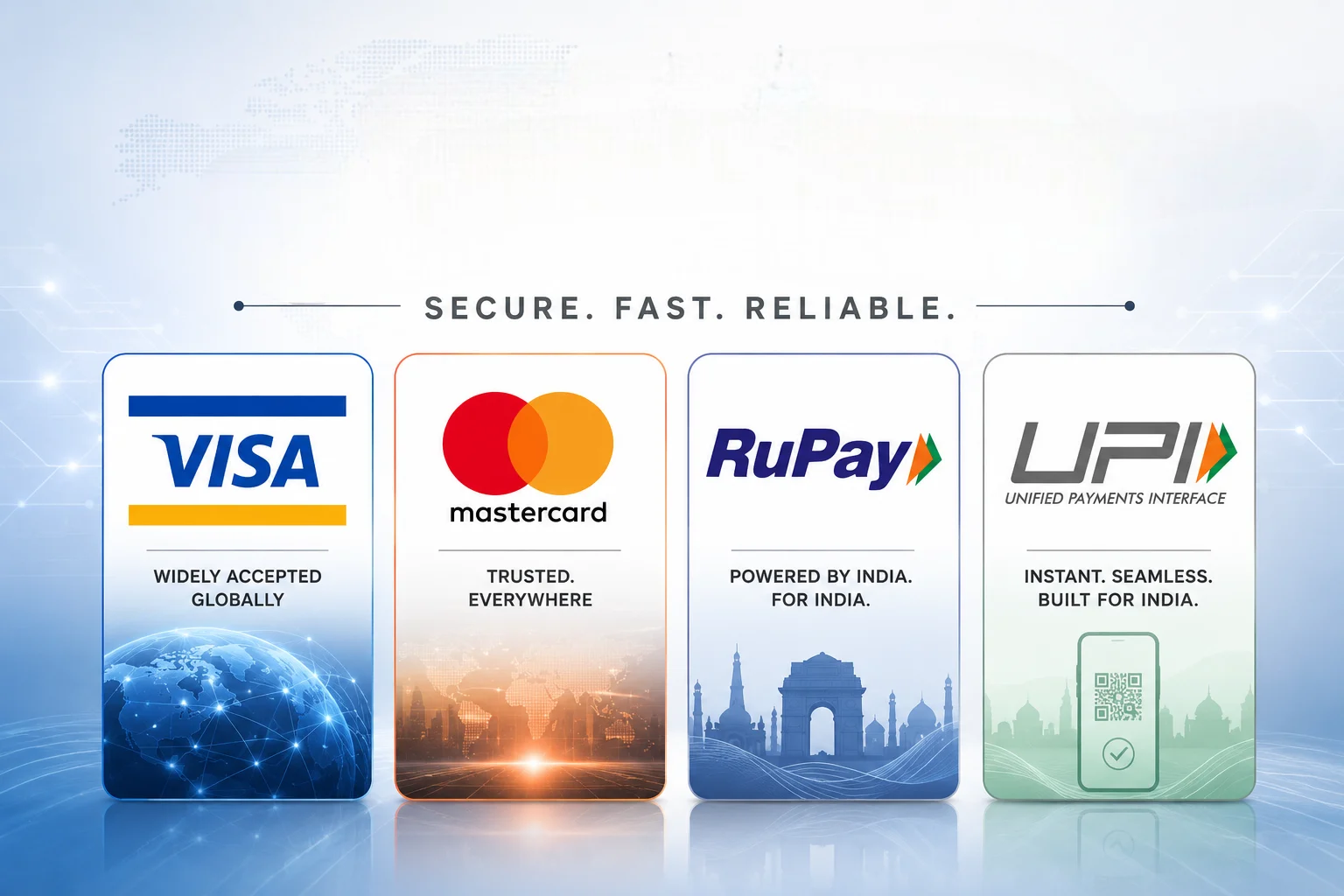
Visa, Mastercard, RuPay & UPI — who really runs your money?
Every swipe, tap, and QR scan in your wallet rides on one of four rails. Here’s the full story of each network — founders, global turnover, features — and a clear verdict on which one actually deserves the top spot in an Indian wallet.


Visa
Origin story
Visa’s story began with Bank of America’s famous “Fresno Drop” of 1958, when unsolicited BankAmericard credit cards landed on the doorsteps of 60,000 Californians. As other banks wanted in, Seattle banker Dee Hock was brought in to organise the chaos — he united the licensee banks into a single cooperative and renamed it Visa in 1976, turning a regional experiment into the world’s first global card network.
Key features
- VisaNet — the global processing backbone connecting banks and merchants in 200+ countries
- Tap to Pay contactless technology, now the majority of face-to-face transactions worldwide
- Tokenisation that replaces card numbers with secure digital tokens for online and app payments
- Visa Direct — real-time money movement for payouts, remittances and P2P transfers
- AI-driven fraud detection, among the earliest networks to deploy neural-network risk scoring
- Extensive travel, insurance and lounge-access benefits bundled with premium card tiers
Visa’s fiscal Q2 2026 (quarter ended March 31, 2026) net revenue rose 17% year-on-year to $11.2 billion, beating analyst estimates and marking its strongest growth in years, on top of a full FY2025 in which Visa processed $16.7 trillion in total volume across 329 billion transactions. Visa held roughly 4.9 billion payment credentials in circulation worldwide and operates in more than 200 countries and territories.
Mastercard
Origin story
Mastercard was born out of competitive necessity: a group of California banks banded together in 1966 as the Interbank Card Association so they could offer their own credit card and keep pace with Bank of America. The brand went through “Master Charge” before settling on Mastercard in 1979, and has since grown from a bank cooperative into a publicly traded payments technology company.
Key features
- A payment network spanning 220+ countries and 150+ currencies
- A fast-growing Value-Added Services arm covering cybersecurity, analytics and fraud prevention
- Mastercard One Credential and tokenisation for unified, secure digital checkout
- Contactless payments now account for the majority of in-person switched transactions
- “Priceless” experiences platform bundling travel, dining and entertainment perks
- Open banking and real-time account-to-account rails via its Vocalink and Finicity acquisitions
Mastercard’s Q1 2026 net revenue climbed 16% year-on-year to $8.4 billion, with value-added services (fraud prevention, identity, insights) growing 22% and now contributing well over 40% of total revenue — a sign the company is becoming as much a data-and-security business as a card network. That builds on a full 2025 in which Mastercard processed $10.6 trillion in gross dollar volume across 220+ countries and 150+ currencies.
RuPay
Origin story
RuPay exists because India didn’t want to keep paying foreign networks just to move its own money. In 2009, the RBI asked Indian banks to build a homegrown card scheme; NPCI took charge of the project and launched RuPay in 2012 as a low-cost, fully domestic alternative to Visa and Mastercard — with the tricolour-inspired logo signalling its national identity.
Key features
- Three card tiers — Classic, Platinum and Select — scaling from basic to premium lounge-access benefits
- Zero Merchant Discount Rate (MDR) on RuPay debit card transactions, keeping costs low for small merchants
- Deep integration with UPI — RuPay is the only network allowed to link credit cards directly to UPI
- EMV chip security plus tokenisation for safer online and contactless payments
- Backbone of financial-inclusion schemes like Pradhan Mantri Jan-Dhan Yojana (PMJDY)
- Expanding global acceptance through tie-ups with JCB and Discover in over 100 countries, including Bhutan, Mauritius, UAE and Singapore
RuPay’s credit-card market share jumped from roughly 3% in 2023 to about 18% by value in 2026 — and it now accounts for about one-third of all new credit cards issued in India — almost entirely on the back of RuPay-on-UPI. That’s proof that pairing a domestic card with India’s own real-time rail is reshaping how the country borrows and spends.
UPI (Unified Payments Interface)
Origin story
UPI isn’t a card at all — it’s a real-time payments layer built by NPCI that lets any bank account talk to any other bank account instantly, using just a mobile number, UPI ID or QR code. Launched in 2016 and expanded with UPI 2.0 in 2018, it has become the default way India pays, from splitting a chai bill to settling business invoices.
Key features
- Instant, 24×7 bank-to-bank transfers with no card or POS machine required
- QR-code based “scan and pay” accepted by over 5 crore merchants nationwide
- Zero-MDR structure for most transactions, making it virtually free for small merchants
- Interoperable across banks and apps — PhonePe, Google Pay, Paytm and others all run on the same NPCI rail
- Credit-on-UPI, letting RuPay credit cards and pre-approved credit lines be used via UPI
- Expanding internationally to Singapore, UAE, France, Sri Lanka, Mauritius and beyond
UPI processed 22.72 billion transactions worth ₹28.92 lakh crore in June 2026 alone — about 757 million payments every single day — up 23% in volume year-on-year. For the full FY2025-26 (April 2025–March 2026), UPI handled roughly 241.6 billion transactions worth about ₹314 lakh crore, and the IMF has recognised it as the world’s largest retail fast-payment system by transaction volume. Even PhonePe and Google Pay’s combined app market share slipped below 80% for the first time in 2026, as newer players chip away at the leaders’ hold.
Visa vs Mastercard vs RuPay vs UPI
| Parameter | Visa | Mastercard | RuPay | UPI |
|---|---|---|---|---|
| Type | Global card network | Global card network | Domestic card network | Real-time bank transfer system |
| Owner | Visa Inc. (public company) | Mastercard Inc. (public company) | NPCI (RBI-backed, not-for-profit) | NPCI (RBI-backed, not-for-profit) |
| Founded | 1958 | 1966 | 2012 | 2016 |
| Global reach | 200+ countries | 220+ countries | 100+ countries (growing) | 10+ countries (growing fast) |
| Latest scale | $11.2B quarterly revenue (Q2 FY26) | $8.4B quarterly revenue (Q1 2026) | 18% of India’s credit card value | 22.72B transactions (June 2026) |
| Merchant fees | Interchange + MDR applies | Interchange + MDR applies | Zero MDR on debit cards | Zero/near-zero MDR |
| Best for | International travel & global e-commerce | International travel & premium rewards | Low-cost domestic spending & govt schemes | Instant everyday payments in India |
| Requires a card? | Yes | Yes | Yes | No — works with just a bank account |
Which is best for Indian users?
UPI wins, easily
For groceries, bill splits, kirana stores and most online shopping in India, UPI is faster, free and more widely accepted than any card. No wonder it now handles nearly 90% of India’s retail digital payment volume.
RuPay is the smart default
With zero MDR on debit cards and now deep integration with UPI credit lines, RuPay keeps costs down for both users and small merchants — and it’s the card most government and bank schemes issue by default.
Visa or Mastercard, still essential
RuPay’s global footprint is growing, but for booking flights, hotels, and shopping on most global websites, a Visa or Mastercard remains the safer, more universally accepted choice today.
Depends on the issuer, not just the network
Lounge access, cashback and travel insurance are largely decided by the issuing bank’s card program — compare specific Visa, Mastercard and RuPay card variants rather than the network alone.
Our take: most Indian users are best served by a combination — a UPI-linked bank account or RuPay card for everyday domestic spending (fast, often free), paired with a Visa or Mastercard for international travel and global online purchases. There’s no single “best” network; there’s a best network for each job your money needs to do.
Frequently asked questions
Who founded Visa?
Who founded Mastercard?
Who founded RuPay?
Who created UPI?
Is UPI a card network like Visa or Mastercard?
Which network is cheapest for merchants in India?
Can I use RuPay or UPI when travelling abroad?
Data sources & further reading:
This article reflects publicly available data as of July 2026, including Visa’s fiscal Q2 2026 and Mastercard’s Q1 2026 earnings and NPCI’s June 2026 UPI figures. Transaction volumes and market share shift every month — check the official sources above for the latest numbers.