Three Things About India’s Quick Commerce That Don’t Add Up — Until You See the Math
Quick commerce was supposed to fail in India. It failed everywhere else in the world first. So why did the “10-minute delivery” model die in Berlin, New York, and Istanbul — and turn into India’s fastest-growing industry instead? And why did Amazon, the world’s biggest retailer, wait years to enter a market it now dominates in growth? The answer is simpler than anyone expected: cold, hard arithmetic.
- 10-minute delivery collapsed in Germany, the US, Turkey and China — but exploded in India, and it isn’t because Indians are “lazy” or “love convenience.”
- The real reason is a cost equation: cheap gig-economy labour plus extreme urban density makes the unit economics work in India when they don’t work anywhere else.
- A real Berlin-vs-Gurgaon comparison shows why: rent, staff, and rider costs are dramatically cheaper in India, and delivery density is up to 6x higher.
- Run the actual profit-per-order formula and Berlin loses €3.45 on every order; Blinkit earns roughly ₹66 profit on every order in FY2025.
- Amazon entered late for two reasons: it needed the math to prove out, and it was boxed in by India’s FDI rules on foreign-owned inventory.
- Amazon’s real weapon isn’t discounts — it’s bundling Amazon Now into Prime, turning a video subscription into a near-zero-cost customer acquisition engine.
- Blinkit, Zepto, Amazon and Flipkart are all navigating the same FDI regulation differently — and the most unexpected potential winner may be Reliance Jio, a fully domestic player the rule was never built to stop.


For years, there were three things about India’s quick commerce boom that simply refused to make sense. Walk through the logic with me, one at a time — because by the end, the answer changes how you’ll see every 10-minute delivery app on your phone.
The Model That Was Supposed to Be Impossible in India
For years, nearly everyone was certain quick commerce could never work in India — and the logic was rock solid. There’s a kirana store in every single lane. India is one of the most price-sensitive markets on earth, where people check three apps just to save ₹10. By most estimates, maybe 0.1% of India’s population would ever genuinely need a 10-minute delivery service.
This wasn’t just theory — the model had already been tried in the West and had failed spectacularly. Getir in Turkey, Gorillas in Germany, and Gopuff and Jokr in the United States had all raised billions of dollars, backed by some of the smartest investors in the world. And yet, almost every single one of these companies has since collapsed. The model is, today, officially dead in the West.
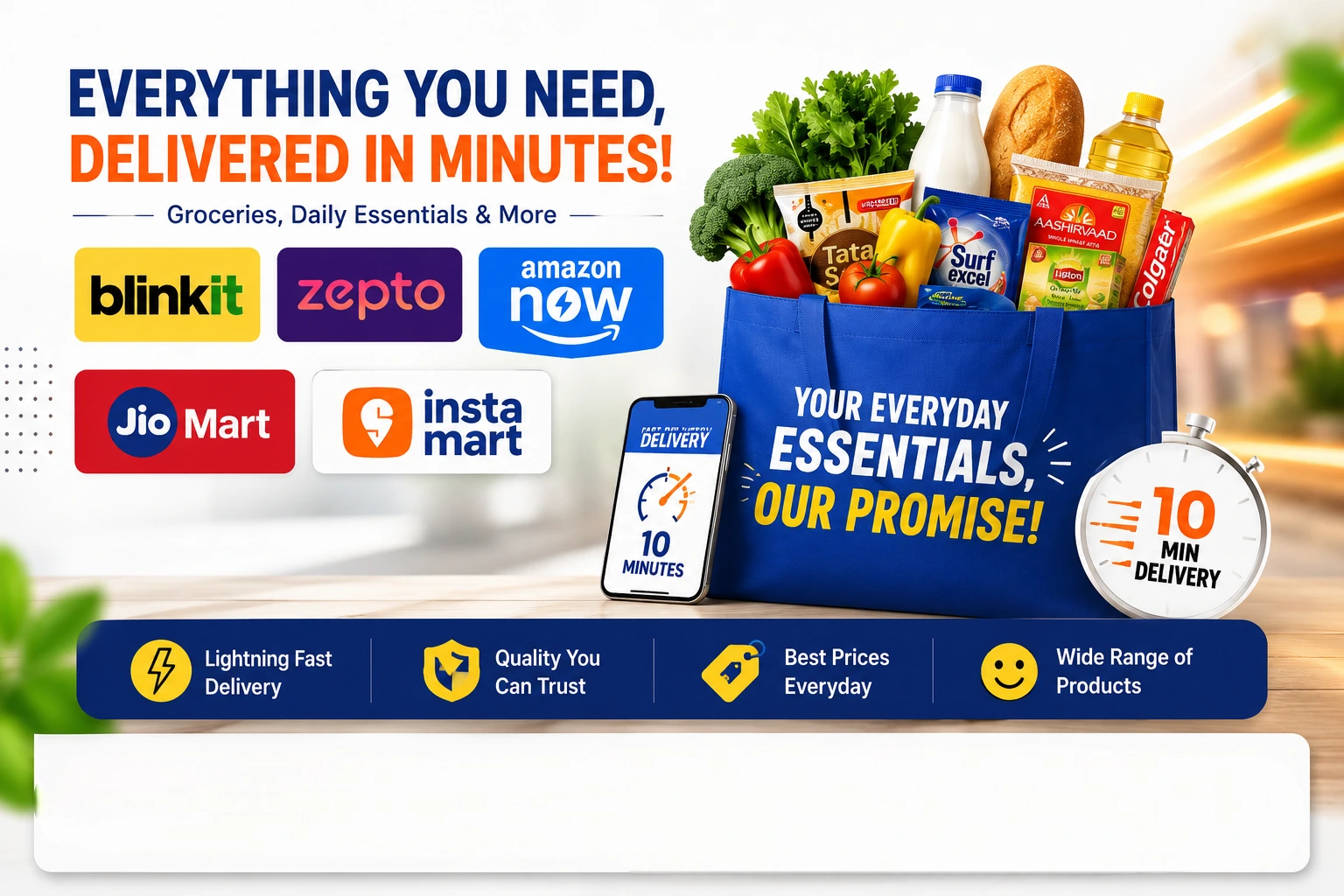
The logic seemed airtight: if the model couldn’t survive in the world’s richest countries, how could it possibly work in a price-sensitive market like India? And yet, the opposite happened. Today, quick commerce is India’s fastest-growing industry. People order constantly, brands are desperate to get listed, and the category has expanded far beyond groceries — electronics, makeup, medicines, even iPhones now arrive in 10 minutes. The question that remains: how did a model that failed across the entire world suddenly explode in India?
India’s Biggest Companies Jumped In — Except One
Seeing this boom, every major Indian conglomerate jumped into the race. Tata’s BigBasket launched 10-minute delivery. Reliance became the largest investor in Dunzo and launched its own quick delivery through JioMart. Flipkart launched Minutes. But while all of this was happening, what was the world’s biggest e-commerce company, Amazon, actually doing?
Amazon only entered this game recently, with Amazon Now. Before that, it had virtually no presence in Indian quick commerce at all. So the question is simple: was a trillion-dollar company really so slow that it watched this entire explosion happen and did nothing? Or did Amazon know something the rest of the market was missing?
The Latecomer That Started Accelerating Fastest
Given how late Amazon entered, it looked like a hopeless game to catch up on. Blinkit, Zepto and Instamart already had massive networks of dark stores, millions of customers, and had expanded into hundreds of cities. By every measure, Amazon should have been miles behind.
And in the beginning, it was — Amazon Now’s growth was noticeably slow. But then Amazon made a quiet move, and suddenly its customers started ordering three times more. Amazon Now’s growth today has actually overtaken Flipkart Minutes. In other words, the company that entered last is now accelerating the fastest.
So what was that quiet move? And what exactly is Amazon’s real strategy for quick commerce? To answer all three of these questions, I went through industry reports, company financials, and ran the actual numbers myself — and honestly, what I found changed how I understood this entire industry.
It Isn’t Culture. It’s Simple Math.
Before Amazon Now, let’s go back and actually understand why quick commerce failed everywhere in the world except India. Was it really because Indians are “lazy” or simply love convenience? Honestly, that answer never convinced me — so I went back and traced every one of these 10-minute startups, the ones that shut down and the ones still alive today, to understand what actually went wrong. The conclusion was refreshingly simple: it’s cost math.
Every quick commerce company in the world, no matter where it operates, is built on four pillars: Product, Technology, Dark Stores, and Delivery. Here’s the interesting part — two of these four pillars are essentially identical everywhere in the world.
Product & Technology: The Same Cost, Everywhere
Take a bottle of Diet Coke as an example. It costs roughly the same whether it’s sitting in a dark store in New York or in Gurugram — pricing may shift slightly for taxes, import duties, or raw materials, but margins are nearly identical across countries. The same holds for technology, which really comes down to two things: app development and server costs. Server costs are the same in the US and in India. Development costs are also broadly similar — and yes, US companies argue their developers are more expensive, but eventually most of them outsource this very development work to India anyway.
So if Product and Technology cost roughly the same everywhere, the entire game comes down to the other two pillars: Dark Stores and Delivery. And that is exactly why quick commerce could sustain itself in India — and nowhere else.
Berlin vs. Gurugram: The Numbers That Explain Everything
To keep the calculation simple, let’s compare two cities in two different countries — Gurugram in India, and Berlin in Germany.
| Cost Factor | Berlin | Gurugram | Difference |
|---|---|---|---|
| Rent (3,000 sq. ft. store) | €7,000/month (≈ ₹7.6 lakh) | ≈ ₹2.5 lakh/month | Berlin is ~3x costlier |
| Store staff salary | ≈ ₹2.8 lakh/month per employee | ≈ ₹18,000/month per employee | Berlin is ~16x costlier |
| Rider cost | ≈ ₹1,530/hour (€14/hr) | ≈ ₹75/hour | Berlin is ~20x costlier |
| Rider employment type | Salaried employees — cost continues even with zero orders | Gig workers — paid per delivery, near-zero cost when idle | Structurally different cost model |
| Customer density (2 km radius of one dark store) | ≈ 50,000 people | ≈ 3,00,000 people | Gurugram has ~6x more customers |
| Deliveries per rider per hour | ≈ 2 orders/hour | ≈ 2.5 orders/hour | India riders complete more trips |
Put together, this is the core of the story: in Berlin, a rider is an expensive, salaried employee sitting mostly idle in a low-density city. In Gurugram, a rider is a flexible gig worker serving six times as many potential customers in the same radius, completing more deliveries per hour, for a fraction of the cost. Investors and VCs kept treating quick commerce like classic e-commerce — assuming that once order volumes rose high enough, profitability would simply follow, the same way it eventually did for Amazon. But that assumption doesn’t hold for quick commerce, and the next section shows exactly why.
The Profit-Per-Order Formula, Run on Real Numbers
Every order in quick commerce is only profitable if this equation clears zero:
Where Money Captured Per Order Order Value × Platform Margin %
Case 1 — Berlin, 2023
Average order value: €25. Store margin: 25%, so money captured per order = €6.25. Rider cost: €14/hour ÷ 2 orders/hour = €7 per order. Packaging cost: €2.70 per order.
€6.25 − €7.00 − €2.70 = −€3.45 per order
RESULT: A LOSS on every single order — before rent or staff salary are even countedThis is the number that breaks the “just scale it” theory. If every order loses money, then more orders simply means more losses, faster. The oft-repeated claim that a store just needs “5,000 orders a day to survive” falls apart here — at −€3.45 per order, higher volume only accelerates the bleeding. The only way this equation flips positive is by cutting rider cost per order or increasing deliveries per hour. Once it does turn positive, and once order volume is high enough to cover fixed costs like rent and staff, the model becomes a genuine money-printing machine.
Case 2 — Blinkit, India, FY2025
Average order value: ₹625. Blended take rate: 21% (roughly 15% margin, the rest from brand advertising and platform fees) → money captured per order = ₹131. Rider cost: ₹30 per order. Packaging cost: ₹35 per order.
₹131 − ₹30 − ₹35 = +₹66 per order
RESULT: A PROFIT on every single orderSame business model. Same 10-minute promise. Essentially the same app. One version of this business loses money on every order; the other earns money on every order. And the moment an order itself becomes profitable, the entire question changes — it’s no longer “can this model ever work?” but simply “can a store get enough orders to cover its rent?”
The Break-Even Reality Check
A Gurugram dark store with roughly ₹28,000/day in fixed costs needs about 423 orders a day to break even (₹28,000 ÷ ₹66 profit per order). Blinkit’s actual average is around 1,400 orders a day — nearly 3x its break-even point. That gap is exactly how Blinkit became profitable, while the same model, run in Berlin, could never cross that line no matter how many orders it added.
Reason One: Amazon Needed the Math to Prove Itself First
Quick commerce was never an Indian idea to begin with — it had already been tried in the West, years before Blinkit or Zepto even existed. It started in 2015 with Getir, the original 10-minute grocery delivery app. By the early 2020s, the model exploded globally: Gorillas and Flink in Germany, Jokr, Buyk and Fridge No More along with Gopuff in the US, and China had its own versions in Missfresh and Dingdong. These weren’t small bets — combined, these companies raised tens of billions of dollars, with the world’s biggest investors like SoftBank, Tiger Global and Sequoia all convinced this was the future of retail.
And then, almost all of them collapsed. Getir shrank back into Turkey. Gorillas was sold off and shut down. Jokr and Buyk exited the US entirely. Even in China, the model failed to work out. Amazon had studied every one of these markets closely, and it knew the model had failed almost everywhere — so its early assumption was that it would fail in India too. That caution is the first reason Amazon entered so late.
The Catalog War
Here’s something worth pausing on: the cost advantages we’ve just walked through — cheap labour, density, gig-economy delivery — aren’t unique to any single company. Blinkit has them. So does Zepto. So does Instamart. India’s structural advantage is common to all of them. So what actually separates these players today? As of now, just one thing: product catalog. Blinkit’s catalog is the largest, which means the largest basket sizes, which means the highest average order value — and remember the formula: a higher AOV means more money captured per order. That’s exactly why Blinkit is currently the only clearly profitable player, while the rest are still fighting to get there. It looked, for a while, like this war would simply be won by whoever sells the most things.
The Quiet Move: Bundling Amazon Now Into Prime
But Amazon has one advantage nobody else can match: Amazon Prime. Amazon recently merged Prime — its streaming subscription — directly with Amazon Now, its quick commerce arm. The result: Amazon Now’s orders are now growing 25% month-on-month, and Prime members are shopping roughly 3x more than before.
Why would a streaming subscription matter to a grocery delivery business? Because Prime Video was never really a video business in the first place. It’s a customer acquisition machine, simply dressed up as a streaming app. Here’s the full loop: you subscribe to Prime, probably for the shows and movies, since it’s one of the cheapest streaming services in India. Why not? But the moment you subscribe, something else gets silently bundled in alongside it: free and fast delivery on shopping.
Now watch what that does to your behaviour. Next week you need a phone charger. The exact same charger, at the exact same price, is available on both Flipkart and Amazon. Where do you buy it from? Amazon — obviously — because delivery there is free and fast, and you’ve already paid for Prime anyway.
That’s the asymmetry. And it flips the industry’s biggest cost on its head: for most quick commerce apps, the single largest expense isn’t dark store staff — it’s the cost of getting you to simply open the app. Blinkit, Zepto and Instamart spend enormous sums on discounts, cashback and advertising just for that. Amazon’s cost to acquire the exact same customer is near zero, because the psychology already did the work: once you’ve paid for something and started using its benefits, you keep coming back to use it again.
The Same Trick, at Smaller Scale: Swiggy One & Zomato Gold
Swiggy and Zomato use a version of this same bundle economics — you’ve probably seen ₹1 trials for Swiggy One or Zomato Gold for three months. That isn’t charity. It’s the identical logic: once you have Swiggy One, you won’t want to pay a delivery fee to switch to Zomato, so you stay locked in for those three months. But Amazon Prime operates on an entirely different scale. Swiggy One offers, essentially, free delivery. Amazon Prime offers video, music, books, fast delivery, and now 10-minute groceries — all stacked into a single subscription. One subscription decision, and every subsequent Amazon service rides free on the back of it.
The Regulation Nobody Talks About
India has a straightforward rule: foreign money can only operate a marketplace model in the country — connecting buyers to sellers, the same way Amazon and Flipkart have historically worked. Sellers list and sell products; customers buy them; the platform earns a commission in between. What a foreign-funded platform legally cannot do is control inventory directly — buying stock itself and selling it straight to customers, like a shop would.
The rule exists for a simple reason: to stop giants like Amazon or Walmart from selling at a loss for years and wiping out millions of kirana stores in the process. But this creates a genuine grey zone for quick commerce: what actually is a dark store? It’s a warehouse the platform itself holds stock in. So the real question is — is a quick commerce company actually a marketplace, or is it inventory retail wearing a marketplace costume? Traders’ bodies have raised exactly this question, which is why the CCI and DPIIT have started reviewing the sector — roughly ₹54,000 crore of foreign money is involved across Blinkit, Zepto and Instamart. None of it has been officially declared illegal; all of it remains under review.
How Each Player Is Navigating It
Blinkit
Parent company Eternal reduced its foreign ownership and raised domestic capital until over 55% of the company was Indian-owned — making Blinkit legally an Indian company. No inventory ban applies to it anymore. On paper it still shows a marketplace model, routing stock through “preferred sellers” it effectively controls. Legal on paper — but regulators are watching closely.
Zepto
Has raised the heaviest share of foreign funding of the three, and directly supplies its own inventory — technically against the marketplace-only rule. It is now racing to copy Blinkit’s Indian-ownership restructuring, with added pressure given its upcoming IPO.
Amazon & Flipkart
Both are foreign-owned — Amazon is a US company, and the majority of Flipkart is owned by Walmart. Neither can use the “become Indian” workaround. Both remain stuck operating strictly as marketplaces, unable to legally control inventory directly, at least on paper — a real structural disadvantage against Blinkit.
Reliance Jio
A fully domestic company from day one — FDI rules simply don’t apply. No restructuring, no workaround, no starting from zero. It already owns Reliance Fresh and Smart Bazaar, with thousands of physical stores, existing staff, existing stock, and rent it’s already paying.
So Who Actually Wins This Race?
Zepto, Blinkit, Instamart, Amazon, Flipkart — who comes out on top? Honestly, probably none of them. There’s a player in this race that almost nobody is talking about: Reliance Jio.
Amazon and Flipkart are both stuck operating within the marketplace model. Zepto is scrambling to become “Indian.” Blinkit has already changed its ownership structure just to be allowed to hold inventory. Reliance never had to run any of that math. It can freely hold its own stock from day one, with no trick and no restructuring required. It doesn’t even need to start from zero — it already owns Reliance Fresh and Smart Bazaar, thousands of physical stores across India, with staff already in place, stock already sitting on shelves, and rent it’s already paying regardless. The entire Berlin-vs-Gurugram cost equation we walked through earlier shifts even further in Reliance’s favour.
Here’s the irony at the heart of this entire story: Indian investors were never really ready to back this category early on, which is exactly why these quick commerce companies had to raise money from foreign investors in the first place. And the FDI rule exists precisely to protect India’s kirana stores from being wiped out by foreign giants. But that same rule may not be able to stop India’s own biggest retail conglomerate from doing exactly that. So — are we actually protecting Indian startups? Are we actually protecting kirana stores? That’s worth sitting with.
A Shareholding Snapshot of the Big Four
Understanding who actually holds the equity in these companies helps explain some of the incentives at play. Here’s a snapshot of major stakeholders as publicly reported.
Swiggy
Prosus (MIH India Food Holdings BV) is Swiggy’s largest stakeholder with roughly 25–33% of the company. Other major institutional investors and founders hold varying minority stakes following Swiggy’s public listing and share dilution.
| Stakeholder | Approx. Stake |
|---|---|
| Prosus (MIH India Food Holdings BV) | ~25% – 33% (largest single investor) |
| Sriharsha Majety (Co-founder & CEO) | ~4% |
| Nandan Reddy (Co-founder) | ~1.6% |
| Rahul Jaimini (Co-founder) | ~1.2% |
| SoftBank | Major pre-IPO institutional backer |
| Accel India | ~2.77% |
| Kotak Mahindra Asset Management | ~3.22% |
| Nippon Life India Asset Management | ~3.30% |
| Mirae Asset Investment Managers | ~2.88% |
| Tencent Holdings | ~2.89% |
| Qatar Holding (QIA) | ~2.53% |
Zepto
Per Zepto’s draft regulatory filings, major institutional investors, founder trusts, and other stakeholders hold the following approximate pre-IPO shareholding.
| Stakeholder | Approx. Stake |
|---|---|
| Nexus Venture Partners | 13.12% |
| Lazarus Trust (Founder-settled family trust) | 9.03% |
| Glade Brook Capital Partners | 7.73% |
| Vohra Trust (Founder-settled family trust) | 7.48% |
| Zepto ESOP Trust | 7.46% |
| StepStone Group | 7.34% |
| Y Combinator | 6.01% |
| LGF Scale | 5.58% |
| General Catalyst | 4.33% |
| Aadit Palicha (Co-founder & CEO — direct holding) | 1.07% |
| Kaivalya Vohra (Co-founder — direct holding) | 0.89% |
| Others & other investors | ~29.96% |
Zomato (Eternal Limited)
Zomato, now officially structured under Eternal Limited, is a professionally managed public company with no identifiable promoter group (0.00% promoter holding). Its stakeholders span early backers, key individuals, and broad institutional ownership.
| Stakeholder | Approx. Stake |
|---|---|
| Deepinder Goyal (Founder & CEO) | ~4.40% |
| Info Edge (India) Ltd (early investor) | ~12.38% |
| Foodie Bay Employees ESOP Trust | ~5.6% |
| Foreign Institutional Investors (FII / FPI) | ~32.61% |
| Domestic Institutional Investors (DII / MFs / Insurance) | ~35.99% |
| Retail & public investors | ~7.62% |
| Other bodies / misc / NRI | ~6.18% |
Amazon
Amazon is a publicly traded company with a market cap of roughly $2.4 trillion. Founder Jeff Bezos remains its largest individual insider shareholder, while major asset managers hold the largest collective institutional blocks.
| Stakeholder | Approx. Stake |
|---|---|
| Jeff Bezos (Founder & Executive Chairman) | ~8.2% – 8.8% |
| Andy Jassy (CEO) | <0.1% |
| Douglas Herrington (CEO, Worldwide Amazon Stores) | <0.1% |
| BlackRock Inc. | ~5.1% – 6.8% |
| Vanguard Group | ~5.8% – 5.9% |
| State Street Corporation | ~3.6% |
| FMR LLC (Fidelity) | ~3.3% |
One Thing Everyone Can Agree On
Whatever side of this story you land on — whether you think Blinkit’s restructuring is a clever legal workaround or a loophole that needs closing, whether Amazon’s Prime bundle feels like smart strategy or unfair leverage, whether Reliance’s position feels like an even playing field or a regulatory blind spot — there’s one thing almost everyone agrees on: quick commerce in India is on an absolutely insane growth trajectory, and it isn’t slowing down anytime soon.
The real story here was never about convenience or laziness. It was always about cost structure, density, regulation, and who could turn a subscription into a habit. Keep an eye on how the FDI review plays out, and keep an eye on Reliance — because the next big shift in this industry may not come from any of the “quick commerce” companies at all.