
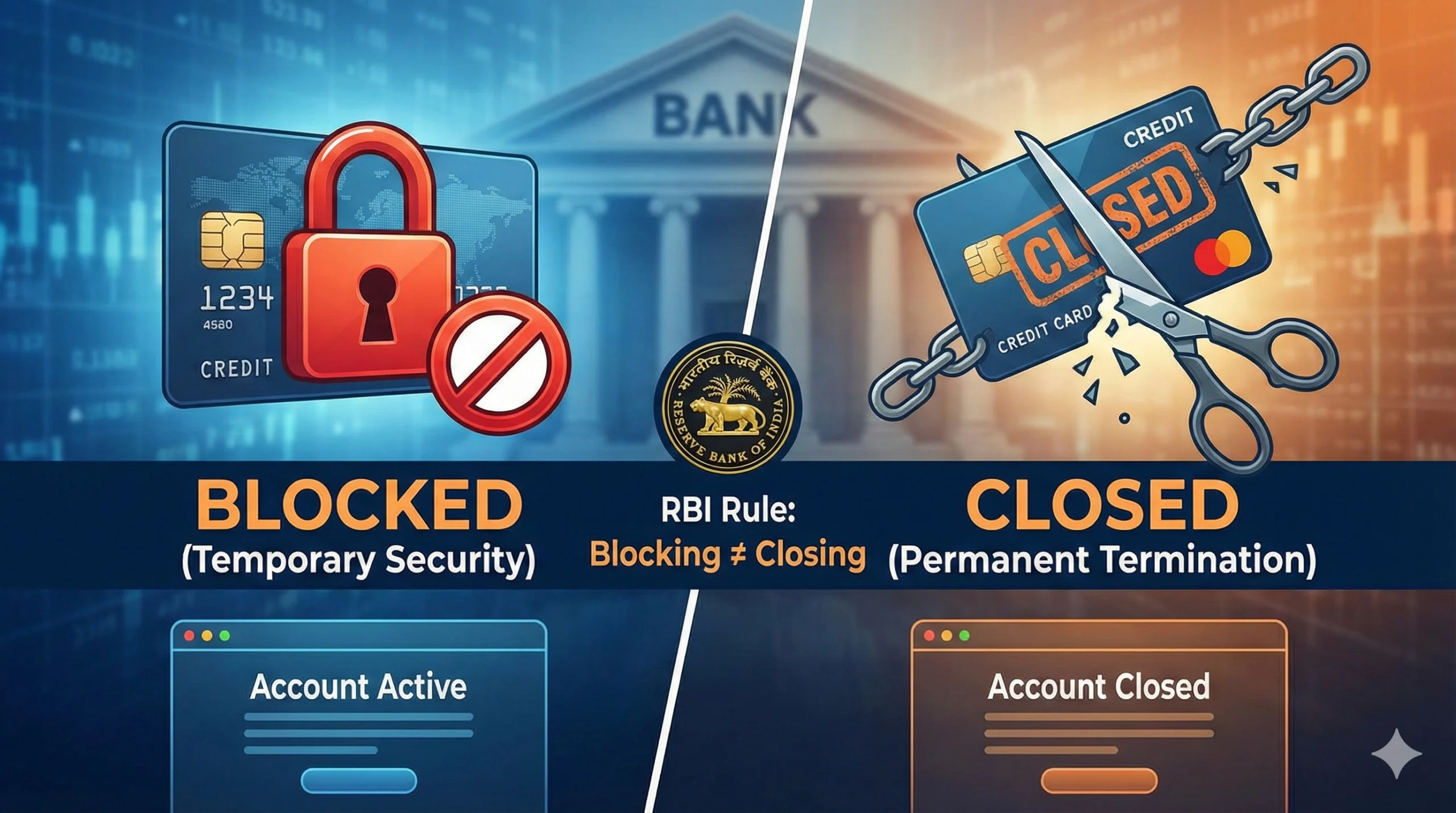
Blocking a credit card and closing it are two different things. According to RBI regulations, blocking a card doesn’t terminate the account; it only halts transactions. Card account closure, on the other hand, means the entire relationship between the card and the bank ends. Due to a misunderstanding, many people mistake blocking for closure and suffer losses.
Nowadays, most people use credit cards, but few understand the true rules. Especially when it comes to blocking, deactivating, or closing a card. People often think that if the card is blocked, the account is automatically closed, but RBI rules state the exact opposite.
The RBI has clarified that blocking a credit card does not mean account termination. This means the card relationship between you and the bank remains intact. Many people make this mistake and assume that blocking the card means the card is closed. The downside is that your card account remains active, charges continue to accrue, and your CIBIL score may be affected.
What is credit card blocking?
When you block or deactivate your card, it means just one thing:
- No transaction will be possible using the card.
- But the card account will remain active between the bank and you.
- The card number and account will remain active in the system.
- Charges may apply (like late fees, interest, etc., if any outstanding)
- According to the RBI, blocking only stops the transaction and does not close the account.
What is card closure?
When you close your card, it means:
- Your card account is permanently closed.
- The relationship between the bank and the cardholder ends.
- No further charges or billing
- The bank has to complete the card closure within 7 working days
The bank will have to report to the CICs, i.e. credit bureaus, that the account has been closed
Full RBI rule: Card Block ≠ Card Close

| point | Card Block/Deactivation | Card Closure |
| Transaction | stops | closed forever |
| account | remains on | always off |
| Charges | may seem | Closed |
| CIBIL Report | The account appears active. | The account appears closed |
| Process | Immediately | 7 working days |
| Outstanding | It can still be blocked even if it is not cleared. | Outstanding must be cleared |
Why does the bank close the card in 7 days?
According to the RBI Master Direction, banks must close cards within seven working days of receiving a card closure request. However, if there is an outstanding balance on the card, the bank will bill immediately. The seven days will not be counted until the customer makes the payment.
The biggest mistake many people make is that they block their card and assume the account is closed. Months later, they notice late fees, interest, and charges, which then impact their CIBIL score. This is because blocking is merely a security feature, not a full closure.
Apply lifetime free credit card

When should the card be blocked, and when should it be closed?
Block a credit card when it’s lost, suspected of fraud, or you won’t be using it for a while. Close it when the card is no longer useful to you. Also, close a card if the annual fee is too high, you have too many cards, or you want to reduce your credit exposure.
Step-by-step process to close your card
- Call customer care
- Submit a card closure request.
- Clear the outstanding amount
- The bank will immediately inform you about the balance.
- Get a confirmation email that the closure process has started.
- Please note the 7 working-day period, which will start only after the funds are cleared.
- Cut up and destroy the card; don’t just throw it away the card. Cut off the strip and chip.
- Check whether the account is closed or not in CIBIL
What misunderstandings arise after blocking the card?
- People think the card has been blocked.
- Charges come after months
- The account appears active in the CIBIL report
- The bank shows overdue
- New loans and cards may be rejected
- How is reporting done in CIC?
The bank must report to the credit bureaus (CIBIL, Experian, CRIF, Equifax) whether the card is closed or simply blocked. If the card is closed, the status is “Closed.” If it is only blocked, it is “Active.”
Conclusion
There’s a significant difference between blocking a credit card and closing it. Blocking only stops transactions, but the account remains open. Whereas card closure terminates the balance, relationship, and all charges between the bank and the customer. The RBI has clarified that card closure must be completed within seven working days, but outstanding dues must be cleared first. Therefore, if you truly want to close your card, blocking it won’t suffice; you’ll need to submit a formal closure request.
Frequently Asked Questions (FAQs)
1- What is a credit card?
A payment card that allows you to spend borrowed money.
2- What is the credit score?
A score based on your credit history.
3- Why is a late fee charged?
For not making a payment on time.
4- How is the card limit decided?
Based on income, score and bank policy.
5- Can an inactive card be closed?
Yes, if not used for a long time.