Indian Rupee Depreciation Explained: Why the Rupee Keeps Falling Against the US Dollar
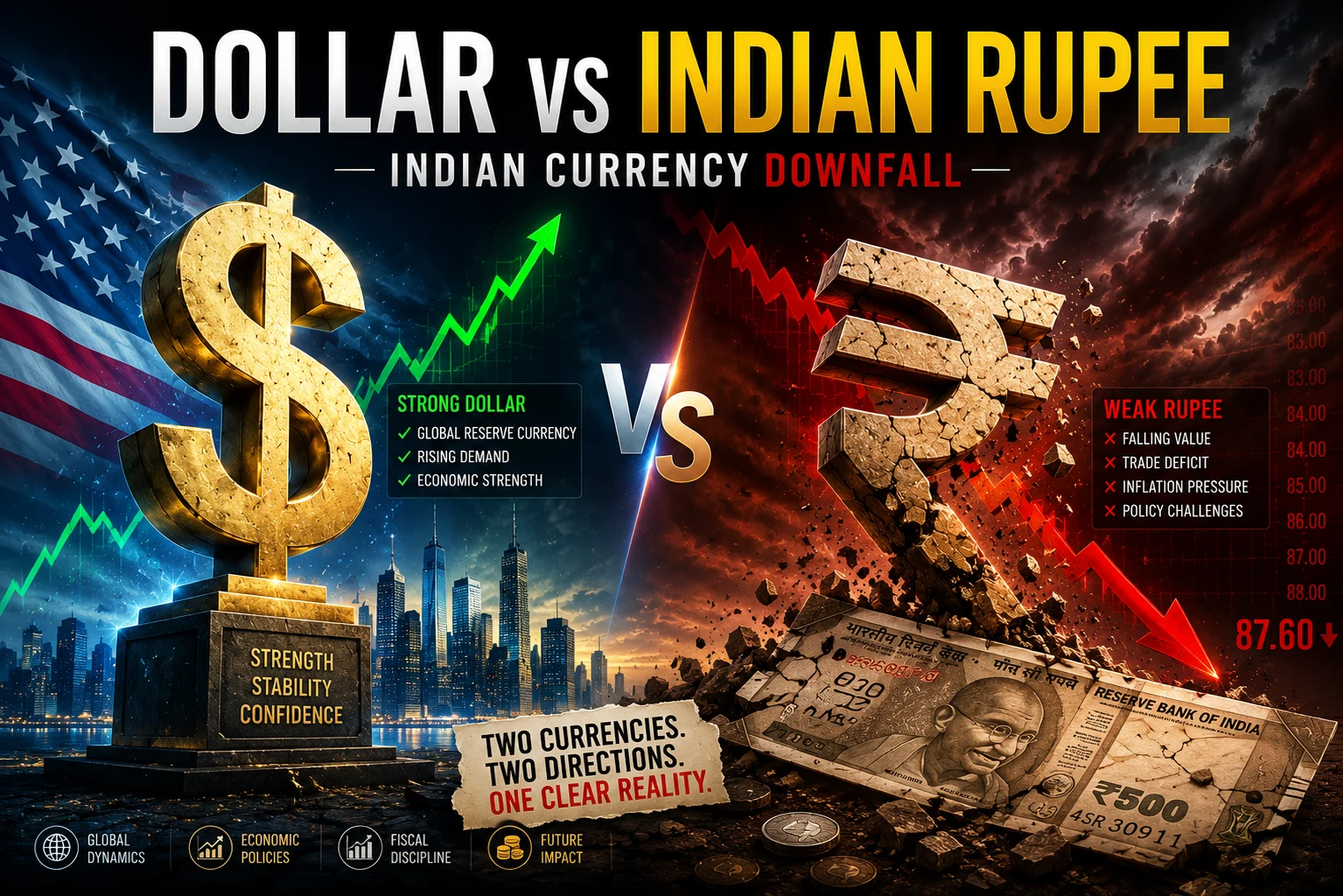
There is a peculiar contradiction sitting at the heart of India’s economic story. On one hand, Prime Minister Modi’s voice rings across global forums — “Today India is the fifth-largest economy in the world.” India’s stock markets were touching new highs almost daily. The dream of becoming the third-largest economy was being spoken about openly. And yet, in the middle of all this triumphant noise, India’s own currency — the rupee — began to gasp. The exchange rate that once caused political earthquakes when it crossed ₹70 or ₹80 to the dollar has now fallen to the lowest level in history. And questions are being asked openly: will the dollar hit ₹150?
So what exactly happened to the rupee amid all these grand economic claims? How did the currency of a nation sprinting toward global superpower status become so helpless before the dollar? Is this just a temporary jolt from global markets — or is it the accumulated result of structural mistakes that our governments, across all parties, have chosen to paper over rather than fix?
Today we trace the full story of the dollar’s historic stranglehold on the rupee — a trap decades in the making. We will examine how a single overnight decision by Prime Minister Indira Gandhi in 1966 broke the rupee’s back, what leading economists warned at the time, and how by 1991 the national treasury had been so hollowed out that India was forced to secretly airlift 67 tonnes of gold to foreign bank vaults. We will talk about the “chalta hai” attitude in government policymaking — the comfortable complacency that keeps us selling cheap bauxite to the world and buying back expensive aluminium cans. And we will ask: why do our policies always wait for a fire before they start digging the well?
First, Bury the WhatsApp Myth
Before we understand the rupee’s decline, we must throw out the biggest myth circulating on WhatsApp University — the claim that in 1947, ₹1 equalled $1. This is completely false. At independence, the rupee was not even measured against the dollar. It was pegged to the British pound sterling. One pound was worth approximately ₹13.33. If you calculate the cross-rate for that era, $1 was worth about ₹3.30 in 1947.
But then — how did the rupee leave the British pound’s shadow and fall into the dollar’s trap? That story begins in 1944, at the Bretton Woods Conference. World War II was nearly over, and the world’s economy lay in ruins. Leaders of 44 nations gathered in the small town of Bretton Woods in New Hampshire, America, to build a new global economic system. This is where the IMF and World Bank were born. America, having emerged as the world’s dominant power, convinced every nation present that the dollar would now be the new boss of global trade. It was decided: the dollar’s value would be fixed to gold, and every other currency in the world would be valued against the dollar. In one conference room, the British pound’s long reign ended forever.
After independence, India remained linked to the pound for a few years, but since everything from crude oil to machinery was being bought and sold globally in dollars, India too had no choice but to seek shelter under the dollar. Everything was proceeding — until the 1960s arrived.
1966: The First Self-Inflicted Wound
For India, the 1960s were nothing less than a living nightmare. The 1962 war with China. The 1965 war with Pakistan. A devastating drought across the country. There was neither enough grain to feed the nation nor enough foreign exchange — forex reserves — to sustain it. India had become wholly dependent on American PL-480 food aid. And the country’s newly appointed Prime Minister was Indira Gandhi.
Seeing India’s desperate condition, the World Bank, the IMF, and America began applying enormous pressure on Indira Gandhi. Their demand: India must devalue its currency — reduce its value — and only then would foreign assistance be forthcoming. The basic logic of economics says that if you reduce your currency’s value, your exports become cheaper for foreign buyers, and foreign money flows into the country.
Before we go further, one important distinction: before the 1992 liberalisation, the value of India’s currency — whether to raise it or lower it — was entirely in the government’s hands. If the government reduced it, that was called Devaluation. If it increased it, that was Revaluation. After liberalisation, this power moved from the government to the market. When market forces reduce a currency’s value, it is called Depreciation; when they increase it, Appreciation. That is why today we say the rupee is depreciating — it is market forces at work, not a government decree.
Now, back to June 6, 1966. Drafted by RBI Governor P.C. Bhattacharya and Chief Economic Adviser I.G. Patel, Indira Gandhi’s government made a move that sent shockwaves through Indian politics and economics both. Overnight, the rupee was devalued by 36 percent. The dollar, which cost ₹4.76 on June 5th, cost ₹7.50 on the morning of June 6th. Congress President K. Kamaraj erupted in fury — convinced that Indira had allowed America to humiliate India.
“Currency devaluation only helps exports if you have a surplus to export. India in 1966 had neither the goods, nor the plan — just the depreciation.”
But the experts’ warning was crystal clear: the benefit of devaluing a currency — increased exports — only materialises when you have surplus goods to sell to the world. India at that moment was reeling from a terrible drought. There was no surplus to export. The result? Exports did not increase. But because the rupee’s value had been cut, all imported goods — machinery, fertiliser, foodgrain — became overnight more expensive. Devastating inflation swept the country.
This was the first blow of 1966 — trapping Indian economics in a swamp of perpetual import dependence. Instead of structural reform — building domestic manufacturing — the government chose the shortcut. And it was this import dependency, this “chalta hai” attitude, that twenty-five years later — in 1991 — brought India to a cliff edge where it had to pawn its gold before the world.
1991: The Night India Pawned Its Gold
After the 1966 devaluation, instead of building export capacity, India chose an easy path: foreign borrowing. By the time the 1980s arrived, the economy was hollow from within. India’s current account deficit — the difference between dollars coming in and dollars going out — had reached 3.1% of GDP. India was earning half an anna and spending a full rupee.
But the real trigger for catastrophe was buried not in India, but thousands of kilometres away in the Middle East. In August 1990, Iraqi dictator Saddam Hussein invaded Kuwait, and the Gulf War began. This single war cut both legs of the Indian economy simultaneously. First: global crude oil prices shot overnight from around $15 per barrel to over $40. India’s oil import bill suddenly doubled. Second: hundreds of thousands of Indian workers in Gulf countries had to flee home to save their lives — and the billions of dollars in foreign remittances they were sending home stopped overnight.
By early 1991, India’s foreign exchange reserves had crashed to just $1.2 billion — enough to cover barely three weeks of imports. The country stood on the edge of sovereign default. V.P. Singh’s government had fallen, Chandra Shekhar was caretaker prime minister, and no foreign bank would lend to a nation whose credit rating had turned to dust.
In May 1991, the Chandra Shekhar government quietly loaded 20 tonnes of customs-seized gold onto chartered aircraft and pledged it with the Union Bank of Switzerland for $200 million in emergency relief. It was a drop in the ocean.
Then, in July 1991, newly sworn-in Finance Minister Manmohan Singh authorised the operation that would be remembered as a national shame. The Reserve Bank of India pledged 47 tonnes of its gold reserves to the Bank of England in London — in exchange for a $400 million loan. Between July 4th and 18th, in four tranches, this gold was flown out of the country in chartered aircraft. When a security van’s tyre burst mid-route to Mumbai airport, armed guards surrounded it — officials reportedly stopped breathing. The convoy was repaired and reached the airport.
When newspaper photographs of gold-laden trucks heading to the airport appeared in print, a nationwide outcry erupted. For ordinary Indians, gold is not merely a metal — it is family honour, family dignity. The country felt as if its household honour had been mortgaged to foreigners. But it was precisely this humiliation that jolted the government into action. Narasimha Rao and Manmohan Singh launched India’s historic LPG Reforms — Liberalisation, Privatisation, Globalisation. India’s markets were opened to the world. The Licence Raj ended.
A Timeline of Crises and Bandages
The Mirage of 2004–2008: Hot Money Is Not Strength
Between 2004 and 2008, during Dr. Manmohan Singh’s first term as Prime Minister, global markets were in a spectacular boom. Foreign Institutional Investors flooded India’s stock markets with dollars. This flood of dollars strengthened the rupee — at one point, $1 was worth just ₹39 to ₹40. But there was a critical detail: this rupee strength was not the fruit of solid Indian exports or manufacturing earnings. It was hot money — foreign capital that arrives chasing profit and disappears the moment it senses risk.
And in 2013, precisely what was feared, happened. This is called the Taper Tantrum in economic history. The US Federal Reserve merely hinted that it would raise interest rates. Just hearing this, foreign investors began pulling their money out of Indian markets overnight. India’s current account deficit was at a historic high — India was selling little to the world and buying enormous quantities of crude oil and gold. Between May and August 2013, the rupee crashed from ₹55 to over ₹68 in just a few months. Morgan Stanley placed India in its notorious “Fragile Five” — the five most economically fragile nations on earth.
The Manmohan Singh government rushed Raghuram Rajan to the RBI as Governor. His response: instruct banks to offer NRIs highly attractive interest rates on their FCNRB accounts — Foreign Currency Non-Resident Bank accounts. NRIs around the world saw they were earning far more interest in India than in American or European banks, with no risk. The result: $30 to $34 billion in foreign exchange flowed into India’s treasury. This flood of foreign money saved the rupee from collapsing further — and pulled the economy back from the brink.
“In 1991, in 1998, in 2013 — the pattern was identical. Governments applied expensive bandages from NRI borrowing instead of treating the real disease: import addiction and weak exports.”
The Three Structural Diseases Killing the Rupee
Every rupee crisis looks different on the surface. Strip away the geopolitical triggers — Gulf wars, Fed rate decisions, nuclear sanctions — and three chronic structural conditions keep reappearing. These are the real diseases. Everything else is just the symptom.
Disease 1 — Crude Oil: The Biggest Dollar Drain
India imports 80 to 85 percent of its crude oil, paying in dollars. Every spike in global oil prices — whether from a Middle East conflict, an OPEC decision, or a shipping route closure — punches a direct, enormous hole in India’s dollar reserves. The Strait of Hormuz — the narrow waterway through which India’s Gulf oil passes — remains a permanent geopolitical vulnerability. If tensions close it for even a few weeks, India’s oil import bill explodes and the rupee takes the full shock. This has been known for decades, and yet no government has built a serious, fast enough domestic energy transition to meaningfully reduce this dependency.
Disease 2 — The Diet Coke Paradox: Selling Raw, Buying Finished
Now you might wonder — what does a Diet Coke can have to do with a falling rupee? Everything, as it turns out.
First, understand the relationship between bauxite and aluminium: it is the same as sugarcane and sugar. Bauxite is the raw rock or ore from which aluminium is refined. India possesses one of the largest bauxite reserves on earth — so large that we could supply the world for the next 350 years. And yet, look at what our policy has produced: we sell our raw bauxite to the world at cheap prices. Other countries refine that bauxite into aluminium and turn it into finished products — including the cans used for Diet Coke or beer. And then India imports those finished cans at premium prices. We sell the raw material for almost nothing, and buy back the value-added product at full cost. This is the Diet Coke Paradox.
The government has placed a 7.5% import duty on raw aluminium, making it expensive for Indian companies to get raw material to manufacture cans. An Indian company spends around ₹10.40 to make one can. But thanks to Free Trade Agreements with South Korea and the UAE, finished cans from those countries arrive at zero percent import duty — and are sold at just ₹9.77. Result: Indian domestic manufacturing is destroyed. We sell our raw wealth cheaply and send our dollars abroad for finished goods. And this disease is not limited to aluminium — the same story plays out across dozens of sectors in the Indian economy.
Disease 3 — Fertiliser and Natural Gas: The Farm Crisis Waiting to Happen
India is an agricultural civilisation — and yet it imports roughly 50% of its natural gas from Qatar, the UAE, and the United States. Natural gas is the primary feedstock for urea. The ammonia required to manufacture urea comes from natural gas — LNG. Without gas, manufacturing urea is impossible.
But it gets worse: India does not just import the gas to make fertiliser domestically. India also directly imports millions of tonnes of finished urea, DAP (diammonium phosphate), and potash — because domestic production falls short of demand. So at every level of the fertiliser supply chain, India is bleeding dollars. Every time global tensions rise, gas prices spike — and India’s import bill for both energy and food production explodes simultaneously. If the Strait of Hormuz were closed for even a few weeks, India would face a severe fertiliser shortage — which would ultimately drive up the price of everything on your dinner plate, several times over.
How the Falling Rupee Actually Works
Economics has a simple, iron rule: when demand for something rises, its price rises. When India buys Korean cans, Qatari gas, foreign gold, or heavy machinery — all payments are made in dollars. To gather those dollars, the government and RBI must sell rupees in the foreign exchange market. When rupees flood the market in quantities exceeding normal demand, the rupee’s price — in dollar terms — falls. The more India imports without equivalent exports, the more rupees enter circulation relative to dollars, and the more the rupee depreciates.
When this cycle accelerates, the RBI steps onto the field. To defend the rupee, the RBI draws dollars from its own reserves and sells them in the market — increasing dollar supply so the rupee gets some support. But in doing this, India burns through the hard-earned foreign exchange reserves it has built over years. The RBI can only defend the rupee to a point — beyond that, it cannot intervene indefinitely. Goldman Sachs and other global institutions forecast the rupee will continue to fall 2–3 percent per year as long as this trade structure persists.
Today, India’s foreign exchange reserves stand at close to $700 billion. Commerce Minister Piyush Goyal recently told the CII Annual Summit that this reserve provides approximately 10 to 11 months of import cover. Even if not a single dollar entered India’s treasury from tomorrow, we could still fund our import needs for nearly a year from reserves alone.
This means India is not facing a 1991-style existential crisis. There will be no gold airlifts. We are not heading toward sovereign default. But a nation whose currency keeps setting all-time lows despite a $700 billion cushion is telling a story about structural weakness that reserves cannot permanently hide. The buffer gives time — it does not solve the problem.
The Painkiller Reflex: A Habit Across All Governments
History is a clear witness: every time the rupee has stumbled, India’s governments — regardless of party — have reached for the same cabinet of painkillers rather than treating the underlying disease.
In 1991, strict gold import restrictions were imposed. In 2013, Finance Minister P. Chidambaram publicly folded his hands and appealed to citizens: “Please stop buying gold.” Gold import duty was raised overnight from 2% to 10%. Today, the same duty has been hiked by a further 18.4 percentage points. Recently, Prime Minister Modi made the “Wed in India” appeal — urging Indians to celebrate their weddings domestically rather than spending dollars abroad on destination weddings and foreign tourism.
None of these measures are wrong in isolation. The problem is that they are the entire response — a painkiller substituting for surgery. The same reflex appears in external financing too: Resurgent India Bonds in 1998, India Millennium Deposits in 2000, FCNRB rate incentives in 2013 — all amounting to borrowing expensive dollars from Indian expatriates to paper over a structural trade gap. The wound is bandaged. The infection continues.
The China Mirror: What Manufacturing Leverage Actually Looks Like
Recently, America imposed sweeping tariffs on nations across the world. India, partly in response to these pressures, even stopped buying cheap Russian crude oil. But China? China never bowed before America. Why? Because China has the leverage of manufacturing. China is the world’s factory. If America imposes restrictions on China, inflation rises in America itself — giving Beijing negotiating power that New Delhi simply does not possess.
China has kept its currency, the yuan, stable against the dollar — not through financial engineering alone, but because the world needs Chinese factories. China doesn’t need the world; the world needs China. That is what manufacturing leverage looks like. And that is precisely what India lacks.
The Asia Truth: We Are Comparing Ourselves to the Wrong Countries
Indians often compare the rupee’s performance to the Pakistani rupee or Bangladeshi taka, finding comfort in the comparison. But recent reports reveal that the Indian rupee has become the worst-performing currency in all of Asia this year. It has depreciated more against the dollar than the Vietnamese dong, the Indonesian rupiah, or the Thai baht. Even more striking: the Pakistani rupee has shown more market stability than the Indian rupee in recent periods — despite Pakistan having a fraction of India’s forex reserves and economic size. That is what structural trade weakness does — it overrides everything else.
| Currency | Country | Trend vs Dollar | Key Reason |
|---|---|---|---|
| Indian Rupee ₹ | India | Worst in Asia 2024–25 | High import dependency, weak exports, hot money reliance |
| Vietnamese Dong ₫ | Vietnam | More stable | Export-oriented manufacturing expanding rapidly |
| Indonesian Rupiah Rp | Indonesia | More stable | Commodity exports + growing industrial base |
| Thai Baht ฿ | Thailand | More stable | Strong export manufacturing, especially automotive |
| Chinese Yuan ¥ | China | Held firm | World’s factory — manufacturing leverage against all pressure |
The Opportunities We Missed: Digging the Well After the Fire
The deepest tragedy is not that India lacked the ideas or the science. Scientists at CSIR’s National Chemical Laboratory in Pune had developed DME — dimethyl ether — years ago: a domestically producible LPG substitute that can be made from coal. It could have meaningfully reduced India’s dependence on imported gas. The government is now, finally, launching a ₹3 lakh crore coal gasification programme. The question that hangs in the air: when we knew that our veins were running with the poison of import dependence, when we knew that for cooking gas alone we were dependent on Gulf nations — why were these decisions not taken 15 years ago?
The Make in India initiative, launched with genuine ambition in 2014, has produced real results in defence manufacturing and mobile phone assembly. But it has not replicated — anywhere near the scale needed — the kind of manufacturing transformation that China achieved. Electronics imports remain massive. Heavy machinery continues to be overwhelmingly sourced from abroad. The structural trade deficit that began deepening in the 1970s is narrower in some sectors, but essentially unresolved at the macro level.
Global agencies like Goldman Sachs say the rupee’s slide is not about to stop. As long as India keeps burning dollars on oil, machinery, and gold without matching export earnings, the rupee will fall 2–3% every year. The ₹150-per-dollar figure circulating on social media is not inevitable — but if our governments do not change course, it is not impossible either. Not in months perhaps, but in years, we will get there.
India is not in a 1991-style existential crisis. The $700 billion reserve buffer means we will not be airlifting gold to London. But a currency setting all-time lows despite that enormous cushion is speaking clearly: structural weakness cannot be hidden by reserves forever. The buffer buys time. It does not buy a solution.
China has shown what manufacturing leverage looks like. Vietnam, Indonesia, Thailand are showing what a purposeful export strategy looks like. India has the population, the raw materials, the engineering talent, and now the political will — at least in rhetoric. The gap between rhetoric and reality is where the rupee lives. Closing that gap — through sustained industrial policy, genuine manufacturing scale, and breaking the import addiction sector by sector — is the only lasting answer. The “chalta hai” attitude must end. The well must be dug before the fire starts.

Pankaj Dubey is an entrepreneur, business analyst, digital marketer, financial researcher, and brand strategist. He specializes in developing marketing strategies, building and positioning brands, and conducting in-depth business and financial research. He is also known for creating detailed case studies on reputed brands, analyzing market trends, and sharing insights through his writing and blogging. His work combines business intelligence, strategic thinking, and digital innovation to help businesses grow and strengthen their market presence.