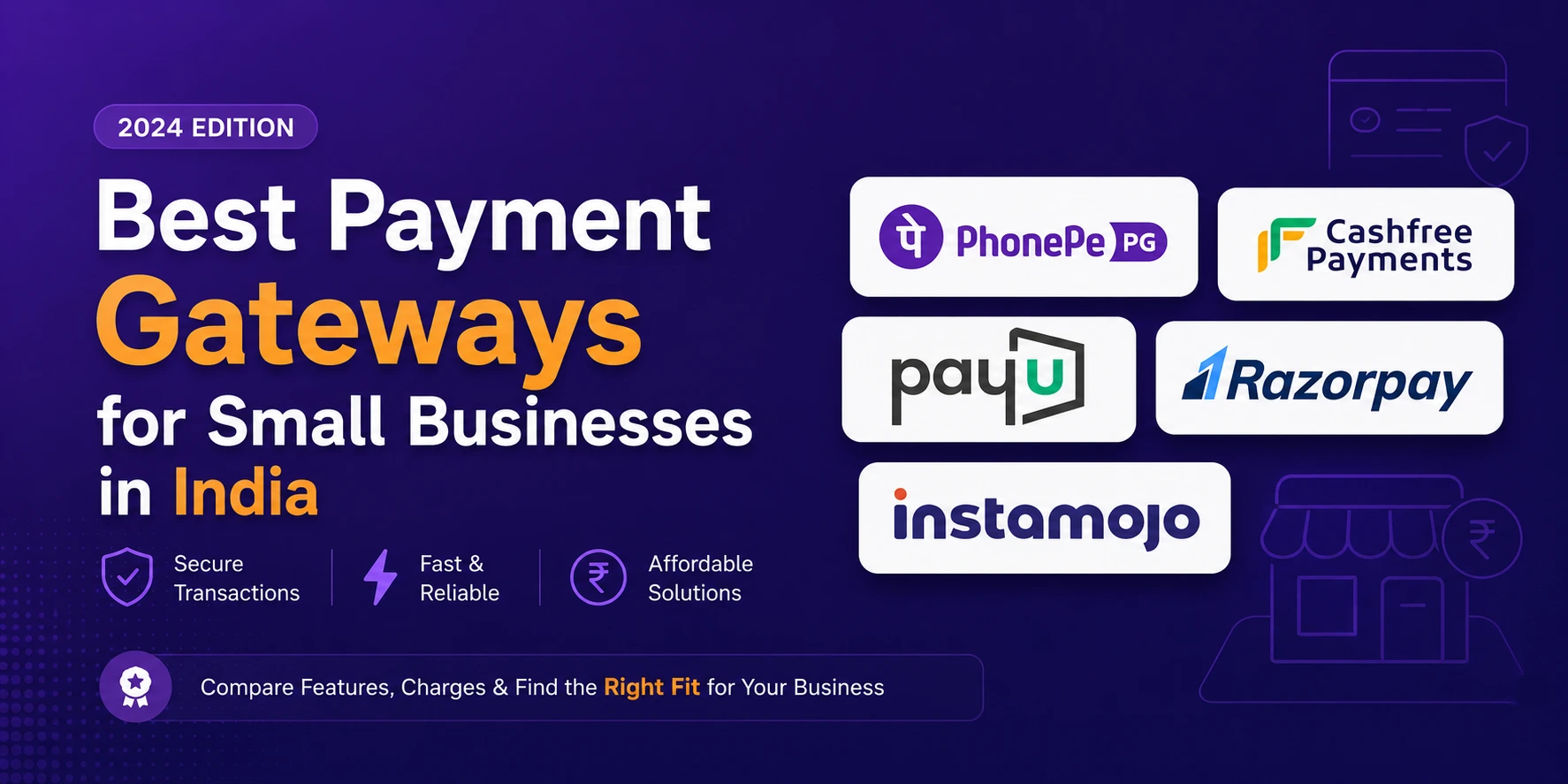
Best Payment Gateways for Small Business in India
UPI, cards, wallets, and payment links — which gateway actually works for a small Indian business in 2026?
If you run a small business in India, accepting digital payments is no longer optional. Customers expect UPI at checkout, service providers send payment links on WhatsApp, and online sellers can’t process an order without a working gateway. The question is no longer whether to use a payment gateway — it’s which one actually fits your business.
Transaction fees, settlement speed, and onboarding friction all vary significantly between providers. This guide breaks down the five payment gateways best suited to Indian small businesses in 202, with pricing, features, and honest context on who each one is right for.
What Is a Payment Gateway and How It Works
A payment gateway is the technology that sits between your customer’s payment method — a UPI app, debit card, or wallet — and your bank account. When a customer pays, the gateway verifies the payment, sends it to the issuing bank for approval, confirms the transaction, and begins the settlement process. Most small businesses access this through website checkouts, payment links, QR codes, or card machines.
Beyond the transaction itself, a gateway affects three things that matter operationally: how fast the money reaches your account, how easily refunds are handled, and how well you can track and reconcile payments. A slow or confusing checkout is where many sales stop. Getting the gateway right reduces that friction at the last step of the customer journey.
Which Small Businesses in India Benefit Most
Payment gateways are used across industries where digital payments are part of daily operations. The clearest use cases in India today:
Kirana stores and neighbourhood retailers typically use QR-based payments at physical counters. D2C brands and online stores depend on gateways at checkout to convert browsing into completed orders. Service providers — consultants, freelancers, event planners — use payment links to collect advances without chasing bank transfers. Coaching centres manage monthly fees and course instalments. Homestays and tour operators use advance payments to confirm bookings. And digital sellers increasingly use UPI Autopay and card subscriptions for recurring revenue.
Across all of these, the gateway that works is the one with the lowest friction, reasonable fees, and reliable settlements.
Best Payment Gateways for Small Business in India

India’s most trusted UPI ecosystem — now for businesses
PhonePe Payment Gateway lets businesses accept UPI, credit/debit cards, and netbanking through hosted checkout pages and direct API integration. The biggest advantage is native integration with PhonePe’s UPI network, which is one of the most widely used payment apps in India. When customers already trust and use PhonePe, checkout friction drops measurably.
The Standard Plan has no setup fee, no annual maintenance fee, and no hidden charges (T&Cs apply). For growing businesses, an Enterprise Plan offers personalised pricing, priority onboarding, and a dedicated account manager. This zero-upfront model makes it particularly suitable for businesses testing digital payments or working with limited initial capital.
- UPI, Cards & Netbanking
- Hosted checkout pages
- API integration available
- Zero mandatory costs on Standard
- Priority onboarding on Enterprise
- Dedicated account manager

Lower entry pricing with strong payout and reconciliation tools
Cashfree Payments handles UPI, cards, netbanking, and wallets through a single gateway. Where it differentiates is in its operational tooling — integrated payouts, refund handling, and reconciliation dashboards that give small businesses a cleaner view of cash flow without needing a separate accounting layer.
New merchants get a 1.6% gateway fee for up to 12 months (subject to T&Cs), compared to the standard 2% most competitors charge. International card transactions are priced at 2.69%. For a business processing ₹5 lakh per month, that 0.4% difference is roughly ₹2,000 saved monthly — not trivial for a small business.
- UPI, Cards, Wallets, Netbanking
- Integrated payout tooling
- Refund handling built-in
- Reconciliation dashboards
- Payment links supported
- International card support

Flexible pricing with EMI and international payments from day one
PayU enables businesses to collect payments across UPI, cards, netbanking, wallets, and EMI. It offers ready-to-use checkout options and integrations, meaning businesses can add payment functionality to websites or apps without building custom flows. The combination of payment methods and EMI support in a single integration is useful for businesses selling higher-ticket products.
PayU uses pay-as-you-use pricing with no setup fee. Standard domestic transactions (cards, netbanking, BNPL, wallets) cost 2% per successful transaction. EMI, American Express, Diners Club, and international transactions are priced at 3%, with 18% GST applying across all transactions.
- UPI, Cards, Wallets, Netbanking
- EMI payments supported
- International transactions
- No setup fee
- Ready-to-use checkout
- BNPL support

Broad payment method coverage with fast self-serve onboarding
Razorpay is one of the most widely used payment gateway providers in India. It supports UPI, credit and debit cards, net banking, wallets, and payment links — covering most payment scenarios a small business will encounter. Self-serve onboarding, a built-in checkout, and a settlement dashboard make it accessible to non-technical founders.
Pricing is transaction-based at 2% per successful transaction plus 18% GST, with no mandatory setup fee on the standard plan. The pay-as-you-go model suits businesses with variable sales volumes. Payment links are particularly useful for service providers collecting payments without a full e-commerce setup.
- UPI, Cards, Netbanking, Wallets
- Payment links via WhatsApp
- Self-serve onboarding
- Refunds management
- Settlement dashboard
- No-code checkout available

Sell online without building a website — storefront and payments in one
Instamojo takes a different approach from pure payment gateways. It lets businesses create an online store, smart page, or payment link and accept payments — all without a separate website or developer involvement. This makes it particularly suitable for first-time sellers and micro-businesses that need to start selling quickly without upfront tech costs.
The Lite plan is free (₹0/year) for businesses that are just starting. Paid plans are priced at ₹6,999/year (Starter) and ₹14,999/year (Growth), with the Growth plan offering lower transaction fees. Fixed annual pricing gives small businesses a predictable budget, with no variable overhead beyond the plan cost and transaction fees.
- Built-in online storefront
- UPI, Cards, Wallets, Netbanking
- Smart pages & payment links
- No coding required
- Predictable annual pricing
- Lower fees on Growth plan
Side-by-Side Comparison: Payment Gateways for Small Businesses
Here is a quick reference to compare the five payment gateways across the factors that matter most for small businesses.
| Gateway | Setup Fee | Transaction Fee | UPI Support | Standout Feature |
|---|---|---|---|---|
| PhonePe PG | ₹0 (Standard) | Free (T&Cs apply) | ✓ Native UPI | Zero-cost Standard Plan, PhonePe ecosystem |
| Cashfree | ₹0 | 1.6% (12-month intro), 2.69% intl. | ✓ | Lower intro fee + payout & reconciliation tools |
| PayU | ₹0 | 2% domestic, 3% EMI/intl. + GST | ✓ | EMI & international from day one |
| Razorpay | ₹0 (Standard) | 2% + 18% GST | ✓ | Broad method coverage, fast onboarding |
| Instamojo | ₹0 (Lite) | Varies by plan | ✓ | Built-in storefront, no website needed |
*Pricing based on publicly available information. Always verify current rates on the official gateway website before onboarding.
Which Payment Gateway Should You Choose?
The right gateway depends on where your business currently is and what it needs to do next. If you’re starting out and want zero upfront cost, PhonePe PG or Instamojo’s Lite plan remove the financial barrier completely. If you’re already processing transactions and want to reduce fees in the first year, Cashfree’s 1.6% introductory rate is worth comparing against Razorpay’s standard 2%.
For businesses selling higher-ticket items where EMI matters, PayU covers that from the outset. If you want the widest payment method support with a proven track record and quick setup, Razorpay is the default choice most small businesses reach for — and for reasonable reasons. And if you’re a solo seller or micro-business without a website, Instamojo solves the entire problem with one platform.
All five support UPI, cards, and wallets. What separates them is pricing structure, operational tooling, and the type of business they’re actually built around. Choose the one that matches your current stage, not just your eventual ambition.
Frequently Asked Questions

Pankaj Dubey is an entrepreneur, business analyst, digital marketer, financial researcher, and brand strategist. He specializes in developing marketing strategies, building and positioning brands, and conducting in-depth business and financial research. He is also known for creating detailed case studies on reputed brands, analyzing market trends, and sharing insights through his writing and blogging. His work combines business intelligence, strategic thinking, and digital innovation to help businesses grow and strengthen their market presence.