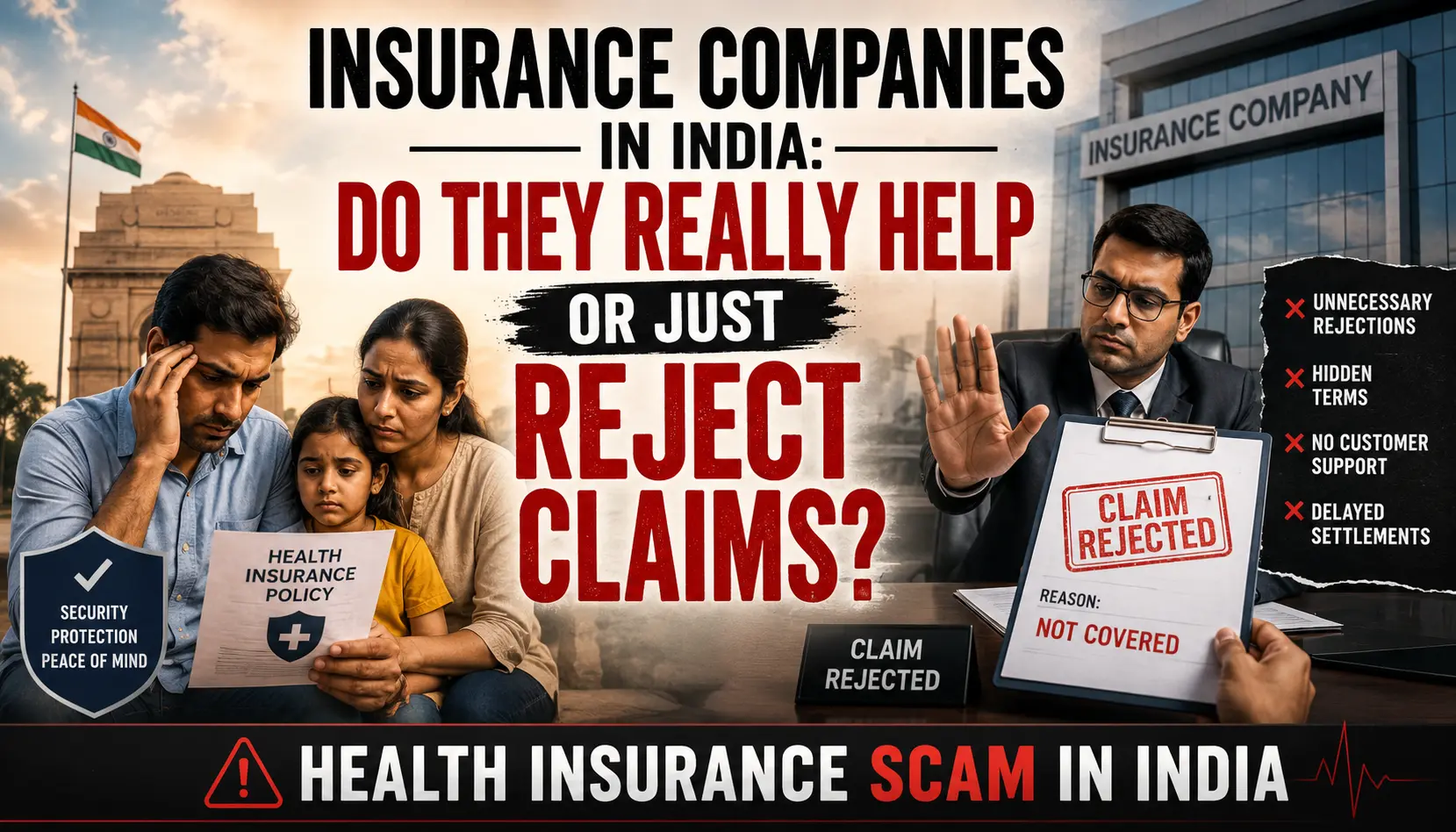
Insurance Companies in India: Do They Really Help Customers or Just Find Ways to Reject Claims?
Millions of Indians pay premiums for years believing insurance will protect them. Then crisis strikes — and instead of support, many get forms, delays, and rejection letters at the worst possible moment.
Think about the last insurance advertisement you saw. A happy family. A devoted father. Reassuring words: “We’re with you.” “Your family’s shield.” Insurance companies spend enormous sums marketing themselves as pillars of support — your guardian angel when life turns difficult.
Now talk to a policyholder who just had a claim rejected.
The contrast between the advertising fantasy and the lived reality of millions of Indian insurance customers is striking, often heartbreaking, and — critics say — not entirely coincidental.
Across social media, consumer forums, newspaper columns, and IRDAI complaint registers, a pattern repeats with troubling consistency: customers who paid premiums faithfully for years find themselves navigating a labyrinth of documentation demands, investigation delays, and technical rejections at the exact moment their need is greatest.
This article does not claim all insurance companies are fraudulent or that every rejected claim is wrongful. But the volume and nature of consumer complaints demands an honest, investigative examination.
1. The Promise vs the Reality of Insurance
Insurance is sold on emotion — fear, love, duty. The challenge is that the product shown in the advertisement is not always the product described in the policy document.
Indian insurance advertising has grown remarkably sophisticated. Campaigns invoke protecting your family’s future, securing your parents’ old age, and ensuring your children’s dreams survive even your death. These motivations are real — and they work.
But between the emotional TV spot and the fine-print-dense policy document, a trust gap has quietly widened. When customers file claims, many report an experience that feels nothing like the warm support promised in the advertisement.
- Long document lists — many not mentioned at the time of purchase
- Queries that seem designed to stall rather than verify
- Investigations that feel adversarial rather than factual
- Technical objections raised after years of accepting premiums without issue
- Rejections citing policy conditions the customer was never clearly explained
The result is a deepening credibility crisis. Customers who have dealt with a claim dispute frequently say they would hesitate to recommend their insurer to family or friends. Trust, once broken in a moment of crisis, is almost impossible to rebuild.
2. Why Customers Say Claims Get Delayed
The Documentation Spiral
Most policyholders report the first document request is just the beginning. Initial submission triggers a request for additional documents. Those are submitted. New queries arise. The cycle continues for weeks or months, each round consuming the policyholder’s time, energy, and often money — at precisely the moment they can least afford it.
Third-Party Administrators (TPAs)
Health insurance claims often pass through a TPA — an intermediary between the policyholder and the insurer. While TPAs exist to streamline processing, consumer complaints frequently cite TPA delays, miscommunication, and lack of accountability as key friction points. When a claim is rejected at the TPA level, many policyholders are uncertain whether to escalate to the insurer or the TPA — a confusion that causes critical timelines to be missed.
Internal Investigations
Insurers have the right to investigate claims — particularly large or complex ones. But consumer complaints suggest some investigations become indefinite: no clear timeline, no regular communication, no explanation of what is being examined. Families waiting for a life insurance claim while managing grief describe this period as among the most painful of their lives.
3. How Technicalities Are Used Against Policyholders
Perhaps nothing frustrates insurance customers more than having a claim rejected not because the event wasn’t covered — but because of a technicality in form-filling, disclosure, or policy interpretation.
Pre-Existing Disease Disputes
This is, by far, the most common ground for health insurance claim rejection in India. Pre-existing disease (PED) exclusions are legitimate — but their application has become, in the view of many consumer advocates, increasingly broad. Customers report claims rejected for conditions they had no knowledge of at policy purchase — conditions undiagnosed or subclinical at the time, revealed only through the very hospitalisation for which they are now claiming.
Non-Disclosure Allegations
A non-disclosure allegation arises when the insurer claims the policyholder failed to reveal a material fact at purchase. These can be raised years — sometimes a decade — after the policy was issued. The insurer may void the policy entirely, meaning all premiums are forfeited and no claim is payable.
Incorrect Form Filling
Many policyholders who purchased through agents report their proposal forms were filled by the agent on their behalf. Errors in these forms — sometimes introduced by agents who feared full disclosure would cost a sale — later become the basis for claim denial. The policyholder signed a form they didn’t fully understand, and years later that signature is used against them.
| Technicality Used | Impact on Customer | Redressal Option |
|---|---|---|
| Pre-existing disease (PED) | Claim rejected if any prior condition found | Ombudsman, consumer court |
| Non-disclosure | Entire policy voided; all premiums lost | IRDAI grievance, civil court |
| Incorrect proposal form | Claim rejected citing mis-statement | Ombudsman if agent at fault |
| Missing documentation | Claim held pending indefinitely | IRDAI escalation after 30 days |
| Policy condition violation | Partial or full repudiation | Consumer forum / NCDRC |
4. Health Insurance Claim Rejections: Where Most Battles Are Fought
Cashless Claim Denials
The “cashless” facility — where the insurer settles the hospital bill directly — is one of the most-marketed features of health insurance in India. But consumers increasingly report that cashless authorisation is declined at the last minute, leaving them to arrange funds urgently and then pursue a reimbursement claim that may itself take months.
Sub-Limits and the Room Rent Trap
Many health policies contain sub-limits — maximum payable amounts for specific items. The room rent cap is a common and controversial one. If a policyholder stays in a room that costs more than the daily limit, many insurers apply a proportionate deduction across the entire claim — not just the room rent component. This is legal under policy terms but is rarely explained clearly to customers at purchase.
Waiting Period Disputes
Most health policies have waiting periods — for pre-existing diseases (2–4 years), specific illnesses (1–2 years), and an initial period (30–90 days) for all hospitalisation except accidents. Customers frequently report not being informed of these waiting periods at purchase, discovering them only when a claim is made.
5. Life Insurance Claim Disputes: Grief Compounded
A life insurance claim is made in the worst possible circumstances. The expectation is that the financial settlement will provide immediate stability. For a significant number of families, the reality is months of waiting, extensive documentation, and sometimes outright denial.
The Contestability Period Problem
Most life insurance policies contain a contestability period — typically two years from issuance — during which the insurer can investigate and reject a claim for any reason, including alleged non-disclosure. If the insured dies within this period, families report that claims are almost routinely investigated, with the burden of proof effectively on the nominee.
Nominee Challenges
Disputes around nominees — who is named, whether they are legally recognised, family disagreements — can hold up life insurance claims for years. Families in distress navigate family court proceedings, succession laws, and insurer bureaucracy simultaneously.
6. Motor Insurance: The Surveyor Problem
Motor insurance is mandatory for all vehicles on Indian roads — making it the most common form of insurance in the country. Yet consumer complaints about motor claims are among the most frequent on consumer forums.
Surveyor Assessment Disputes
When a vehicle is damaged, the insurer appoints a surveyor to assess damage and estimate repair costs. Consumers frequently report that surveyor assessments are far below the actual repair estimates from authorised service centres — leaving them paying significant amounts out of pocket despite having insurance.
Depreciation Deductions
Standard motor policies deduct depreciation on replaced parts. Many consumers report depreciation rates applied are higher than expected, significantly reducing the claim payout. Zero-depreciation add-on covers exist to address this — but are not always clearly explained to buyers at purchase.
Technical Rejection Grounds
Motor claims are also rejected when: the driver’s licence was not valid at the time; the vehicle had undisclosed modifications; or the vehicle was used for commercial purposes when insured for private use. Some of these exclusions are legitimate — others, critics argue, are applied with excessive rigidity to deny valid claims.
7. The Hidden Fine Print Most Customers Never Read
Every insurance policy is a legal contract. The fine print is technically available to everyone — but the reality of how insurance is sold in India means the vast majority of policyholders have never read their policy document carefully.
| Fine Print Element | What It Means | Impact at Claim Time |
|---|---|---|
| Sub-limits | Maximum payable for specific treatments | Large gap between bill and payout |
| Co-pay / co-insurance | You pay a fixed % of every claim | Ongoing out-of-pocket costs |
| Room rent cap | Max daily room rent covered | Proportionate deduction on entire bill if exceeded |
| Waiting periods | Conditions not covered for set period | Claim rejected if within wait period |
| Disease-specific exclusions | Certain conditions always excluded | No cover regardless of premium paid |
| Network hospital clause | Cashless only at empanelled hospitals | No cashless if admitted elsewhere |
8. Why Many Consumers Feel the System Favours Insurance Companies
Consumer advocates who study the insurance sector point to a fundamental structural problem: the relationship between an insurance company and a policyholder is profoundly asymmetric.
- Information asymmetry: The insurer wrote the policy document. The policyholder is bound by terms they rarely fully understood at purchase.
- Financial power imbalance: Insurers have legal teams, industry expertise, and substantial resources to contest claims. The average policyholder has none of these.
- Incentive misalignment: Critics argue that at the operational level, claims staff may be incentivised to control payouts rather than maximise customer satisfaction.
- Access to records: Insurers can obtain hospital records, medical histories, and investigation reports that the policyholder may not even know exist.
- Regulatory distance: While IRDAI provides recourse mechanisms, accessing them requires awareness, literacy, and persistence that many claimants — particularly those in distress — simply do not have.
9. Real Customer Experiences Shared Online
The following section presents publicly available posts in which individual users have shared their experiences with insurance companies. These represent personal accounts and should be viewed as individual experiences rather than verified findings about any specific company. We include them because they reflect concerns that resonate widely with Indian consumers.
10. Are Existing Consumer Protection Mechanisms Strong Enough?
India has a reasonably robust consumer protection framework for insurance policyholders — on paper. IRDAI is the sector regulator. The Insurance Ombudsman scheme provides free, accessible dispute resolution. Consumer courts under the Consumer Protection Act 2019 offer another route. But in practice, consumer advocates identify significant gaps.
- Awareness deficit: A large proportion of policyholders are unaware of the Ombudsman scheme. Many give up after the internal escalation process fails.
- Ombudsman capacity: With thousands of complaints annually, resolution can take months even through this channel.
- IRDAI’s reactive posture: Critics argue that regulatory intervention has historically been reactive rather than proactive — responding to systemic issues after widespread harm has accumulated.
- Consumer court delays: Cases can drag on 1–3 years, during which the financial need that prompted the claim may have long since become critical.
- Corporate legal resources: Insurers can engage full legal teams at every level. Individual consumers rarely can.
11. What to Do Before Buying Insurance: A Practical Checklist
The single most effective time to protect yourself against a future claim dispute is before you sign the proposal form.
- Read the policy document — specifically exclusions, waiting periods, and sub-limits — before paying the first premium, not after.
- Declare all pre-existing conditions fully and accurately. A disclosure that seems unnecessary to you may be critical to the validity of your policy.
- Ask your agent in writing: “What are the top 10 reasons this policy’s claims get rejected?” Get the answer in writing.
- Check the insurer’s Claim Settlement Ratio (CSR) — published annually by IRDAI. A higher ratio suggests better settlement practices.
- Verify your preferred hospital is in the insurer’s network before purchasing, not after hospitalisation.
- Consider zero-depreciation add-on for motor insurance and room-rent-waiver add-on for health insurance — both eliminate major sources of claim disputes.
- Keep copies of your proposal form, all medical reports submitted, and all communication with the insurer from day one.
- Check the free look period — most policies allow 15–30 days to review and return the policy for a full refund if unsatisfied.
- Understand who the TPA is, how to contact them, and what their claim response timelines are.
- If purchasing through an agent, meet the insurer’s branch representative directly to confirm key terms.
12. What to Do After a Claim Rejection: Step-by-Step
A claim rejection is not the end of the road. Here is a systematic approach to challenging it:
- Get the rejection letter in writing with specific reasons cited. If you haven’t received one, demand it immediately.
- Gather all documents: policy document, proposal form copy, claim form, hospital records, all insurer/TPA communication, and the rejection letter.
- File an internal escalation — write formally to the insurer’s Grievance Redressal Officer (every insurer is required to have one). This creates a paper trail and triggers mandatory response timelines.
- Approach the Insurance Ombudsman — if the insurer doesn’t resolve your complaint within 30 days. This is free, and awards up to ₹50 lakh. Find your Ombudsman at cioins.co.in.
- File with IRDAI — register complaints at igms.irda.gov.in or call toll-free 155255.
- Consumer Forum — file with the District Consumer Disputes Redressal Commission. No lawyer required for claims under ₹50 lakh.
- Civil court — for high-value disputes where all other mechanisms have been exhausted.
13. How Insurance Companies Could Rebuild Consumer Trust
Many claim rejections are legitimate. Fraud, genuine non-disclosure, and excluded events do occur. But the intensity of consumer complaints suggests a systemic problem that goes beyond individual bad actors. Here is what reform-minded observers suggest:
| Reform Area | Suggested Change | Expected Benefit |
|---|---|---|
| Policy language | Mandatory plain-language summaries of all exclusions in regional languages | Reduces “I wasn’t told” disputes |
| Sales process | Video/audio confirmation of exclusion disclosures at sale | Reduces mis-selling complaints |
| Claims process | Single upfront document list — no follow-up queries unless genuinely new information surfaces | Eliminates documentation spiral |
| Transparency | Public disclosure of top 10 rejection reasons per insurer per product type | Enables market comparison; creates accountability |
| Investigation timelines | Mandatory interim payments during investigation for large medical claims | Reduces financial distress during dispute |
| Agent accountability | Agent commission linked partly to claims satisfaction scores of their policyholders | Reduces incentive to mis-sell |
🔑 Key Takeaways
- Insurance advertising and insurance reality can diverge dramatically — understand both before buying.
- Pre-existing disease clauses, non-disclosure allegations, and sub-limits are the most common grounds for rejection or underpayment.
- Read your policy’s exclusion list before signing — not after your claim is rejected.
- IRDAI mandates 30-day claim settlement timelines (90 days with investigation). Know your rights.
- The Insurance Ombudsman offers free dispute resolution up to ₹50 lakh — use it before giving up.
- Document every interaction with your insurer from day one of any claim.
- Social media creates accountability, but internal and regulatory escalation remain the most effective formal paths.
- Claim Settlement Ratios, while imperfect, offer a useful proxy for insurer performance. Compare before buying.
Frequently Asked Questions
These are the most commonly searched questions about insurance claim rejection in India — answered clearly and directly.
The Safety Net Has Too Many Holes
Insurance, at its best, is one of the most powerful financial tools available to ordinary people — a mechanism by which millions share the burden of individual catastrophe. At its worst, it is a product sold on emotional promises and delivered through technical rejections.
The truth in India lies somewhere between these poles. What is consistent, however, is that the consumer — the individual policyholder facing a medical crisis, a death in the family, or a damaged vehicle — is almost always the least powerful party in any dispute.
The good news: the regulatory framework, however imperfect, does provide meaningful redress. The Insurance Ombudsman, IRDAI’s grievance system, and consumer courts have all produced rulings that vindicated policyholders. Awareness, documentation, and persistence matter enormously.
Read the fine print. Ask the hard questions. Keep every document. And know that if a claim is wrongfully denied, you have options — and the law is on your side more often than the insurer would like you to believe.

Pankaj Dubey is an entrepreneur, business analyst, digital marketer, financial researcher, and brand strategist. He specializes in developing marketing strategies, building and positioning brands, and conducting in-depth business and financial research. He is also known for creating detailed case studies on reputed brands, analyzing market trends, and sharing insights through his writing and blogging. His work combines business intelligence, strategic thinking, and digital innovation to help businesses grow and strengthen their market presence.