Pine Labs’ Hidden Gift-Card Profit Engine Is Staring Down an RBI Rule Change
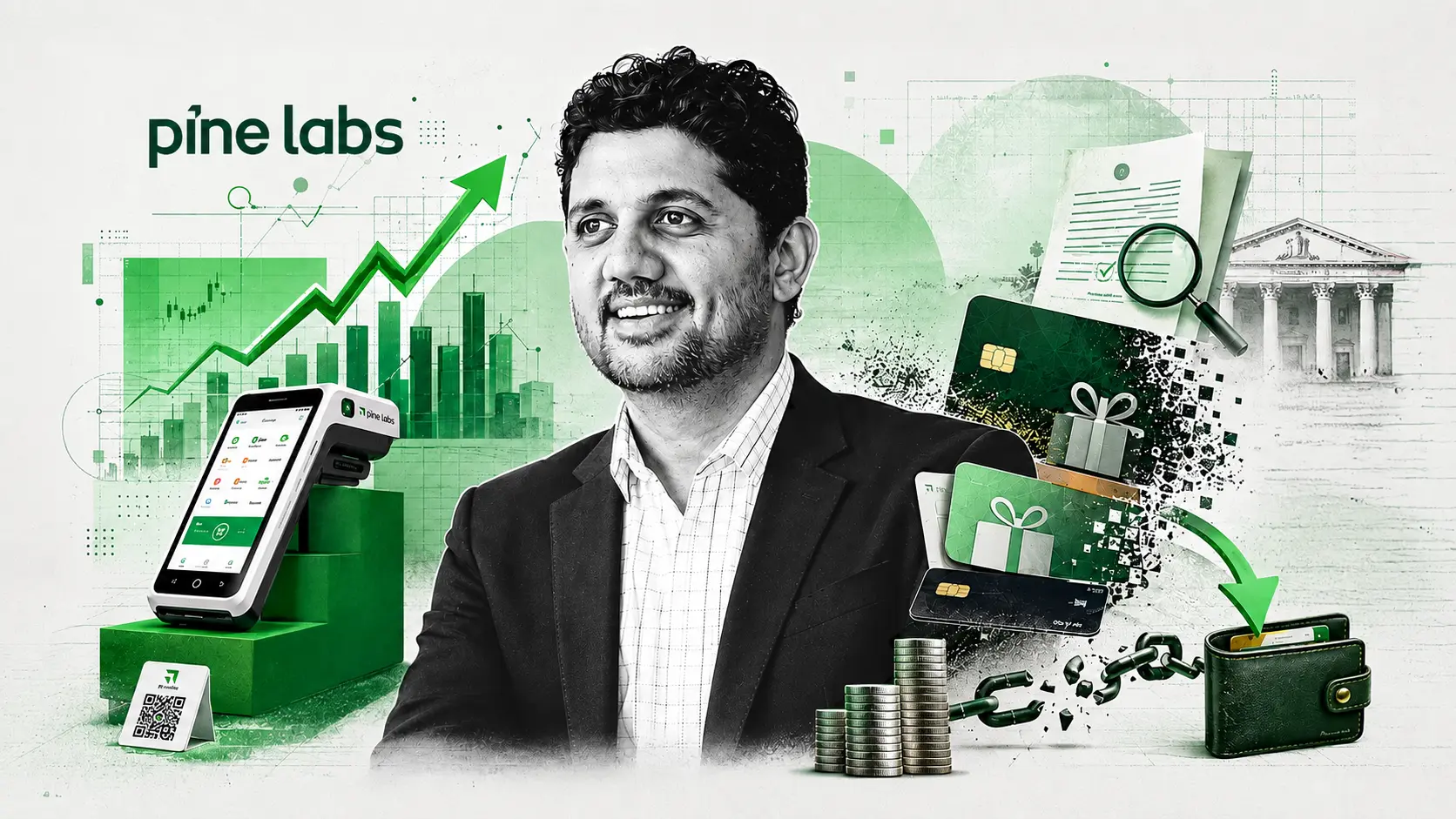
Pine Labs just posted its first full-year profit. Tucked inside that number is “breakage” income from its Qwikcilver gift-card business — a high-margin revenue line the company has never disclosed, and one the RBI’s draft PPI rules could wipe out.
Pine Labs closed FY26 with a net profit of Rs 113 crore — its first full year in the black. EBITDA margins expanded from 16% to 21%, and operating cash flow climbed eightfold. For a company that listed only seven months ago at a valuation already well below its 2022 peak, and whose shares have since slipped a further 30% below the IPO price, that profit number was more than a financial milestone — it was the narrative investors had been waiting for.
The timing mattered. After debuting in November 2025, Pine Labs shares now trade around Rs 154 — roughly 30% below the IPO price and nearly 45.8% below their 52-week high. Several early institutional backers, including PayPal and Mastercard, partially exited through the IPO’s offer-for-sale process, and additional selling followed the expiry of lock-in restrictions earlier this year. For investors who had waited years for Pine Labs to list — and even longer for it to turn profitable — FY26 was supposed to mark the turning point. Profitability became the central pillar of the entire investment story.
But an Entrackr investigation has found that one of the highest-margin income streams inside Pine Labs’ gift-card business may now be facing a direct regulatory threat. The company has never disclosed the size of this income stream publicly, analysts do not appear to model it separately, and an RBI proposal published earlier this year could effectively eliminate it altogether. That income stream is called breakage, and it sits inside Qwikcilver — the gift-card business Pine Labs acquired for approximately $110 million in March 2019.
The acquisition that became more valuable than it appeared
When Pine Labs acquired Bengaluru-based Qwikcilver Solutions in March 2019, it was one of the largest fintech acquisitions in India at the time. The deal wasn’t simply about adding revenue — it gave Pine Labs a dominant position in India’s gift-card infrastructure market. Qwikcilver powers gift-card programmes for brands including Amazon, Flipkart, Myntra, Croma and hundreds of enterprise customers, and Pine Labs issued 87 crore prepaid cards in FY26, up from 71 crore a year earlier.
The business brought scale, sticky enterprise relationships, and deep integrations that made switching difficult for customers. But according to sources familiar with the company, the real value of Qwikcilver was not merely transaction volume — it was an unusually profitable revenue stream embedded inside the gift-card business. Sources familiar with Qwikcilver’s financials told Entrackr that the subsidiary contributes roughly Rs 800 crore, or about 30%, to Pine Labs’ consolidated annual revenue of Rs 2,711 crore.
How Qwikcilver actually earns its revenue
Qwikcilver operates through two business lines. The larger is its gift-card business, estimated by sources to contribute roughly 90% of the subsidiary’s revenue — powering programmes for Amazon, Flipkart, Myntra, Croma and hundreds of enterprise customers across employee rewards, customer incentives, loyalty programmes and consumer gifting. Sources familiar with the financials estimate approximately Rs 700 crore of Qwikcilver’s revenue comes from this gift-card business alone.
The second, smaller segment is a software-as-a-service (SaaS) business providing technology infrastructure to merchants and enterprise customers, estimated to contribute the remaining 10%. The regulatory issue at the centre of this story relates specifically to the gift-card business — which remains the primary contributor to Qwikcilver’s revenue and profitability.
What is “breakage” income, and why does it matter here?
Imagine receiving a Rs 1,000 gift card from your employer. You spend Rs 800 and forget about the remaining Rs 200, or perhaps never redeem the card at all. Historically, those unused balances didn’t always return to customers — instead, they eventually became income for the issuer. That income is called breakage: the value of gift cards and prepaid vouchers that are never fully redeemed.
According to sources familiar with Qwikcilver’s financials, breakage is generated from the company’s gift-card business, the same segment that contributes an estimated Rs 700 crore to Pine Labs’ consolidated revenue. Sources familiar with the matter estimate breakage accounts for approximately 5–6% of revenue generated by the gift-card business. Entrackr is not publishing a specific rupee figure because Pine Labs declined to confirm the number — but the economics around it are clear.
Unlike payment-processing fees, merchant acquiring revenue, POS hardware sales or lending income, breakage requires almost no incremental cost to generate. No merchant is paid. No product is delivered. No additional infrastructure is consumed — the money simply remains behind. For gift-card issuers, that makes breakage one of the highest-margin income streams in the business. According to sources familiar with the matter, unredeemed balances that eventually qualify as breakage accrue to Pine Labs and flow almost directly to the bottom line.
And that becomes meaningful when set against Pine Labs’ FY26 net profit of Rs 113 crore. Because breakage carries exceptionally high margins, even a relatively small contribution to revenue can have a disproportionately large impact on overall profitability — yet Pine Labs has never disclosed the size of breakage income in quarterly results, annual reports, analyst presentations, or investor communications reviewed by Entrackr.
Pine Labs has acknowledged breakage in its IPO filings — just not the amount
Importantly, Pine Labs itself has previously acknowledged breakage as a revenue stream. The company’s Draft Red Herring Prospectus (DRHP) identifies breakage income as part of its earnings and states that Pine Labs is entitled to recognise revenue arising from unutilised prepaid card balances upon expiry, in accordance with its accounting policies. That disclosure matters: it establishes breakage as an accounting and revenue line within Pine Labs’ own filings — not merely an industry concept or a source-based assertion — even though the company has never separately quantified how much it earns from it or how much it contributes to profitability.
As part of its research, Entrackr also found that Amazon’s gift-card terms state that Amazon Pay Gift Cards are issued by Pine Labs Pvt. Ltd. — indicating that Pine Labs itself acts as the issuer of the prepaid payment instrument (PPI) under the RBI’s regulatory framework, placing it directly in scope of any rule change governing unredeemed PPI balances.
“A rupee of breakage lost is effectively a rupee of profit lost — and that’s not true of most other revenue lines inside Pine Labs.”
The RBI proposal that could end it
On April 22, 2026, the Reserve Bank of India published its draft Master Direction on Prepaid Payment Instruments for public consultation. Buried within the document is a provision with potentially significant consequences for the entire gift-card industry. Paragraph 12(d) states that outstanding balances on prepaid instruments should be transferred back to the source account, or to a verified bank account of the holder, whenever the instrument expires, becomes inactive, or is closed.
For gift cards, the implication is straightforward: unused balances would no longer remain with issuers — they would have to be returned. The money that historically became breakage income would instead go back to customers. If implemented in its current form, the proposal would effectively eliminate breakage as a revenue category for gift-card issuers altogether. Unused balances would no longer remain with companies such as Pine Labs; instead, they would have to be transferred back to the originating account or to a verified bank account of the customer.
The direction of regulatory travel here is unambiguous. And regardless of the absolute size of breakage income, the loss of a high-margin revenue stream can have a disproportionate effect on profitability. Given the scale of Qwikcilver’s gift-card operations, even a relatively modest amount of breakage can have a meaningful impact on earnings.
What analysts may not be pricing in
The issue becomes more significant because Pine Labs’ profitability story is still in its early stages. Analysts covering the company have focused heavily on revenue growth, operating leverage and margin expansion. JPMorgan, for example, projects revenue growth of approximately 17% annually between FY26 and FY28, while expecting EBITDA to expand faster than revenue — a thesis that relies heavily on operating leverage.
But historically, part of the margin profile within Qwikcilver’s gift-card business included breakage income. If that income stream disappears, some of the assumptions underpinning future profitability may need revision. Yet no analyst research reviewed by Entrackr explicitly discusses breakage income or attempts to quantify the impact of the RBI proposal — no note appears to model a scenario where breakage income is eliminated entirely. That creates a gap between the regulatory risk emerging today and the earnings expectations investors may be relying upon.
The disclosure question
The RBI draft direction was published on April 22, 2026. Pine Labs held its Q4 FY26 earnings call on May 26 — shortly after the consultation period had ended. Yet Entrackr could find no public disclosure quantifying breakage income, estimating the impact of the RBI proposal, or discussing how future profitability may be affected. No guidance revision. No investor note. No stock exchange disclosure. No quantified assessment.
For investors, this creates a genuine information gap: they are being asked to evaluate the sustainability of Pine Labs’ first-ever annual profit without visibility into a revenue stream that regulators may eliminate. Entrackr sent detailed questions to Pine Labs regarding breakage income, the contribution of Qwikcilver, the potential impact of the RBI proposal, and related disclosure obligations. The company did not respond.
What it means for investors and analysts tracking Pine Labs
Pine Labs deserves credit for reaching profitability. Revenue grew 19%. Cash flows improved dramatically. Operational execution clearly strengthened. But investors still do not know how much of that profitability depends on an income stream the RBI now appears determined to phase out. The open question is narrower and more specific than the headline number suggests: how much of the Rs 113 crore net profit, and how much of the FY27–FY28 margin expansion that brokerages like JPMorgan are modeling, leans on a revenue line that may not survive in its current form.
Until Pine Labs quantifies the contribution of breakage income and the potential impact of the RBI proposal, investors are left evaluating the sustainability of the company’s first-ever annual profit without visibility into one of the most profitable components of the business. For a company whose profitability story has finally begun to convince the market, that is a question that can no longer be ignored.
What is breakage income in the gift card business?
Breakage is the value of gift cards or prepaid vouchers that customers never fully redeem. When that unused balance expires, it has historically been recognised as revenue by the card issuer rather than returned to the customer.
How is Pine Labs connected to breakage income?
Pine Labs owns Qwikcilver, the gift-card infrastructure business behind programmes for Amazon, Flipkart, Myntra and Croma. Breakage income is generated within Qwikcilver’s gift-card business, which is estimated to contribute around Rs 700 crore of Pine Labs’ consolidated revenue.
What does the RBI’s draft PPI rule propose?
The RBI’s draft Master Direction on Prepaid Payment Instruments, published April 22, 2026, proposes that unused balances on prepaid instruments be returned to the holder’s source or verified bank account when the instrument expires, becomes inactive, or is closed — which would largely eliminate breakage as a revenue source.
Has Pine Labs disclosed how much it earns from breakage?
No. Pine Labs has acknowledged breakage as a recognised revenue category in its draft IPO prospectus, but it has not disclosed the specific amount in quarterly results, annual reports, or investor communications.
How has Pine Labs’ stock performed since its IPO?
Pine Labs listed in November 2025. As of mid-2026, shares trade around Rs 154 — roughly 30% below the IPO price and nearly 45.8% below their 52-week high. Early backers including PayPal and Mastercard partially exited via the IPO’s offer-for-sale, with further selling after lock-in expiry.
What do analysts project for Pine Labs’ future growth?
JPMorgan projects revenue growth of approximately 17% annually between FY26 and FY28, with EBITDA expanding faster than revenue. However, no analyst research reviewed by Entrackr explicitly models the impact of breakage income being eliminated under the RBI’s draft rule.
Reporting and financial estimates referenced in this article are based on Entrackr’s investigation into Pine Labs and Qwikcilver, published June 2026. This piece is for informational purposes and is not investment advice.

Pankaj Dubey is an entrepreneur, business analyst, digital marketer, financial researcher, and brand strategist. He specializes in developing marketing strategies, building and positioning brands, and conducting in-depth business and financial research. He is also known for creating detailed case studies on reputed brands, analyzing market trends, and sharing insights through his writing and blogging. His work combines business intelligence, strategic thinking, and digital innovation to help businesses grow and strengthen their market presence.