
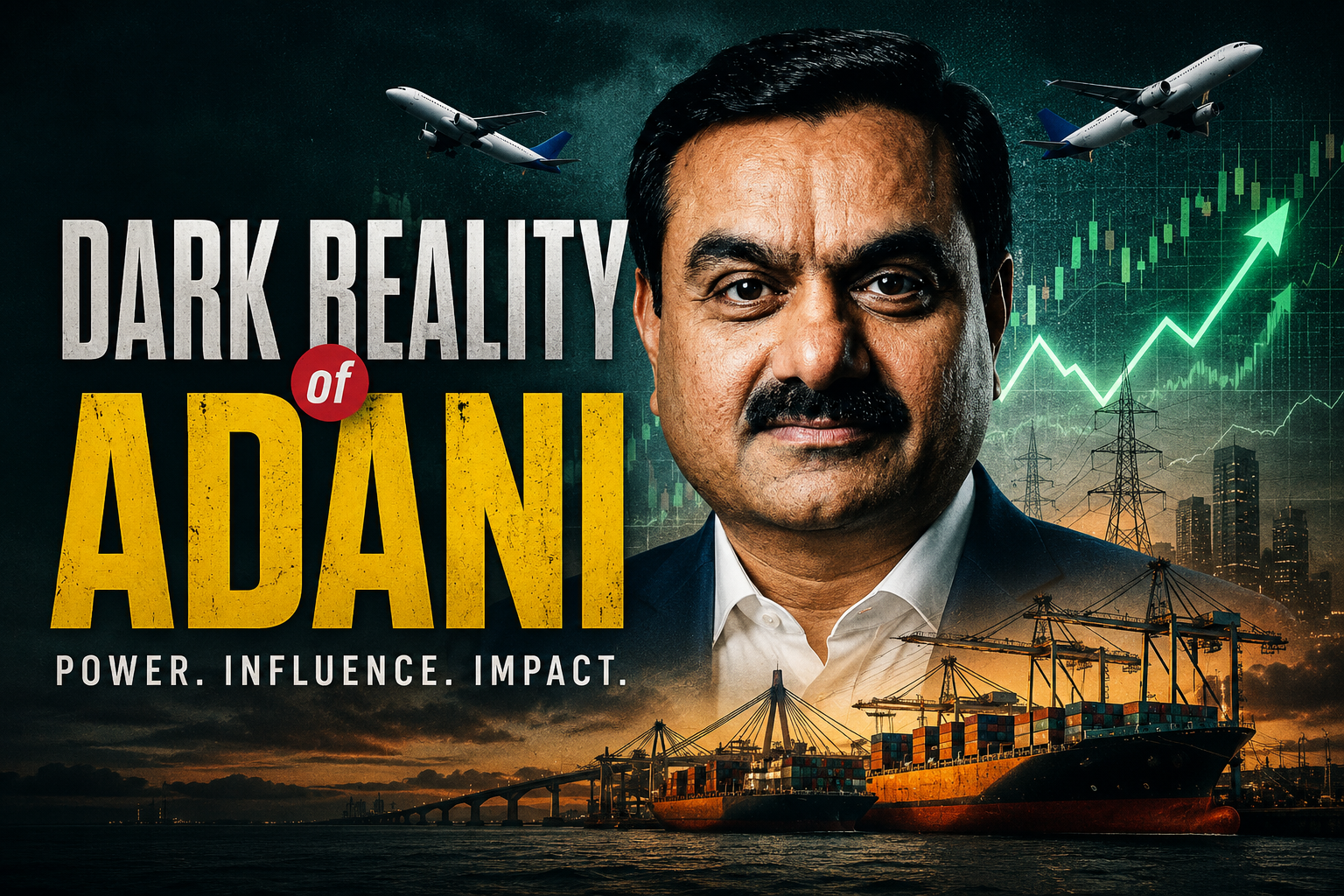
From ₹100 in His Pocket to ₹1,000 Crore a Day: The Untold Story of Gautam Adani
A textile seller’s son who dropped out of college to sort diamonds in Mumbai. A kidnapping that nearly ended everything before it began. A swampy stretch of coastline that became India’s biggest private port. This is the complete story of how Gautam Adani built an empire — and every controversy that followed him on the way up.
The year was 2003. Gujarat was governed by the BJP, and the state had organized an event to attract investment — the Vibrant Gujarat Summit. All eyes were on industrial giants like Tata, Birla, Ruia, and Ambani, with everyone watching to see who would commit the most capital. But the real shock came from a relatively new face in the business world, who stunned the room by announcing an investment of ₹15,000 crore.
That “new” businessman was, in fact, an old player who had been quietly building for two decades. He had grown his turnover from ₹3,300 crore in 2000 to ₹47,000 crore by 2013, and by 2022 his group’s combined turnover crossed $150 billion, putting him ahead of nearly every capitalist in the country. That man was Gautam Adani.
So in this story, we trace the journey of Gautam Adani — son of textile trader Shantilal Adani from Ahmedabad — whose business beginnings were as mysterious as his success has been spectacular. It’s a story full of twists, alliances, government favors of every kind, and a relentless will that took him from rags to riches, and eventually to a position where he earns roughly ₹1,000 crore every single day.
This is a long story, because it covers everything — his early struggles, the controversies that have followed him for decades, and yes, even the time Gautam Adani himself was kidnapped. Let’s begin.
A 16-Year-Old Leaves Home With ₹100
To understand Gautam Adani, you first have to understand the struggle that shaped him. His story begins in Ahmedabad, where his father Shantilal Adani had left his ancestral home in Tharad, Gujarat, to start a textile business in the city, settling in the Sheth’s Pol area. It was there, in June 1962, that Gautam Adani was born.
He studied through Class 12 at Sheth Chimanlal Nagindas Vidyalaya in Ahmedabad. On his uncle’s advice to try something new, a 16-year-old Gautam dropped out of college, took ₹100 from his father, and left for Bombay.
His brother Vinod Adani was already living there, working in the wholesale cut-piece cloth trade for Vipin Mills and Rajesh Mills. Gautam moved in with him and enrolled in a commerce college in South Mumbai. Near that college was the office of Mahindra Brothers, a diamond trading company that bought rough diamonds directly from mines, cut and polished them, and sold the finished stones in the market.
Gautam took up work there alongside his studies — sorting diamonds by size and quality. Through this repetitive, detail-heavy work, he developed a sharp eye for assessing a diamond’s purity, cut, and brilliance, and learned how that translated into price. Juggling college attendance with the diamond job eventually became too much. When he fell ill one day and couldn’t manage both, he chose the diamond trade and left college behind entirely. Within two years, he had mastered the business well enough to quit Mahindra Brothers altogether.
A cabin in Zaveri Bazaar
In 1980, Gautam set up his own small brokerage — a bridge between sellers and buyers — in a tiny cabin on Dhanji Street, tucked inside the maze-like lanes of Mumbai’s Zaveri Bazaar, one of India’s oldest gem markets, where even today nearly 65% of the country’s gold trade takes place. This was his first truly independent office.
He understood the trade instinctively: buy cheap from one source, sell higher to another. Within a single year, his diamond trading turnover reached roughly ₹1 lakh — equivalent to nearly ₹5 crore in today’s money.
The Call Back to Ahmedabad — And a Stroke of Policy Luck
While Gautam was thriving in Mumbai, his eldest brother Mansukh Adani had bought a plastics factory in Ahmedabad that same year — one of three factories owned by a fellow member of the Jain community from Tharad, Sevantilal Bora, whose two partners had split from him. At the time, PVC (polyvinyl chloride), the core raw material for plastic manufacturing, wasn’t easily available in India. Mansukh called his brothers back — first Vinod, then Gautam — saying the PVC business was growing faster than the two of them could manage alone.
Gautam realized that staying in diamonds meant remaining a broker forever, while his brother’s company was something the family could actually own and grow. So he shut down his thriving diamond business, hopped onto his grey Bajaj Super scooter, and rode to Ahmedabad in 1981 — right as India’s License Raj made starting any business a bureaucratic ordeal.
He learned the rules of running a company and began sourcing PVC for his brother’s factory. Business grew well enough that the brothers opened two more factories — EG, Eco, and Elite — bringing the count to three.
Then came a decision by Rajiv Gandhi’s government that changed Gautam Adani’s fortunes overnight. Under the old quota-permit system, importing PVC required government permission. But Rajiv Gandhi moved PVC into the Open General License category, meaning neither Adani nor fellow Gujarati entrepreneur Dhirubhai Ambani needed government approval to import it anymore.
At the time, the Adani brothers needed about 20 tonnes of PVC every month, while the state import agency, Indian Petrochemicals Corporation Limited (IPCL), could supply only 2 tonnes a month. Gautam used the new open license to start importing directly from abroad himself — and his fortunes began to shift dramatically.
Discovering the Sea Route — and a Government Loophole
Importing raw material all the way to Ahmedabad was expensive. Adani realized shipping by sea was cheaper, so he began routing his cargo through Kandla port. Handling this trade also taught him the economics of ports — knowledge that would later define his entire empire.
Around this time, Gujarat ran a state agency called the Gujarat State Export Corporation (GSEC). According to senior journalist Aryan Bhaskar’s book on Gautam Adani, GSEC had accumulated import credits earned by exporting handicrafts — credits that allowed certain goods to be imported duty-free, but which GSEC itself had no use for since it didn’t trade in plastics.
Adani struck a deal: he would buy GSEC’s unused credits, import his plastic under the corporation’s name, and pay GSEC for the privilege. The officials agreed — a 23-year-old was offering them good money for credits otherwise sitting idle. Through this arrangement, Adani imported ₹1 crore worth of plastic and earned an extraordinary profit. Because GSEC was a government body, it didn’t need a Letter of Authorization to import goods — meaning the government never questioned why the imports were happening. Adani used this loophole, collecting Letters of Authorization from traders across the country and routing their imports through GSEC’s name, with no restrictions whatsoever.
As competition intensified in the PVC business and margins shrank, Adani looked for a market that could supply raw material on a more stable basis — landing him in South Korea, where he bought 200 metric tonnes of raw material in a single deal, establishing his name internationally and opening a new import channel.
Adani Exports Is Born
It was during this period that Adani realized something important: if the same ship that brought goods in could also carry goods out, profits could effectively double — importing and exporting together. On March 1, 1988, he founded a new company: Adani Exports. Import volumes grew from 100 to 400 metric tonnes, and the company began exporting Indian goods abroad too — starting with agro products, then expanding into toothpaste, shoe polish, seafood, cosmetics, metals, and textiles.
Around this time, P.V. Narasimha Rao became Prime Minister with Manmohan Singh as Finance Minister. In 1991, Manmohan Singh opened India’s markets to the world, ending the quota-permit system through economic liberalization. Adani threw himself fully into both importing and exporting on this newly opened global stage.
The Birth of Mundra Port
This was also when Adani first felt the pain of relying on government-run ports, where simple cargo operations took weeks because everything moved at bureaucratic pace. He calculated that government inefficiency was costing him ₹8 crore to ₹1 crore in losses every year — and concluded that even a single private jetty could cut that delay down to hours.
In 1991, Gujarat’s then Chief Minister Chimanbhai Patel, leading a Congress government, allowed private companies to build their own jetties at ports. Adani received this permission.
An American food company changes everything
Around this time, American agribusiness giant Cargill — founded in 1865 — needed to buy several lakh tonnes of salt from India. Cargill approached Adani, and a deal was struck. But the salt needed a port or jetty to load onto ships. Cargill used its contacts to consult America’s space agency NASA, which identified Gujarat’s Mundra Port — originally established in the 17th century by Rao Bhojraj I but long since fallen into disrepair — as ideal for a new jetty, due to its unusually deep waters suitable for large vessels in any season.
Adani approached Chimanbhai Patel’s government, which allotted roughly 3,000 acres of coastal land — then a swampy, undeveloped stretch — to Adani and Cargill jointly for salt farming. Even after the Chief Minister’s approval, Gujarat’s bureaucracy sat on the file. According to journalist Aryan Bhaskar’s book, no one wanted that land, yet officials still refused to clear it. Adani eventually rented a plane, flew an official to Mundra personally, and when the official pointed out the land was swampy, Adani replied: “That’s exactly my point — I’ll reclaim this land and create jobs.” The official signed off.
The total project, split 50-50 between Adani and Cargill, cost roughly ₹100 crore. Critics called the jetty and salt-farm venture reckless, predicting it would bankrupt Adani. He ignored them, building the jetty while simultaneously acquiring the salt farms — a move that created income for the government, the landowners, and jobs for salt workers tasked with handling the bulk shipments.
In 1992, as part of liberalization, the central government allowed 100% foreign investment in government ports and jetties to boost foreign exchange reserves. Cargill, sensing opportunity, demanded a bigger stake in the Mundra jetty. Adani refused. The dispute escalated to the state and then central government, which eventually offered Cargill a terminal at Kandla port instead. Cargill accepted and exited Mundra — leaving the entire port in Adani’s hands.
From ₹78 Lakh Profit to a Stock Market Debut
By 1993, five years after its founding, Adani Exports released its first annual report: ₹18.88 crore in exports, yielding a profit of ₹78 lakh. That number might sound modest today, but it didn’t take Adani long to travel from ₹78 lakh a year to ₹1,000 crore a day. He understood that more exports meant more profit — and more exports needed more capital. So he decided to go public.
By then, Adani Exports had already earned the government’s “Superstar Trading House” designation, giving the company strong market credibility — banks lent freely, and foreign companies were comfortable working on his guarantee alone. On November 1, 1994, Adani Exports listed on the Bombay Stock Exchange. The IPO was oversubscribed 25 times over, and roughly 12,500 shares raised ₹18.75 crore.
By 1995, all three plastics factories were shut down, and Adani’s full focus shifted to the import-export trade. Around the same time, a major political shift occurred in Gujarat — the BJP ended Congress’s long rule in the state. New Chief Minister Keshubhai Patel announced Gujarat’s first Private Port Policy, opening 10 ports — including Mundra — to private development. Mundra was deeper than Kandla, capable of berthing ships carrying up to 2 lakh metric tonnes.
From Jetty to Full-Blown Port and Special Economic Zone
Already building a jetty at Mundra, Adani proposed something far bigger: a complete port, with surrounding land converted into a Special Economic Zone. He offered the state government a 26% equity stake in return. Keshubhai Patel’s government accepted, granting every necessary approval almost instantly. Adani then formed a joint venture with the state-owned Gujarat Port Infrastructure Development company, naming it Adani Ports and Special Economic Zone, and Mundra’s development began in earnest. He also secured central government approval to lay roughly 60 km of railway track, connecting his port directly to India’s main rail network. In 1998, Mundra Port received its first ship, the MT Alpha.
As operations gathered pace, Adani gradually bought out the government’s stake, turning Mundra into a fully private port. But the approvals that made this possible — land pricing, environmental clearances, SEZ status — became the subject of lasting controversy. Allegations surfaced that Mundra’s development proceeded without proper environmental clearance, causing damage to mangroves and mismanagement of fly ash. Around the same time, the government had refused Australian company P&O Ports permission to build a container terminal at the state-run Kandla port — so P&O turned to Mundra instead, building its terminal there and even investing in Adani’s company.
Notably, Kandla’s own plan to become a Special Economic Zone was rejected on environmental grounds — while Mundra received SEZ clearance despite lacking the same environmental approval. Multiple legal challenges over Mundra’s development reached the Gujarat High Court, which briefly halted work. A committee led by environmentalist Sunita Narain, set up under the Manmohan Singh government, found grounds to fine the Adani Group ₹200 crore — a fine that was ultimately never enforced, after the company argued the land was barren and swampy and required heavy investment to develop. Mundra kept growing through every allegation, every legal challenge, and every dismissal, becoming the nucleus of Adani’s entire business empire.
The Kidnapping That Shook the Family
On January 1, 1998, Gautam Adani had visited Ahmedabad’s Karnavati Club. As his car left the club toward Mohammedpura Road, a scooter blocked his path while a van pulled up alongside. Men in the van abducted both Gautam Adani and Shantilal Patel. Reports indicate the kidnapping involved two gangsters, Fazlur Rehman and Bhogilal Darji, alias “Mama.”
According to The Telegraph, Adani and his companion were released the following day, though it’s widely believed a ransom of ₹15 crore had been demanded — whether it was ever paid remains unclear. In an interview with Financial Express, Adani later described the episode as one of two or three deeply unfortunate events in his life.
Twenty years later, in 2018, a Gujarat court acquitted both Fazlur Rehman and Bhogilal Darji for lack of evidence. Additional District Judge D.P. Patel noted that Adani had been summoned twice but never appeared in court, and that witnesses and investigators could not clearly establish what had actually happened. Fazlur Rehman, originally from Bihar, had been an active gangster in Gujarat through the 1980s and 90s, known for ransom kidnappings, with a network reportedly rivaling Dawood Ibrahim’s gang. As of recent reports, Rehman remains in Sabarmati Central Jail on other charges, while Bhogilal Darji is out on bail.
A New Partnership — and the First Legal Trouble
Later that same year, Adani met Malaysian businessman Kuok Khoon Hong, chairman of Singapore-based Wilmar International, a cooking-oil company linked to the Shangri-La hotel group. Adani brought Kuok to Mundra and proposed building a refinery together. Kuok agreed, and on January 22, 1999, the joint venture Adani Wilmar was born.
But 1999 also brought Adani’s first real legal trouble. The Directorate of Revenue Intelligence arrested his elder brother Rajesh Adani for the first time, on charges of duty evasion amounting to ₹1.4 crore. The arrest happened in Bhuj — though Rajesh subsequently complained of back pain and was admitted to a hospital in Bhuj rather than jail, remaining there until the Gujarat High Court granted bail.
Despite the legal troubles, the Adani-Wilmar refinery was completed by October 2000, and on November 24, 2000, it produced its first packet of cooking oil. That refinery in Mundra is where Fortune oil — found in households across the country — is made, and Adani Wilmar today is India’s largest edible oil brand.
As Mundra grew, more ports followed — Dhamra, Visakhapatnam, and Vizhinjam in Kerala all eventually came under Adani’s control. With ports and rail connectivity secured, Adani’s next move was energy.
The Coal Empire — and the Controversy That Followed
India was facing a power shortage, and the government wanted private players to build power plants. Coal was the essential input, and Adani never lacked it — he had been importing coal for government power companies since 1999, supplying state-owned giants like Coal India and NTPC. With Mundra Port now operational, logistics were no longer a constraint, and in 2006 he bought coal mines in Indonesia to secure even more supply.
In April 2006, Mundra Port and the Mundra SEZ were merged into a single venture called Mundra Port and Special Economic Zone Limited (MPSEZL), and that same year Adani founded a new company: Adani Power. He built a 4,620-megawatt power plant inside the SEZ — at the time, the largest private thermal plant in the country. By November 2007, MPSEZL was listed on both the NSE and BSE, with its IPO oversubscribed 16 times. That year, Forbes first listed Gautam Adani among India’s ten richest individuals.
The over-invoicing allegation
But success brought scrutiny. Adani faced serious allegations of over-invoicing coal imports from Indonesia. According to a report by the Organized Crime and Corruption Reporting Project (OCCRP), coal that traveled directly from Indonesia to India was billed through a chain of intermediary companies based in Dubai, Singapore, and the British Virgin Islands — inflating its paper value far above market price by the time it reached Mundra. Coal reportedly worth $1.9 million on paper in Indonesia became valued at $4.3 million by the time it reached India, with the difference — roughly $2.4 million — allegedly routed through intermediary firms in Dubai and Taiwan.
The same report alleged the Adani Group purchased low-quality, low-calorie coal and rebilled it as high-quality, high-calorie coal at inflated prices — causing financial losses to state power utilities, particularly Tamil Nadu’s TANGEDCO, and downstream environmental harm. The claim was that when state utilities bought this overpriced coal, the resulting electricity became more expensive, with the cost ultimately passed on to ordinary consumers. Congress leader Rahul Gandhi called it a scam worth roughly ₹1,000 crore.
India’s Directorate of Revenue Intelligence (DRI) investigated 40 companies involved in similar coal purchases, including Adani’s, estimating roughly ₹9,000 crore in irregularities. That investigation was never completed, and Adani Group entities were ultimately excluded from its scope. The Adani Group has consistently denied these allegations, calling them attempts to damage its reputation.
Rajasthan and Chhattisgarh: A Coal Deal That Crossed State Lines
In 2008, Ashok Gehlot’s Rajasthan government chose Adani Power to address the state’s electricity shortage, signing an MoU for the Kawai power plant in the Kota-Baran region, with land provided by the state. The state was also supposed to supply coal in exchange for 50% of the plant’s output — but failed to deliver it. Adani Power imported coal from Indonesia instead, and when the cost rose, the company demanded additional compensation from the state. The matter went to court, which ordered the state to pay Adani roughly ₹3,000 crore, plus further compensation — triggering political backlash over allegedly inflated, unfairly subsidized power purchases.
A separate, related controversy unfolded in Chhattisgarh, where the Parsa East and Kanta Basan coal blocks — allocated to supply Rajasthan’s power plants — sat inside the Hasdeo forest. Extracting coal there required cutting down lakhs of trees. Adani’s company won the contract to mine coal that belonged to Rajasthan but had to be extracted from Chhattisgarh — even as governments changed in both states and allegations over deforestation persisted. Questions were also raised about Adani being reimbursed from state coffers for road transport costs that, by agreement, should have been borne by the company itself, since no rail line existed for the route.
The dispute came full circle when Congress governments held power in both states simultaneously — Chhattisgarh’s Bhupesh Baghel government halted tree-felling for the mine, prompting Rajasthan’s Ashok Gehlot to write to Baghel warning that the state would face a power crisis without the coal. The episode illustrates a recurring pattern: regardless of which party governs a state, Adani has found a way to maintain working relationships across the political spectrum.
Jharkhand, Bangladesh, and a Special Economic Zone Built Around One Plant
In Godda, Jharkhand — governed by neither Congress nor BJP but the Jharkhand Mukti Morcha — Adani operates a 1,600-megawatt power plant that exports electricity to Bangladesh, under an agreement signed during Sheikh Hasina’s government. After Hasina’s ouster, Bangladesh’s new government raised concerns that the power being purchased from Adani was overpriced.
In India, the central government controversially declared the standalone Godda plant a Special Economic Zone in 2019 — despite rules at the time stating that a standalone power plant, even one exporting all its output, could not normally receive SEZ status. The Commerce Ministry changed the rule, directly benefiting Adani’s company with major tax exemptions, customs duty waivers on plant machinery, reduced duties on imported coal, and corporate tax relief for the plant’s first five to ten years of profit. The opposition alleged the central government handed Adani’s company windfall profits through this reclassification. Separately, allegations emerged that roughly 513 hectares of farmers’ land and forest in Godda were acquired without proper consent. Despite the controversy, Jharkhand Chief Minister Hemant Soren continued meeting with Adani, framing the project as being in the state’s interest — illustrating how even opposition-aligned state governments have worked closely with the Adani Group, even as their national leadership criticizes the central government over the same company.
Stop Adani: The Fight in Australia
Adani’s coal ambitions also triggered one of the most sustained environmental protests against any company globally — the “Stop Adani” movement in Australia, formed in opposition to his Carmichael coal mine project. Activists argued the mine threatened the Great Barrier Reef and would significantly increase carbon emissions. Several banks declined to fund the project. Adani proceeded regardless, eventually partnering with the Australian government to bring the mine into operation.
Allegations of Regulatory Favoritism in India
According to a report by The Economic Times, India’s Comptroller and Auditor General (CAG) found that between 2006 and 2009, the Gujarat State Petroleum Corporation purchased natural gas from the open market and sold it to the Adani Group at a price below its own purchase cost — generating a profit of ₹70.5 crore for Adani while causing losses to the state corporation. The same report noted that the Gujarat Urja Vikas Nigam fined Adani Power ₹79.8 crore for supply disruptions between August 2009 and January 2012, even though CAG’s own assessment suggested the penalty should have been ₹240 crore.
Further allegations of close ties with regulators surfaced involving G.K. Pillai, who as Union Home Secretary in 2010 oversaw the ministry’s refusal to grant Adani Ports security clearance to bid for projects in Kerala, Tamil Nadu, and the Jawaharlal Nehru Port Trust, citing economic offence concerns. After retiring in October 2012, Pillai joined Adani’s company as an independent director — and by 2013, Adani Ports had received every clearance it previously needed.
Questions have also been raised about the Adani Group’s relationships with Gujarat’s legal establishment. When Rajesh Adani was arrested a second time by the CBI on February 28, 2010 — again over duty evasion, this time related to undervalued naphtha and petroleum imports causing an alleged ₹1.7 crore loss to the exchequer — Gujarat’s Advocate General Kamal Trivedi represented him in court against the case filed by the Enforcement Directorate. Critics allege that nearly all of Gujarat’s prominent senior lawyers, including several who once opposed Adani in court, now work for his companies.
The numbers tell their own story. In 2006-07, the Adani Group’s total revenue stood at ₹16,953 crore, with debt of ₹4,353 crore. By 2012-13, revenue had grown to ₹47,352 crore, while debt rose to ₹61,762 crore — a period spanning a BJP government in Gujarat and a Congress-led UPA government at the center.
The Empire Expands: Transmission Lines, Airports, Cement, and Media
On August 20, 2009, Adani Power listed on the BSE and NSE — its IPO oversubscribed 21 times despite a global recession. To carry electricity from his plants, Adani built Adani Energy Solutions, laying transmission lines and later purchasing additional lines from Reliance Infrastructure to supply power to Mumbai. Today, Adani operates India’s largest private transmission network.
From there, the group expanded aggressively:
- 2019: Adani won the bid for all six airports India put up for privatization — Ahmedabad, Lucknow, Mangaluru, Jaipur, Guwahati, and Thiruvananthapuram.
- May 2020: A $6 billion deal with Solar Energy Corporation of India brought an 8,000-megawatt photovoltaic power plant into the group.
- September 2020: Adani acquired a 70% stake in Mumbai Airport.
- May 2022: Adani bought Ambuja Cement and its subsidiary ACC from Switzerland’s Holcim Group for $10.5 billion.
- August 2022: Through AMG Media Networks, Adani acquired a stake in NDTV.
By this point, Adani’s net worth had climbed to roughly $150 billion, making him not just India’s richest person but briefly the third-richest in the world. Solar energy, green energy, agro-processing units, data centers — the group’s portfolio had grown so vast that even Adani himself might struggle to count every entity under it.
The Hindenburg Report: India’s Biggest Corporate Storm
Behind this dazzling success lies a darker thread — one that has made Adani as controversial as he is successful. The most serious allegations arrived in January 2023, when US short-seller Hindenburg Research published a report calling the Adani Group’s business practices the largest fraud in corporate history.
Hindenburg alleged that the group used improper means to artificially inflate its stock prices, which had risen by more than 800% in some listed entities over just three years. The report claimed Gautam Adani’s elder brother Vinod Adani, through associates, had set up 38 shell companies in tax havens including Mauritius, Cyprus, and Caribbean islands — used to route money that was then invested back into Adani Group shares. Hindenburg also alleged the group had pledged its richly valued shares to raise enormous bank loans, and that five of its seven major listed companies had a current ratio below 1 — meaning insufficient liquid assets to cover short-term liabilities.
Two further allegations stood out: that Adani Enterprises, despite its massive scale, was audited by a small firm called Shah Dhandharia with very few partners, raising questions about audit capacity; and that promoters held more than 75% ownership through shell entities, violating India’s requirement that at least 25% of a listed company’s shares be publicly held.
The US Indictment: The Most Serious Allegation Yet
The biggest legal challenge Gautam Adani currently faces is in the United States, where he has been charged under the Foreign Corrupt Practices Act — a law that prohibits American companies, or foreign companies raising money from US investors, from bribing foreign officials.
US prosecutors allege the Adani Group promised approximately $265 million in bribes to government officials in the Indian states of Andhra Pradesh, Odisha, and Tamil Nadu, in order to secure favorable, costly solar power purchase agreements. Around the same time, Adani entities allegedly raised billions of dollars in loans from US banks and investors without disclosing this alleged bribery scheme — a non-disclosure that US authorities classify as securities fraud.
According to reports, the FBI is said to possess emails, messages, and phone call records connected to the case, with evidence allegedly recovered from devices belonging to Gautam Adani’s nephew, Sagar Adani. A New York court has issued arrest warrants for both Gautam Adani and Sagar Adani — making this the most serious legal threat Adani has faced to date.
Sri Lanka, Bangladesh, and Kenya: Controversy Beyond India’s Borders
Adani’s international ventures have followed a similar pattern of opportunity intertwined with controversy. In Sri Lanka, a planned East Container Terminal — a joint project between India, Japan, and Sri Lanka — collapsed after opposition from Sri Lankan trade unions. India and Japan were unhappy, so Sri Lanka offered India the West Container Terminal instead. Adani’s company struck a deal with the Sri Lankan government, taking a 51% stake. Sri Lankan officials stated the Indian government had nominated Adani for the project; India maintained it was purely a private commercial matter.
A separate energy agreement in Sri Lanka was abandoned after a change in government — when President Anura Kumara Dissanayake pushed to lower electricity rates, Adani’s group chose to walk away from the project rather than renegotiate.
In Bangladesh, similar questions arose about whether diplomatic coordination between governments led to an expensive power supply contract for Adani. With Sheikh Hasina’s government — under which the original deal was signed — now ousted, Bangladesh’s new administration is reportedly reviewing the agreement.
In Kenya, a bid by Adani to expand Nairobi’s airport faced fierce public opposition, leading the Kenyan government to cancel the deal entirely.
Closer to Home: Dharavi, Land Leases, and Political Crossfire
Domestically, Adani’s redevelopment contract for Mumbai’s Dharavi slum has drawn significant controversy, as has the broader airport privatization deal. In Bihar’s Bhagalpur district, a power plant project in Pirpainti drew criticism after roughly 1,050 acres of land were leased to Adani for just ₹1.
Political battle lines over Adani remain sharply drawn — opposition parties at the national level consistently accuse the central government of favoritism toward the group, even as their own state governments continue working closely with Adani on major projects, from Gehlot’s Rajasthan to Baghel’s Chhattisgarh, Mamata Banerjee’s Bengal, and Congress-led Karnataka and Telangana.
The Family Business — And Two Close Calls With Death
Today, Gautam Adani chairs the Adani Group. His wife Priti Adani heads the Adani Foundation. Elder son Karan Adani serves as CEO of Adani Ports and SEZ, while younger son Jeet Adani leads Adani Airports and Adani Digital Labs. The family runs the empire together, continuing to expand it across sectors.
Adani’s personal life has had its own brushes with danger. During the 26/11 Mumbai terror attacks, he narrowly escaped death — he was inside the Taj Hotel with Dubai Port CEO Mohammed Sharaf when the attackers struck, at one point just 15 feet from the gunmen. He hid first in the hotel kitchen, then in a restroom, remaining concealed through the night until security personnel found him the next morning.
In 2002, Adani was briefly arrested after a senior official at a company called MS Shoes filed a fraud complaint against him. A non-bailable warrant was issued when he failed to appear in court, leading Delhi Police to make the arrest. The case was dismissed the very next day after both parties reached an out-of-court settlement.
From a Grey Scooter to a Fleet of Private Jets
Across roughly 45 years in business — since he first left Ahmedabad with ₹100 in his pocket in 1978 — Gautam Adani has weathered every allegation, sidestepped political controversy, and pursued every ambition relentlessly. The journey that began on a grey Bajaj Super scooter now runs through a fleet of private jets. The same Ahmedabad he left behind is now home to thousands of crores of his personal wealth, including his bungalow Shantivan in Navrangpura, the Adani Group’s international corporate headquarters, and more than 50 real estate projects.
Commuting between Ahmedabad and Mumbai, Adani now earns roughly ₹1,000 crore on an average day — though market swings have, on occasion, wiped out sums larger than most businesses earn in a lifetime, including the roughly 50% drop in net worth following the Hindenburg report.
The trajectory of that wealth is itself remarkable. By 2014, Adani’s estimated net worth stood far lower than it would soon become; within eight years, by 2022, it had grown roughly 18-fold to around $125 billion. Looked at another way, in the eight to ten years following 2014, Gautam Adani’s total net worth grew by somewhere between 1,500% and 1,800% — a pace of wealth creation that few business empires anywhere have matched, before the Hindenburg report cut that fortune roughly in half.
Despite the fall, he remains among the world’s wealthiest individuals — and given how quickly his fortune has moved up or down in the past, that figure could easily shift by the time you finish reading this story. As they say, it’s all just a game of money.
Frequently Asked Questions
How did Gautam Adani start his career?
He left Ahmedabad at age 16 with ₹100, moved to Mumbai, and began sorting diamonds for Mahindra Brothers. Within two years he understood the trade well enough to start his own brokerage in Zaveri Bazaar in 1980.
How did Gautam Adani acquire Mundra Port?
He first built a jetty at Mundra in the early 1990s after Cargill, advised by NASA’s data on the site’s deep waters, identified the location. The Gujarat government allotted coastal land for salt farming, and after Cargill exited, Adani gained full control and expanded it into a complete port and Special Economic Zone.
What were the main allegations in the Hindenburg report?
The January 2023 report alleged stock manipulation through offshore shell companies in tax havens, undisclosed related-party transactions, and high debt pledged against inflated share value. The group denied the claims, and SEBI later said it found no conclusive evidence of manipulation.
What is the US indictment against Gautam Adani about?
US prosecutors allege roughly $265 million in bribes were promised to Indian state officials to secure favorable solar power deals, while billions were raised from US investors without disclosing the alleged scheme — treated as securities fraud under US law.
How much is Gautam Adani worth today?
His net worth peaked at around $125 billion in 2022. After the Hindenburg report, it roughly halved, with current estimates placing it between $60 and $70 billion.
From a diamond-sorting teenager with ₹100 to one of the most powerful — and most scrutinized — businessmen in the world, Gautam Adani’s story is still being written. Every allegation has been met with denial, every legal battle with another deal, and every dip in fortune with another decade of expansion. Whether history remembers him as India’s greatest builder or its most controversial dealmaker may depend on which chapter comes next.
Read this also: Full Biography of Gautam Adani
Read this also: Adani vs America: The $265 Million Bribery Case That Just Changed Its Ending

Pankaj Dubey is an entrepreneur, business analyst, digital marketer, financial researcher, and brand strategist. He specializes in developing marketing strategies, building and positioning brands, and conducting in-depth business and financial research. He is also known for creating detailed case studies on reputed brands, analyzing market trends, and sharing insights through his writing and blogging. His work combines business intelligence, strategic thinking, and digital innovation to help businesses grow and strengthen their market presence.